
Short-term rental compliance documentation is the complete set of permits, contracts, insurance policies, tax registrations, and safety certifications that legally authorize you to operate a rental property. Without these records, you risk fines, forced closures, and removal from platforms like Airbnb and Vrbo. The must-have compliance documents for STR hosts fall into five clear categories: licensing, insurance, guest contracts, tax paperwork, and safety certifications. Each category carries distinct requirements that vary by city and state, making a structured compliance documentation checklist the single most reliable defense against regulatory penalties.
1. What are the must-have compliance documents for STR hosts?
The core compliance documents every short-term rental host needs include a local short-term rental permit, a business license, a dedicated liability insurance policy, a signed guest rental contract, transient occupancy tax registration, and current safety certifications. These are not optional additions. Most municipalities require all of them before a host can legally accept a single booking.
Hosts who treat compliance as an afterthought typically discover the gap during an audit or after a guest incident. At that point, missing paperwork becomes a legal liability rather than an administrative inconvenience. Treating your required legal documents as a living portfolio, not a one-time filing, is the foundation of sustainable STR operations.

2. Essential licenses and permits every STR host must have
Mandatory licenses for short-term rental hosts typically include a business license, a short-term rental permit, local business tax registration, and in some cities, neighbor notification documentation. Cities like Nashville and Scottsdale specifically require proof that adjacent neighbors have been formally notified before a permit is approved.
The permit application process often requires you to submit:
- A completed short-term rental permit application form
- Proof of property ownership or a signed lease authorizing subletting
- A current government-issued ID
- Proof of liability insurance meeting local minimums
- A floor plan showing sleeping areas and emergency exits
- Neighbor notification letters with delivery confirmation where required
Processing times vary widely. Some cities approve permits in two weeks. Others take three to four months due to volume or zoning review requirements.
Pro Tip: Start your permit application at least 90 days before your planned launch date. Insurance underwriting and zoning reviews frequently create delays that catch first-time hosts off guard.
3. Why dedicated STR liability insurance is non-negotiable
Dedicated short-term rental liability insurance costs $800 to $2,500 annually and is mandatory for most municipal permits, with coverage minimums typically set at $500,000. That cost range reflects property size, location, and occupancy frequency. A single-bedroom urban condo and a six-bedroom mountain retreat carry very different risk profiles.
Hosts often mistakenly believe that Airbnb’s AirCover or Vrbo’s liability program satisfies city insurance requirements. Platform protections do not meet municipal standards because they carry exclusions and coverage limits that fall short of what local ordinances demand. Cities require a third-party liability policy that specifically covers commercial short-term rental activity.
Your insurance policy documentation for permit applications should include:
- The declarations page showing coverage limits and effective dates
- A certificate of insurance naming the city or municipality as an additional interested party where required
- Proof that the policy covers commercial short-term rental activity, not just personal homeowner use
- Contact information for your insurer for city verification
Pro Tip: When selecting a policy, confirm in writing that the coverage explicitly includes guest bodily injury, property damage caused by guests, and loss of rental income. Standard homeowner policies exclude all three.
Real estate investors operating in markets like Sedona should also review local STR restriction changes that can affect insurance and permit requirements at the city level.
4. Key contract and guest data documents every host must maintain
A short-term rental contract requires core provisions including occupancy limits, deposits, cancellation policies, privacy notice references, governing law, and verified signatures to be enforceable. The contract does not need to be lengthy. It needs to be explicit. A two-page agreement with clear rules holds up in small claims court far better than a vague five-page document full of boilerplate.
The operational best practice is to require signed rental contracts and house rules before releasing check-in details or door codes. This “Documents First, Access Second” protocol reduces disputes and gives you documented proof that guests acknowledged your terms before entering the property.
Privacy documentation is equally critical. Your privacy notice must include:
- The lawful basis for collecting and processing guest data
- A clear statement of guest rights regarding their personal information
- Consent records showing guests acknowledged the notice
- Data retention timelines and deletion policies
- Contact information for data-related inquiries
| Document type | Primary purpose |
|---|---|
| Rental contract | Enforces occupancy rules, deposits, and cancellation terms |
| House rules addendum | Documents specific property conduct expectations |
| Privacy notice | Discloses data collection practices and guest rights |
| Guest ID verification record | Confirms identity for liability and dispute purposes |
Pro Tip: Store guest ID records separately from booking data, with access restricted to compliance officers or property managers. Redact sensitive fields after the retention period expires.
5. What safety and inspection compliance documents are required?
Safety compliance documents include smoke detector certifications, carbon monoxide detector installation proofs, fire extinguisher documentation, floor plans with emergency exits, and local inspection certificates. These records prove to inspectors that your property meets minimum health and safety codes at the time of each inspection.
Most municipalities require these documents to be current, meaning annual or biannual renewal is standard. Letting a safety certificate lapse is one of the most common reasons hosts lose their permits mid-season.
| Safety document | Typical renewal period |
|---|---|
| Smoke detector certification | Annual |
| Carbon monoxide detector proof | Annual |
| Fire extinguisher inspection tag | Annual |
| Local property inspection certificate | 1–2 years depending on city |
| Floor plan with emergency exits | At permit renewal or after renovation |
Keep physical copies of all safety documents on-site and digital copies in your compliance folder. Inspectors frequently conduct unannounced visits, and on-site availability of these records can be the difference between a passed inspection and a temporary closure order.
6. How to organize and maintain your compliance documents for audit readiness
Compliance document management must include lifecycle practices like version control, access restrictions, retention timelines, and audit readiness protocols. Possessing the right documents is only half the requirement. Demonstrating that they are current, accessible, and properly controlled is what satisfies regulators.
A practical document lifecycle system for STR hosts follows these steps:
- Create and classify. Label every document by type, property address, and effective date at the moment of creation.
- Assign ownership. Designate one person, whether you or a property manager, as the document owner responsible for renewals and updates.
- Restrict access. Role-based access control limits document visibility to compliance officers, managers, auditors, and approved third parties, with all activity logged.
- Set retention timelines. Most jurisdictions require booking contracts and tax records to be retained for three to seven years. Confirm your local requirement.
- Archive and redact. After the retention period, redact personal guest data before archiving or deleting records to meet privacy regulations.
Hosts should also maintain a chronological receipt trail of all booking-related documentation including contract versions, guest ID verification, and communication logs. Judges rely on these trails when evaluating liability in damage or dispute claims.
Pro Tip: Schedule a quarterly compliance review on your calendar. Check permit expiration dates, insurance renewal windows, and safety certificate deadlines at the same time each quarter so nothing slips through.
You can use the host compliance checklist from Strcomply as a starting framework and adapt it to your specific city’s requirements.
Key takeaways
Short-term rental hosts who maintain current permits, dedicated liability insurance, signed guest contracts, and safety certifications in an organized, audit-ready system face the lowest risk of fines, permit revocation, or platform removal.
| Point | Details |
|---|---|
| Permits and licenses come first | Secure your STR permit and business license before accepting any bookings. |
| Platform insurance is not enough | Airbnb and Vrbo protections do not satisfy city liability insurance requirements. |
| Contracts must be explicit | A short, clear rental agreement with verified signatures is legally stronger than a vague long one. |
| Safety documents require renewal | Smoke detector, CO detector, and fire extinguisher records must stay current, typically annually. |
| Document lifecycle matters | Version control, access restrictions, and retention timelines are required, not optional best practices. |
What I’ve learned about compliance documents after working with STR hosts
Most hosts I’ve worked with get the permit. They buy the insurance. They even draft a rental contract. Where things fall apart is in the maintenance layer. A permit filed in january of one year expires quietly in january of the next, and nobody notices until an inspector shows up or a platform flags the listing.
The insurance gap surprises me most consistently. Hosts who have been operating for two or three years still believe their Airbnb coverage is sufficient for city compliance. It is not, and the moment a guest files a claim that exceeds platform limits, that misunderstanding becomes very expensive.
The “Documents First, Access Second” rule is the single operational change I recommend most. Requiring a signed contract before releasing a door code takes less than five minutes to set up and eliminates the most common dispute scenario: a guest who claims they were never told the rules.
Compliance documentation is not a legal formality. It is your operating license, your liability shield, and your audit defense, all in one organized folder.
— Jure
Stay compliant with Strcomply
Managing permits, insurance records, safety certifications, and guest contracts across multiple properties is a significant administrative load. Strcomply is built specifically to reduce that load for short-term rental hosts and property managers across the United States.
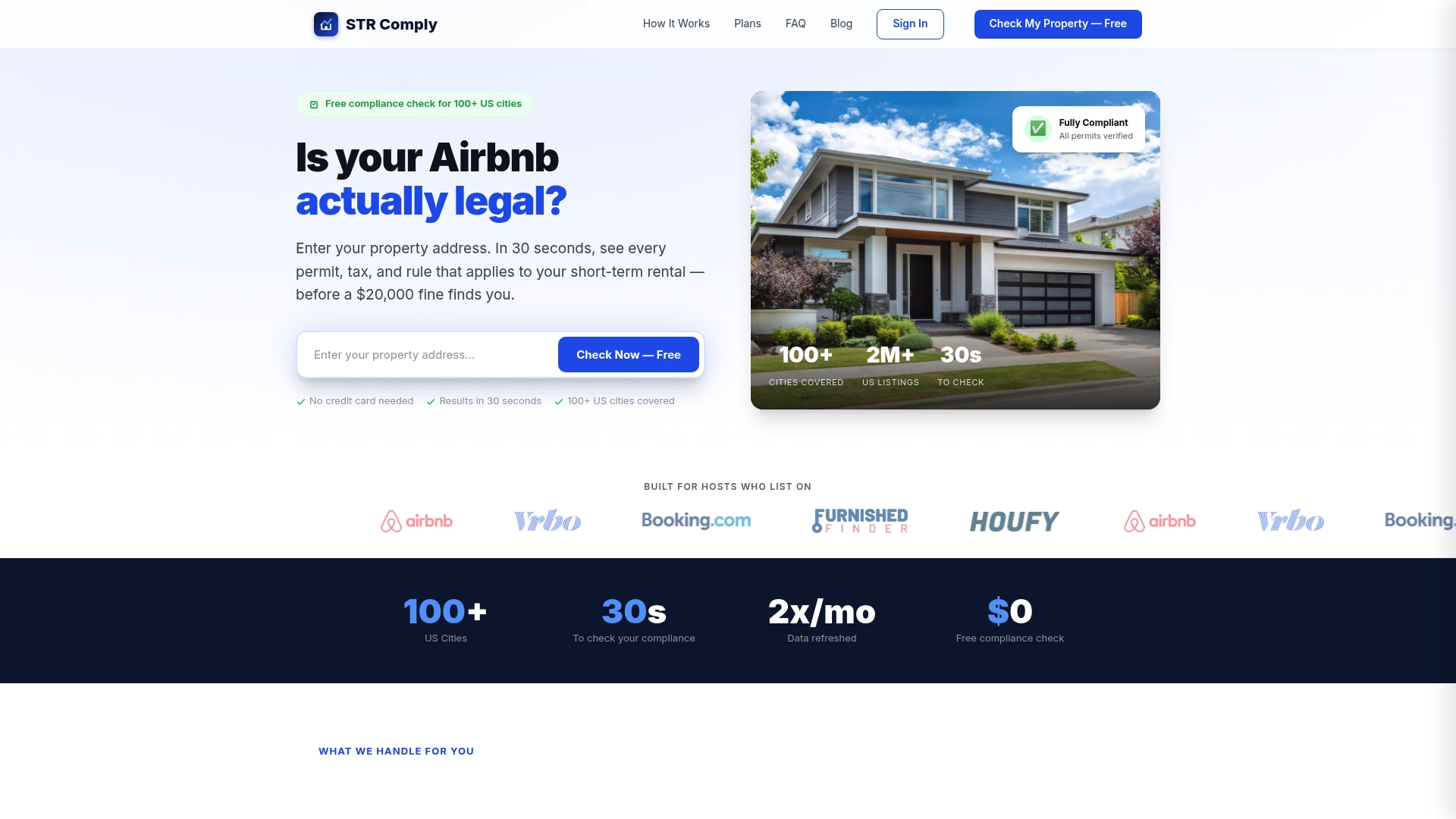
Strcomply’s free compliance check tool lets you instantly verify whether your listing meets local permit, tax, and zoning requirements. Paid plans add permit tracking, renewal alerts, and regulatory update notifications so your compliance documentation stays current without manual monitoring. Whether you manage one property or a growing portfolio, Strcomply gives you city-specific guidance that replaces hours of legal research. Visit Strcomply to check your listing’s compliance status today.
FAQ
What are compliance documents for short-term rentals?
Compliance documents are the permits, licenses, insurance policies, contracts, tax registrations, and safety certifications that legally authorize you to operate a short-term rental. Each document type addresses a specific regulatory requirement set by local, state, or federal authorities.
Does Airbnb insurance count as liability coverage for city permits?
Airbnb’s AirCover and similar platform protections do not satisfy municipal liability insurance requirements. Cities require a dedicated third-party policy that explicitly covers commercial short-term rental activity, typically with a minimum of $500,000 in coverage.
How long should I keep short-term rental compliance documents?
Most jurisdictions require booking contracts and tax records to be retained for three to seven years. Safety certifications and permit records should be kept for the duration of your permit plus at least one renewal cycle.
What happens if I operate without the required compliance documents?
Operating without required permits or insurance exposes you to fines, forced closure, and removal from platforms like Airbnb and Vrbo. In some cities, repeat violations can result in permanent permit denial.
Do I need a privacy notice in my rental contract?
Yes. Privacy notices must disclose the lawful basis for collecting guest data, guest rights, consent records, and data retention timelines. This requirement applies to hosts collecting any personal information, including names, IDs, and payment details.
Recommended
Check your city's STR regulations
Free compliance reports for 100+ US cities. Permits, taxes, zoning — all in one place.
Check My Address — Free