
Regulatory compliance for short-term rental managers is not a form you fill out once and forget. Defining regulatory compliance for rental managers means understanding a multi-layered system of local, state, federal, and international rules that dictates how you operate, what documents you maintain, and what taxes you collect. Most hosts learn this the hard way. A permit lapses, a registration number goes missing from a listing, or a local inspector arrives without warning. This guide breaks down exactly what compliance means in practice, what the main regulatory categories are, what happens when you miss requirements, and how to build systems that keep you protected.
Table of Contents
- Key takeaways
- Defining regulatory compliance for rental managers
- Key regulatory requirements for rental managers
- Consequences of failing rental compliance
- Best practices for managing rental compliance
- My perspective on what compliance really demands
- How Strcomply helps you stay compliant
- FAQ
Key takeaways
| Point | Details |
|---|---|
| Compliance is ongoing | Permits, registrations, and inspections require continuous tracking, not one-time completion. |
| Multiple regulatory layers apply | Local zoning, state licensing, federal tax rules, and international data laws all affect rental managers. |
| Procedural compliance matters | Responding to notices correctly and keeping records can determine enforcement outcomes. |
| Penalties are significant | Fines, listing removals, and legal action are active risks rental managers face for non-compliance. |
| Technology reduces risk | Dedicated compliance tools help managers track deadlines, verify registration status, and stay audit-ready. |
Defining regulatory compliance for rental managers
Regulatory compliance, in the context of rental management, means adhering to every applicable law, rule, ordinance, and administrative requirement that governs how you offer, operate, and manage a rental property. That definition sounds straightforward. In practice, it covers an extensive range of obligations across multiple government levels and jurisdictions.
At the local level, compliance typically involves obtaining and renewing short-term rental permits, registering with the city or county, and following zoning restrictions that determine whether short-term rentals are permitted at all in a given location. State-level compliance adds licensing requirements, landlord-tenant law obligations, fair housing rules, and state tax collection duties such as transient occupancy tax. At the federal level, IRS reporting requirements and anti-discrimination laws apply.
The scope of rental management compliance has also expanded internationally. EU Regulation 2024/1028 establishes a harmonized framework for host registration and mandatory data sharing with authorities, effective May 20, 2026. Under this regulation, registration numbers must be displayed on listings, verified by platforms, and transmitted via a national single digital entry point to competent authorities. If you manage properties in Europe or list on platforms that operate there, this directly affects you.
Compliance also covers these core operational areas:
- Permits and licenses: City-issued short-term rental permits, business licenses, and any operator certificates required to list legally
- Zoning and land use: Confirming that the property type and location are approved for short-term rental use under local zoning codes
- Health and safety standards: Fire safety, building codes, smoke and carbon monoxide detector requirements, pool barriers, and structural inspections
- Tenant rights and fair housing: Anti-discrimination requirements under the Fair Housing Act and applicable state laws
- Tax compliance: Collecting and remitting transient occupancy tax, sales tax, and any other locally mandated lodging taxes
- Data and reporting obligations: Maintaining guest records, reporting stays to authorities, and sharing platform data as required by law
Regulatory compliance for rental managers is not a static state. It is a continuous operational discipline that evolves as regulations change, permits expire, and enforcement priorities shift.
Understanding this definition is the starting point. What you do with it determines whether your rental business remains protected or exposed.
Key regulatory requirements for rental managers
Most regulatory requirements rental managers encounter fall into a few major categories. Knowing each category in detail helps you build a practical compliance checklist for your portfolio.
-
Permits and licenses. Most cities and counties require a specific short-term rental permit before you can legally list a property. Requirements vary widely. Some jurisdictions require proof of primary residency. Others cap the number of nights per year. Illinois added a specific procedural requirement effective January 1, 2026: landlords must attach a Summary of Rights document to all leases, with penalties for non-compliance reaching actual damages up to $2,000 or a $100 minimum. Missing this kind of procedural requirement counts as non-compliance even if every other part of your operation is in order.
-
Registration and data reporting. Beyond local permits, many jurisdictions now require formal registration with a government database. Under EU Regulation 2024/1028, platforms must verify registration numbers and platforms operating under this framework must share data with national authorities via a digital entry point. This obligation covers both hosts and the platforms they use, meaning your listing can be removed if your registration number is missing or unverified.
-
Inspections. Many cities conduct periodic inspections to verify housing code compliance. Los Angeles enforces housing compliance through programs like its Rent Escrow Account Program. Since 2008, 31,000 units improved and 840 utility shut-offs were prevented through this program alone. Regular self-inspections and documented remediation are the practical response to this kind of enforcement environment.
-
Tenant rights and fair housing compliance. You are required to follow the Fair Housing Act, which prohibits discrimination based on race, color, national origin, religion, sex, familial status, and disability. Many states and cities add protected classes beyond the federal minimum. Keeping written policies, training any staff, and documenting decisions are standard protective measures.
-
Zoning regulations. Local zoning codes define where short-term rentals are legally allowed. Some zones restrict rental duration. Others prohibit rentals entirely in residential districts. You can review operational restrictions by area to understand how zoning rules translate into day-to-day limitations for hosts.
Pro Tip: Before listing any new property, verify zoning approval at the parcel level, not just the neighborhood level. Two adjacent properties can fall under different zoning classifications and face entirely different rules.
Consequences of failing rental compliance
Non-compliance in rental management is not a theoretical risk. Enforcement is active, penalties are measurable, and the consequences extend beyond fines.

Financial penalties vary by jurisdiction but are substantial in most markets. England’s Renters’ Rights Act enforcement regime, starting May 1, 2026, empowers local authorities to impose fines up to £40,000. The notice process allows 28 days for written representations, with tribunal appeals available within defined timelines. Missing a response window can convert a manageable situation into a finalized penalty.
License suspension is another direct consequence. A city can revoke a short-term rental permit for repeated violations, effectively ending your ability to list legally in that market. Listing platforms act in parallel. Under EU Regulation 2024/1028, platforms have 10 working days to remove listings after receiving an authority order, or 48 hours for severe breaches. A de-listing event that lasts two weeks during peak season represents a direct revenue loss that no fine waiver can recover.
Beyond fines and de-listing, rental managers also face:
- Civil liability claims: Tenants or guests can pursue legal action for housing code violations, habitability failures, or fair housing breaches
- Criminal prosecution: In some jurisdictions, repeated or willful non-compliance carries criminal liability
- Reputational damage: Enforcement actions are public records in many cities and can affect your standing with property owners and future guests
- Revenue recovery demands: Owner agreements that do not address compliance liability can leave managers personally responsible for lost income caused by enforced shutdowns
The most overlooked risk is procedural. Structured enforcement with defined schedules for notices, responses, and appeals means that procedural proficiency can help avoid or reduce penalties. A rental manager who receives an enforcement notice and fails to respond within the specified window may lose the right to appeal, even if the underlying violation was minor or correctable.
Best practices for managing rental compliance
Managing rental compliance effectively requires systems, not just awareness. The following comparison shows the difference between reactive and proactive compliance management:
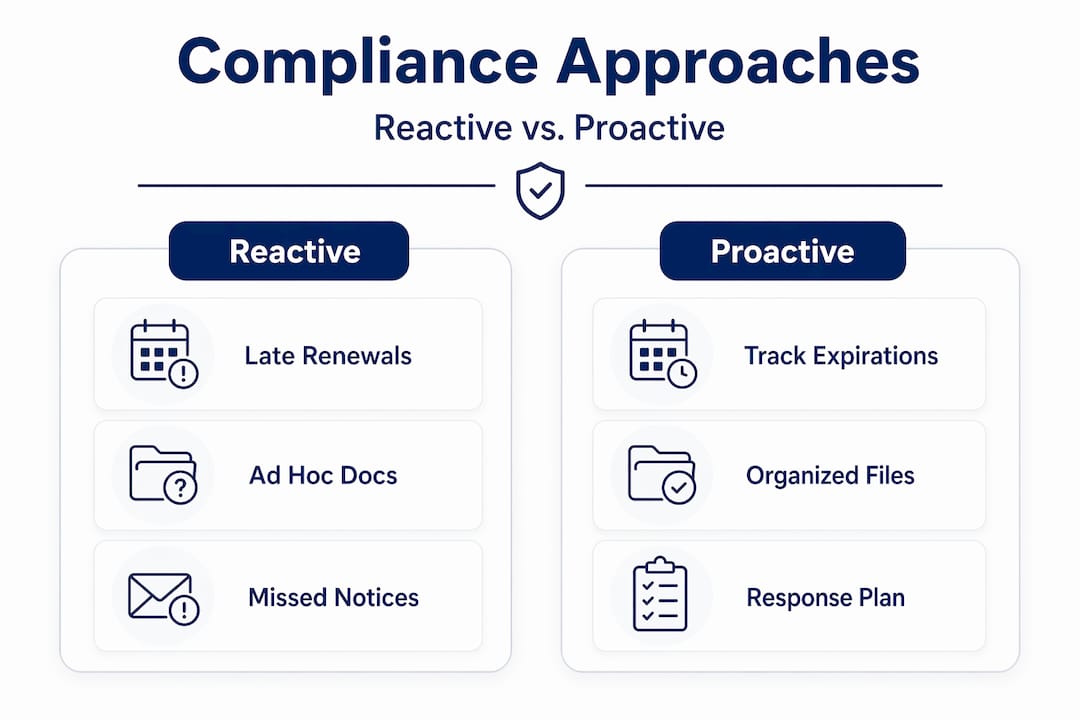
| Compliance area | Reactive approach | Proactive approach |
|---|---|---|
| Permit renewals | Renew after receiving a violation notice | Track expiration dates and renew 60 days early |
| Inspection readiness | Prepare only when contacted by authorities | Conduct quarterly self-inspections with written logs |
| Registration data | Update listings when platforms request it | Maintain a data parity workflow between PMS and listings |
| Owner agreements | Use generic management contracts | Update contracts to address liability under current laws |
| Record keeping | Store documents informally as needed | Maintain an organized audit trail with signed records |
The IRS recommends keeping maintenance and compliance documents for at least three years. Many enforcement actions review records going back further. Treat your compliance documentation as a legal asset.
On data accuracy, the EU framework highlights a specific operational gap many managers overlook. A data parity workflow, where property identifiers in your property management system exactly match those on listing platforms, prevents enforcement flags that arise from mismatched registration numbers. This is a technical step with direct legal consequences.
Updating owner agreements is equally important. As data-sharing and enforcement regimes expand, owner contracts need to clearly assign responsibility for compliance costs, permit applications, and revenue loss caused by violations. Ambiguous contracts create disputes at the worst possible time.
Pro Tip: Build a compliance calendar that tracks every permit expiration, tax filing deadline, and inspection requirement across your entire portfolio. A single missed renewal in a high-enforcement market can cost more than a full year of management fees.
You can also review essential compliance documents to build a solid documentation baseline for each property you manage.
My perspective on what compliance really demands
I’ve worked with enough rental managers to say this clearly: the biggest compliance failures I’ve seen were not caused by ignorance of the law. They were caused by treating compliance as a task rather than a discipline.
Most managers know they need permits. What they underestimate is the procedural layer. An enforcement notice arrives, the response window is 28 days, and if you do not have your inspection logs and signed documents ready, you are defending yourself with nothing. I’ve seen penalties finalized not because a violation was severe but because the manager could not demonstrate what they had actually done.
The shift to data-driven enforcement, particularly under EU Regulation 2024/1028, raises the stakes further. Authorities now have access to platform data, registration records, and listing histories. Discrepancies between your property management system and your listings can flag violations you did not know existed. This is not a future concern. It becomes enforceable in May 2026.
My view is that compliance readiness is one of the most concrete competitive advantages a rental manager can build. Owners want to work with managers who protect their assets. Guests want properties that meet safety standards. Local authorities respond better to operators who demonstrate organized, documented practices. The managers I’ve seen scale successfully are not just the ones with the best properties. They are the ones who treat legal obligations for rental managers with the same seriousness they give to pricing and occupancy.
Proactive engagement with your owner contracts and your documentation systems is not optional at this point. It is the baseline expectation in a market where enforcement is accelerating.
— Jure
How Strcomply helps you stay compliant
Managing regulatory requirements across multiple markets, permit types, and filing deadlines is a significant operational challenge. Strcomply is built specifically for short-term rental managers who need compliance clarity without spending hours on legal research.
Strcomply provides city-specific compliance summaries covering permit requirements, tax obligations, and zoning restrictions for listings on Airbnb, VRBO, and similar platforms. Paid plans include portfolio dashboards, permit tracking, renewal alerts, and regulatory update notifications so nothing slips through. Whether you manage two properties or two hundred, the platform reduces the time you spend on research and increases your confidence that each listing meets current local standards. Review the platform terms and offerings to understand how Strcomply fits your operation, and explore the Strcomply blog for in-depth guides on specific compliance topics across U.S. markets.
FAQ
What does regulatory compliance mean for rental managers?
Regulatory compliance for rental managers means following all applicable laws, permits, zoning rules, tax requirements, and safety standards at the local, state, and federal levels. It is an ongoing obligation, not a one-time approval process.
What are the main permits and licenses short-term rental hosts need?
Most jurisdictions require a short-term rental permit or business license before you can legally list a property. Some cities also require separate zoning approval and health and safety certifications. Requirements vary significantly by city and county.
What happens if a rental manager fails to comply with regulations?
Consequences include financial fines, permit revocation, listing removal by platforms, civil liability claims, and in some cases criminal prosecution. Under EU Regulation 2024/1028, platforms must remove non-compliant listings within 10 working days of an authority order.
How long should rental compliance records be kept?
IRS guidelines recommend keeping maintenance and compliance documents for at least three years. Many enforcement actions review records beyond that window, so longer retention is a safer practice.
How can short-term rental managers stay current with changing regulations?
Use a compliance calendar to track permit renewals, inspection deadlines, and tax filing dates. Dedicated platforms like Strcomply provide regulatory update alerts and city-specific summaries to reduce the research burden as rules change.
Recommended
Check your city's STR regulations
Free compliance reports for 100+ US cities. Permits, taxes, zoning — all in one place.
Check My Address — Free