
Many short-term rental hosts assume that rental operational restrictions only apply to long-term leases or apartment buildings. That assumption is costly. If you list on Airbnb or VRBO, you operate inside a web of rules set by your homeowners association (HOA), your city, your state, and the IRS, each with its own definitions, penalties, and enforcement timelines. Understanding what are rental operational restrictions, and exactly how they apply to your property, is the difference between a profitable rental and a fine, a delisting, or a legal dispute.
Table of Contents
- Understanding rental operational restrictions: definitions and types
- How HOA rental restrictions impact short-term rentals
- City and state operational restrictions for short-term rentals
- Tax and record-keeping obligations tied to rental operations
- Navigating overlapping and conflicting rental restrictions
- The overlooked complexities and practical realities of rental operational restrictions
- Stay compliant with STR Comply’s short-term rental compliance tools
- Frequently asked questions
Key Takeaways
| Point | Details |
|---|---|
| Definition and scope | Rental operational restrictions are rules by HOAs and local governments that limit how properties can be rented short term. |
| HOA rental caps | HOAs often cap rentals to 10-25% of units, affecting lending eligibility and requiring recorded rules to be enforceable. |
| City regulations vary | Cities like New York and Houston require registration, host presence, and limit occupancy with unique fees and permits. |
| Tax reporting rules | Rental income under 15 days per year is exempt from reporting but longer rentals require income reporting and expense allocation. |
| Layered compliance | Hosts must navigate HOA, city, state, and tax laws simultaneously, ensuring clear owner authorization and registrations. |
Understanding rental operational restrictions: definitions and types
Rental operational restrictions are legally enforceable rules that govern how, when, and to whom a property can be rented. They exist at multiple levels of authority and often layer on top of one another. For short-term rental (STR) hosts, ignoring any single layer can trigger consequences ranging from fines to forced cancellations.
Rental restrictions operate through a tiered enforcement structure that includes governing documents, board rules, rental caps, lease approval processes, and formal enforcement mechanisms. That tiered structure means compliance is not a single checkbox. It is an ongoing process across multiple jurisdictions.
The main types of rental operational restrictions include:
- Rental caps: Limits on the percentage of units or homes in a community that can be rented at any one time
- Short-term rental prohibitions: Outright bans on rentals under a set duration, often 30 days
- Registration and permit requirements: Mandatory city or county registration before accepting guests
- Occupancy limits: Caps on the number of guests per rental unit per night
- Owner presence requirements: Rules requiring the host to be physically present during a guest’s stay
- Lease approval processes: HOA board reviews of rental agreements before tenants or guests are allowed
Understanding short-term rental zoning laws is equally important because zoning designations at the city or county level can limit or permit STR activity independent of HOA rules.
The term “short-term rental” typically refers to a rental period of fewer than 30 consecutive days, though some jurisdictions set the threshold at 28 days or even 7 days. That variance matters. A city ordinance using a 30-day definition may treat a 29-day stay as a short-term rental, while the HOA uses a 28-day definition and does not. Both rules apply simultaneously.
Pro Tip: Review the exact definition of “short-term rental” in every governing document that applies to your property. Definitions vary, and the narrower one typically controls enforcement.
How HOA rental restrictions impact short-term rentals
HOAs hold significant authority over short-term rental operations. Their power derives from the Covenants, Conditions, and Restrictions (CC&Rs) recorded with the county at the time a development is created. These are not informal guidelines. They are legally binding property encumbrances.

HOA rental caps typically limit 10 to 25 percent of units being rented simultaneously. Caps below 35 percent also affect FHA and Fannie Mae lending eligibility, which can complicate refinancing or resale for owners in those communities.
Common HOA restrictions on short-term rentals include:
- Minimum lease terms: Often 30 days, specifically designed to block platforms like Airbnb
- Rental bans: Some HOAs prohibit all rentals unless the owner has obtained board approval
- Waitlists: Communities at their rental cap may require owners to join a waitlist before listing
- Lease approval: Some boards require submitted copies of rental agreements before a guest checks in
- Guest registration: Hosts may be required to register guests with the HOA management office
For an HOA to legally enforce a new restriction, the CC&Rs must be properly amended. That process typically requires a supermajority vote of homeowners, often two-thirds. Amendments recorded with the county become binding on all owners, including those who voted against them.
One important protection for existing hosts is the grandfather clause. If you purchased your property and were operating as a short-term rental before the HOA adopted new restrictions, you may be protected. However, grandfather rights are not automatic. They depend on how the amendment was written, whether you continuously operated as an STR, and your state’s legal framework.
| Restriction type | Legal basis | Enforcement method | Common outcome |
|---|---|---|---|
| Rental cap | CC&Rs recorded with county | Board-tracked occupancy list | Waitlist placement or denial |
| STR prohibition (under 30 days) | HOA amendment, supermajority vote | Fines, cease-and-desist letters | Forced delisting |
| Lease approval required | Board rules or CC&Rs | Lease review, tenant screening | Delayed occupancy, rejection |
| Owner presence requirement | CC&Rs or local ordinance | Complaint-based investigation | Fines, permit revocation |
Understanding rental registration in HOAs before listing your property can prevent you from walking into a community where short-term rentals are already capped or prohibited.
Pro Tip: Request the full CC&Rs, not just a summary, before purchasing a property you intend to use as a short-term rental. Summaries often omit amendment history, which is where restrictions on STRs are most commonly buried.
City and state operational restrictions for short-term rentals
City and state regulations add another layer of rental compliance requirements on top of HOA rules. Most major U.S. cities now regulate short-term rentals through registration programs, operational mandates, and penalty structures.
Houston requires certificates of registration, written owner authorization, and compliance with occupancy limits for STRs, with rules taking full effect in 2025. The city’s framework is specifically designed to ensure operators are accountable at the property level.
New York City requires host presence during all stays under 30 days, primary residence status for the listed property, a maximum of two guests at a time, and registration with the city’s Office of Special Enforcement (OSE).
Here is a comparison of regulations across three U.S. cities:
| City | Registration required | Registration fee | Occupancy limit | Owner presence required |
|---|---|---|---|---|
| New York City | Yes (OSE registration) | Varies | 2 guests | Yes (host must be present) |
| Houston | Yes (certificate of registration) | Set by city ordinance | Per unit standards | Written authorization required |
| Spokane, WA | Yes (annual permit) | Annual renewal fee | Per zoning district | No |
“Short-term rental operators in Houston must provide written authorization from the property owner and must comply with all applicable HOA rules as a condition of city registration.” Houston STR Director Rules and Regulations, 2025.
A typical city registration process involves these steps:
- Confirm your property’s zoning classification allows short-term rentals
- Obtain any required state-level license or business registration
- Apply for a city STR permit or certificate of registration
- Pay applicable fees and submit proof of insurance
- Post your permit number on all rental listings as required
- Renew your permit on the city’s schedule, typically annually
Handling short-term rental permits correctly from the start keeps your listing active and protects you from back fines that accumulate when hosts operate without authorization.
Pro Tip: Verify deed restrictions and HOA compliance at the same time you check city permit requirements. Addressing both simultaneously prevents conflicts that surface only after you have already invested in a listing.
Tax and record-keeping obligations tied to rental operations
Rental compliance requirements extend beyond permits and HOA approvals. The IRS has specific rules governing how short-term rental income is reported and how expenses can be deducted.
If you rent your property for fewer than 15 days in a calendar year, you do not report that rental income and you cannot deduct rental expenses. If you rent for 15 days or more, all income is reportable and expenses must be allocated based on the ratio of rental days to total days of use.
Beyond IRS compliance, strong record-keeping is essential for audits and any disputes with guests or local authorities. Best practices include:
- Separate bank account: Keep rental income and expenses in a dedicated account to make reporting accurate and audit-ready
- Transaction logs: Record every booking, payment, and refund with dates and amounts
- Tenant and guest files: Retain copies of rental agreements, guest communications, and identification documents
- Expense receipts: Document all deductible expenses including cleaning, maintenance, platform fees, and insurance
- Retention timeline: Keep records for a minimum of three years from the date you file the return they relate to
Understanding your short-term rental tax obligations also means tracking transient occupancy tax (TOT), which many cities and counties require hosts to collect and remit separately from income tax reporting.
Pro Tip: Maintain digital backups of all rental documents and guest communications for at least three years. Cloud storage with organized folders by property and year makes audit responses manageable rather than stressful.
Navigating overlapping and conflicting rental restrictions
The most challenging compliance scenario for STR hosts is when multiple authorities impose restrictions that overlap or directly conflict. Understanding which authority takes precedence in each situation protects you from following one rule while violating another.
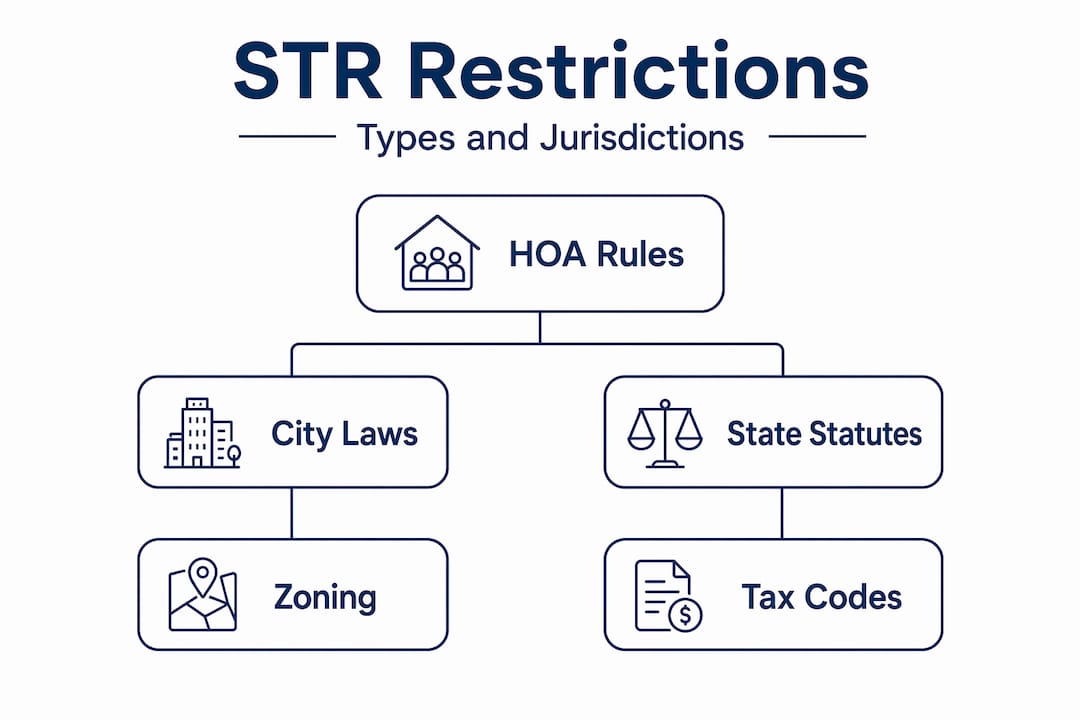
The regulatory layers most hosts face simultaneously include:
- HOA CC&Rs: Private, property-level restrictions that bind all owners within the community
- City ordinances: Local government rules on registration, occupancy, and operational standards
- State statutes: Statewide frameworks that may limit or expand what cities can regulate
- IRS tax codes: Federal rules on income reporting and deduction eligibility
Arizona’s state law prevents cities from banning STRs entirely, but it does not override enforceable HOA minimum lease terms, as affirmed in Kalway v. Calabria Ranch. In practice, this means an Arizona host can operate legally under state law and still be prohibited from short-term renting by their HOA.
Here is how those layers interact:
| Authority | Can override city bans? | Can override HOA CC&Rs? | Enforcement body |
|---|---|---|---|
| State statute | Yes, in some states | No, if CC&Rs are recorded | State legislature or courts |
| City ordinance | No | No | City code enforcement |
| HOA CC&Rs | No | N/A (is the restriction) | HOA board or courts |
| IRS tax rules | No | No | IRS, federal courts |
Practical steps to manage overlapping restrictions:
- Obtain and read the full HOA CC&Rs including all recorded amendments
- Check your city’s STR ordinance and verify which zoning districts are eligible
- Confirm your state has no preemption law that limits local authority
- Apply for all required city and county permits before listing
- Set up compliant tax accounts for transient occupancy tax if your city requires it
- Document owner authorization if required by your city’s STR framework
- Revisit all of the above annually, since rules change frequently
Review zoning laws for short-term rentals across your specific market to understand whether your property’s zoning designation is the first barrier you need to clear before any other compliance step applies.
Pro Tip: In markets with multiple overlapping rule systems, engaging a local real estate attorney or a specialized compliance service for an initial review is often less expensive than the first fine you would otherwise receive.
The overlooked complexities and practical realities of rental operational restrictions
Most short-term rental hosts approach compliance the same way: they read a summary blog post, check one government website, and assume they are covered. That approach misses the layers that actually generate fines and delistings.
The most common misconception is that rental restrictions are uniform within a city. They are not. Two properties on the same street can face entirely different rules if one sits within an HOA and the other does not. Even within an HOA, restrictions adopted before 2015 may read very differently from those amended in 2022 to specifically target platforms like Airbnb.
Precise definitions of short-term rentals in CC&Rs are crucial for legal enforcement and for withstanding court challenges when HOAs move to stop platform-based rentals. Vague language in older CC&Rs has allowed hosts to continue operating in communities that intended to ban STRs, while overly broad amendments have been challenged successfully in court.
Host pitfalls that appear regularly in compliance disputes:
- Missed permit renewals: Cities rarely send reminders. Expired permits trigger fines and listing suspension.
- Ignoring owner authorization requirements: Some cities require a signed, notarized owner authorization on file, separate from your permit.
- Unclear rental duration definitions: Booking a guest for 28 days when the HOA defines “short-term” as fewer than 30 days creates unexpected violations.
- Record-keeping lapses: Missing guest files or transaction logs during an audit can result in disallowed deductions and penalties.
- Assuming grandfather protection: Grandfather clauses require continuous operation and proper documentation. Stopping for even one season can forfeit protection.
The hosts who operate without incident are not the ones who found a loophole. They are the ones who read the actual governing documents, confirmed their rental registration insights for their specific community, and built a system to track renewals and regulatory updates year over year. Compliance is not a one-time task. It is an ongoing operational responsibility.
Stay compliant with STR Comply’s short-term rental compliance tools
Navigating rental operational restrictions across HOA rules, city ordinances, state statutes, and tax codes is time-consuming. STR Comply was built specifically to reduce that burden for short-term rental hosts and property managers.

With STR Comply’s free compliance check, you can instantly verify whether your listing meets local permit, tax, and zoning requirements. The platform delivers city-specific compliance summaries that cover operational limits on rentals, registration requirements, and occupancy rules, so you are not spending hours on government websites. Paid plans add permit tracking, renewal alerts, and regulatory update notifications, giving you a reliable system to maintain compliance as laws change. Review the terms of service to understand exactly what the platform covers and how your data is protected.
Frequently asked questions
What exactly are rental operational restrictions for short-term rentals?
Rental operational restrictions are rules set by HOAs, cities, and states that limit how and when you can rent your property short term, covering caps, registrations, occupancy limits, and owner presence requirements. These restrictions operate through governing documents, board rules, and formal enforcement mechanisms.
Do short-term rentals always require registration or permits?
Most U.S. cities require short-term rental properties to register and obtain permits or certificates of registration, with fees and renewal obligations to ensure compliance and public safety. Houston and comparable cities require certificates and permits with defined fees and annual renewal processes.
How do HOA rental caps affect my ability to rent short term?
HOA rental caps limit the percentage of units allowed to be rented simultaneously, often restricting short-term rentals and potentially affecting your mortgage eligibility. Rental caps typically limit 10 to 25 percent of units, and communities below 35 percent affect FHA and Fannie Mae lending eligibility.
What tax rules should short-term rental hosts be aware of?
If you rent your home for fewer than 15 days, you are not required to report that rental income; if rented more, you must report all income and can deduct expenses proportionally. IRS rules require expense allocation based on rental use versus personal use when the 15-day threshold is exceeded.
Can state laws override HOA restrictions on short-term rentals?
State laws may limit city bans on short-term rentals but generally cannot override enforceable HOA restrictions recorded in CC&Rs. Arizona’s experience confirms that court rulings uphold HOA authority over minimum lease terms even where state law protects STRs from city-level prohibition.
Recommended
Check your city's STR regulations
Free compliance reports for 100+ US cities. Permits, taxes, zoning — all in one place.
Check My Address — Free