
Imagine closing on a vacation rental property, listing it on a major platform, and welcoming your first guests, only to receive a city citation two weeks later threatening a $1,000 daily fine. This happens more often than most new hosts expect. Zoning laws for STRs in the U.S. are set at the local level, meaning every city and county writes its own rules. What’s perfectly legal in Phoenix may be entirely prohibited in Santa Monica. This guide breaks down how these rules work, what you need to watch for, and how to keep your rental both legal and profitable.
Table of Contents
- How zoning laws shape short-term rentals in the U.S.
- Key zoning restrictions: The big four rules
- Licensing, permits, and compliance: What you must do
- Comparison table: How major cities regulate STRs
- Why understanding local nuances beats relying on general rules
- How STR Comply helps you stay legal and profitable
- Frequently asked questions
Key Takeaways
| Point | Details |
|---|---|
| Local laws rule | City and county zoning mainly decide what’s allowed, not just state law. |
| Know the top restrictions | Primary residence, occupancy limits, and ownership caps are the most common zoning hurdles. |
| Annual licensing is mandatory | Be ready for fees, inspections, and ongoing compliance checks. |
| Compliance is trackable | High-tech enforcement means owners can’t rely on obscurity—compliance tools help avoid penalties. |
| Local updates matter | Stay alert for zoning changes and renewal risks to protect your STR business. |
How zoning laws shape short-term rentals in the U.S.
Understanding who controls short-term rental (STR) zoning is the first step toward operating legally. In the United States, STR zoning rules are set primarily at the local level, with city councils and county governments writing and enforcing the specific codes that apply to your property. State governments typically play a supporting or limiting role, either enabling municipalities to regulate as they see fit or, in some cases, preempting local restrictions entirely.
States like Arizona and Florida have passed laws that limit how aggressively cities can restrict short-term rentals, while states like New York and Hawaii give cities sweeping authority to impose strict limits or outright bans.
This division matters enormously for property owners and managers. If you operate in a pro-host state, you may have more flexibility, but you still need to review the specific municipal code where your property sits. A state-level protection does not override every local requirement. Licensing, tax collection, and safety standards are almost always enforced locally, regardless of how permissive the state framework is.
Keep an eye on rental law updates regularly, because local governments revise their STR codes frequently, sometimes annually. Cities respond to housing pressure, neighborhood complaints, or tourism demand by updating their rules without much public fanfare. Missing a regulatory change can put an otherwise compliant property into violation overnight.
Key factors that drive variation between cities include:
- Housing affordability concerns: Cities with tight housing markets tend to impose stricter STR limits to preserve long-term rental stock.
- Tourism reliance: Destination cities may be more permissive to protect visitor accommodation supply and local tax revenues.
- Neighborhood character: Residential zones often carry stricter STR rules than commercial or mixed-use areas.
- Platform enforcement partnerships: Some cities work directly with listing platforms to enforce compliance automatically.
Now that you know why context matters, let’s break down the main zoning frameworks impacting short-term rentals.
Key zoning restrictions: The big four rules
With the legal framework in mind, let’s break down the most common zoning rules you’re likely to face and how they work in practice.
Short-term rental ordinances across the country tend to cluster around four main restriction types. Understanding these will help you evaluate any market before you invest or list.
1. Primary residence requirements
The most widely used restriction is the primary residence rule. Under this requirement, you must live in the property for a defined portion of the year, typically six months or more, to qualify for an STR permit. Many cities, including Denver and Nashville, use this rule to prevent investors from converting residential housing into full-time vacation rentals. Primary residence rules are more permissive toward owner-occupiers than toward non-resident investors. In practical terms, this means non-owner investors face much higher hurdles, often needing a separate investor-class license or being prohibited entirely.

2. Caps on non-owner-occupied rentals
Some cities limit how many STR permits can exist in a given area, regardless of ownership. These caps are often tied to census tract data or neighborhood boundaries. When a cap is reached, no new permits are issued until an existing one lapses. This creates a waiting list environment that can make entering certain markets very difficult.
3. Building and density limits
Cities like Bellingham, Washington, and Spokane apply building-level caps restricting the percentage of units in a multi-family building that can operate as STRs. A common threshold is 25 to 30 percent of total units. For condominium owners, this means your building’s HOA rules and the municipal code must both be satisfied before you can list.
4. Ownership caps
Some municipalities go further and limit how many properties a single person or corporate entity can hold STR permits for. Atlanta, for example, caps individual ownership at two STR properties, with at least one being a primary residence. Provincetown, Massachusetts, caps individual ownership at three properties. These rules specifically target institutional investors and property management companies operating large portfolios.
Pro Tip: Before purchasing any investment property, review rental registration basics for that specific city and county to confirm permits are actually available to non-resident owners.
| Restriction type | Common threshold | Example cities |
|---|---|---|
| Primary residence rule | 6+ months per year | Denver, Nashville, San Francisco |
| Building density cap | 25 to 30% of units | Bellingham, Spokane |
| Non-owner permit cap | Varies by census tract | New Orleans, New York City |
| Individual ownership cap | 2 to 3 properties | Atlanta, Provincetown |
Knowing which restriction type applies to your property tells you which compliance path to follow. For multi-unit properties, also review property inspection rules early, since building-level safety requirements often accompany density caps. And don’t overlook STR tax obligations, which apply in virtually every jurisdiction regardless of which zoning restriction type you face.
Licensing, permits, and compliance: What you must do
Understanding the restrictions is crucial, but knowing exactly how to stay legal is just as important. Here’s a breakdown of the must-follow compliance steps.
Most cities that allow STRs require you to obtain a permit or license before your first guest checks in. The application process, costs, and ongoing requirements vary, but the broad framework is consistent enough that you can plan for it in any market.
Standard steps for obtaining an STR permit:
- Confirm zoning eligibility. Before applying, verify that your property’s zoning classification allows STRs. Residential zones, commercial zones, and mixed-use zones often carry different rules.
- Complete the application. Most cities require proof of ownership or lease authorization, a site plan or floor plan, and sometimes neighbor notification. Application processing times range from a few days to several months.
- Pay the permit fee. Annual STR permit fees typically range from $150 to $925, with some cities charging higher amounts for non-owner-occupied properties or multi-unit buildings.
- Pass a safety inspection. Many jurisdictions require a physical inspection covering smoke detectors, carbon monoxide alarms, fire extinguishers, emergency egress, and maximum occupancy compliance. Some cities mandate annual re-inspection at renewal time.
- Post your permit number visibly. A growing number of cities require the permit or license number to appear on every online listing. Platforms are increasingly enforcing this as a listing condition, and failure to display it can trigger automatic de-listing.
- Apply for renewal annually. Permits are typically valid for one calendar year. Renewal deadlines, fees, and requirements must be tracked carefully. Missing a renewal deadline can result in operating without a valid permit, which carries the same penalties as never having applied at all.
Statistic callout: Annual permit fees across major U.S. cities range from $150 to $925, but the cost of operating without one, including fines, back taxes, and forced de-listing, can reach tens of thousands of dollars.
Pro Tip: Set calendar reminders 60 and 30 days before your permit expiration date. Reviewing the permit renewal process well in advance gives you time to correct any compliance issues before they jeopardize your renewal application.
Beyond the permit itself, most cities impose occupancy limits, typically calculated as two guests per bedroom plus an additional allowance for common areas. Exceeding these limits is a common cause of complaints and violations, particularly in urban neighborhoods where noise and parking are sensitive issues.
Comparison table: How major cities regulate STRs
To help make sense of local differences, this table breaks down the zoning rules in several leading U.S. rental markets.
No two cities regulate STRs the same way. High-enforcement cities like New York City and San Diego achieve 90 percent or higher compliance rates through technology partnerships with listing platforms and self-funded enforcement programs supported by permit fees. Other cities rely primarily on complaint-driven enforcement with lower compliance rates but fewer immediate penalties for non-compliant hosts.
| City | Primary residence required | Ownership cap | Building cap | Annual fee range | Enforcement model |
|---|---|---|---|---|---|
| New York City | Yes | 1 property | N/A | $145 | Platform-tech enforcement |
| San Diego | No | No cap | No cap | $150 | Tech/platform partnership |
| Nashville | Yes | 1 non-primary permit | N/A | $312 | Complaint + tech |
| Denver | Yes | No cap | No cap | $300 | Complaint-based |
| Atlanta | Yes | 2 properties max | N/A | $150 | Complaint-based |
| Bellingham, WA | No | No cap | 25 to 30% of units | Varies | Municipal inspection |
| New Orleans | Yes | No cap | N/A | $500 | Active enforcement |
| Scottsdale, AZ | No | No cap | No cap | $250 | State-preempted limits |
This table illustrates a key pattern: cities facing housing pressure (New York City, New Orleans, Nashville) tend to enforce primary residence rules and use technology partnerships to close the compliance gap. Markets in pro-host states like Arizona tend to be more open, though local fees and safety requirements still apply. Hosts operating in multiple markets need city-specific knowledge for each location, not just a general understanding of STR rules.
Why understanding local nuances beats relying on general rules
Having compared the rules across cities, what’s often missing in how hosts approach compliance is a genuinely local-first mindset. Generic STR advice circulates widely online, and much of it is outdated or oversimplified. Relying on it can lead to costly mistakes.
Local ordinances are amended regularly. A city that allowed unlimited investor-owned STRs in 2022 may have introduced a primary residence requirement by 2025 without major news coverage. Platform enforcement has also raised the stakes significantly. When cities partner with listing platforms to enforce compliance, a permit violation doesn’t just result in a fine. It can mean automatic de-listing, which cuts off your income immediately.
One aspect that catches many experienced hosts off guard is the concept of grandfathered STRs and corporate ownership restrictions. Some cities allow properties that were operating legally before a new ordinance to continue under the old rules, but only as long as ownership doesn’t change and no violations occur. The moment a grandfathered property is sold or cited for a nuisance complaint, it loses its protected status and must comply with current rules. Corporate ownership bans are another layer: several cities now prohibit LLCs and other business entities from holding residential STR permits, effectively forcing investors to hold permits in their personal name.
The renewal risk after a violation is real and underappreciated. A single noise complaint that results in a formal citation can be referenced during your next permit renewal review. Cities like New Orleans and New York City have provisions allowing renewal denial for prior violations, even minor ones. This means that a one-time event, like an unauthorized party or a neighbor complaint about trash, can threaten the entire following year of operation.
The most reliable approach is to treat local registration strategies as a living process rather than a one-time checklist. Review your city’s STR code at least once per year. Attend local city council meetings when STR ordinance amendments are on the agenda. And use compliance tools that track regulatory changes in your specific market automatically.
Blanket advice won’t keep you compliant. Local knowledge, current data, and proactive monitoring will.
How STR Comply helps you stay legal and profitable
Navigating city-specific zoning rules, permit timelines, and annual renewal requirements across one or more properties is a significant operational burden. STR Comply was built specifically to reduce that burden for property owners and managers who can’t afford to get it wrong.
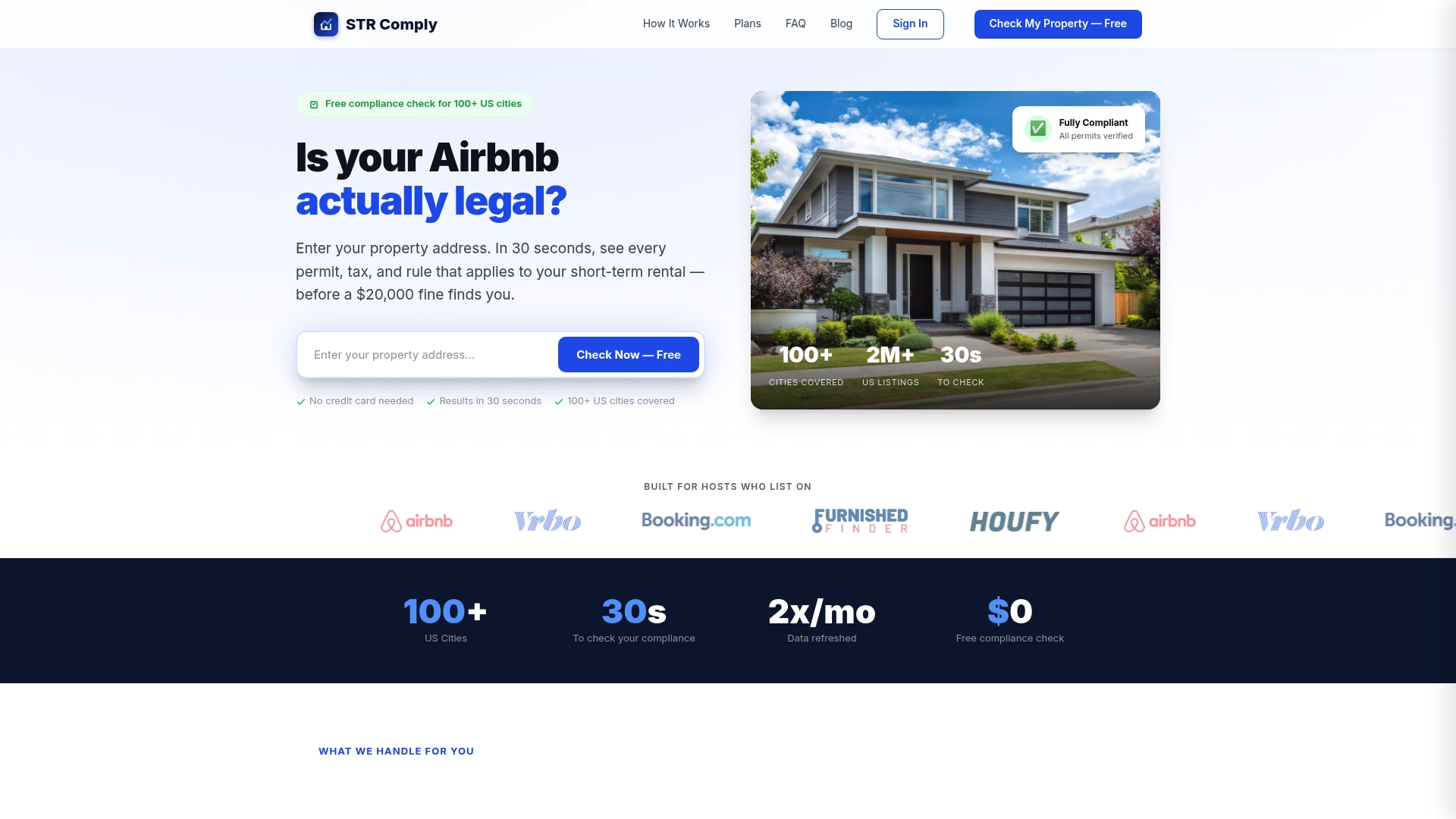
Check your STR’s compliance in minutes using STR Comply’s free tool, which pulls city-specific permit requirements, zoning restrictions, tax obligations, and operational rules for your exact address. No hours of legal research, no digging through municipal codes. You get a clear, actionable compliance summary that tells you where you stand right now. For owners managing multiple properties across different markets, compliance tools for owners include portfolio dashboards, permit renewal alerts, and regulatory update notifications that keep you ahead of changes before they become violations. Protecting your investment starts with knowing your compliance status today.
Frequently asked questions
Are short-term rentals legal in every U.S. city?
No. Legality depends on local zoning set by city and county governments, with some jurisdictions allowing STRs freely, others requiring permits, and others banning them outright in residential zones.
What is a primary residence rule for short-term rentals?
This rule requires you to live in the property for most of the year, typically six months or more, to qualify for an STR permit. Over 30 states are more permissive for owner-occupied rentals than for investment properties.
How many short-term rentals can one person own?
It varies by city. Atlanta caps ownership at two properties, with at least one being a primary residence, while Provincetown caps it at three. Always verify the ownership limit in your specific municipality.
What’s involved in STR licensing and renewal?
You’ll typically pay an annual fee between $150 and $925, display your permit number on listings, pass a safety inspection, and submit a renewal application each year before your permit expires.
Can a previous violation keep me from renewing my STR permit?
Yes. Many cities can deny renewal for prior violations such as unauthorized parties, noise complaints, or exceeding occupancy limits, even if the original citation seemed minor at the time.
Recommended
Check your city's STR regulations
Free compliance reports for 100+ US cities. Permits, taxes, zoning — all in one place.
Check My Address — Free