
Listing your property on Airbnb without proper registration is one of the fastest ways to face unexpected fines, forced delisting, or even city enforcement actions that shut your rental down entirely. Many hosts assume the process is straightforward or that Airbnb handles the legal side automatically. It does not. Every U.S. city, county, or municipality sets its own short-term rental (STR) rules, and the gap between what hosts assume is legal and what actually is legal can be costly. This guide walks you through exactly what to prepare, how to register, and how to confirm your listing stays fully compliant.
Table of Contents
- What you need before starting Airbnb registration
- Step-by-step: How to register your Airbnb legally in the U.S.
- Troubleshooting: Common legal pitfalls and how to avoid them
- How to confirm your Airbnb is fully compliant
- Our take: Why ‘one-size-fits-all’ solutions put Airbnb hosts at risk
- Legal compliance made simple: Get a personalized Airbnb registration check
- Frequently asked questions
Key Takeaways
| Point | Details |
|---|---|
| Start with zoning and eligibility | Always check both local zoning rules and HOA restrictions before you begin the registration process. |
| Follow each registration step | Obtain the right permits, register for required taxes, and document each step to ensure legal operation. |
| Avoid common pitfalls | Don’t ignore neighbor notification, tax registration, or renewal deadlines—these cause most compliance failures. |
| Confirm ongoing compliance | Keep permits current and display all required information on your listing and at the property. |
| Leverage expert compliance tools | Use checklists, calendars, and digital audits to catch issues before they become enforcement actions. |
What you need before starting Airbnb registration
With the risks in mind, let’s start by organizing everything you’ll need before jumping into city applications.
Before you submit a single form, you need to know whether your property is even eligible for short-term rental operation under local law. This is not always obvious. Zoning designations, HOA bylaws, and local ordinances all play a role, and conflicting rules can disqualify a property before the process begins.
According to guidance from the City of Bend Short-Term Rentals program, hosting an Airbnb legally in the U.S. generally requires three core elements: zoning or land-use approval for short-term rentals, a short-term rental permit or license, and local tax registrations for lodging or hotel occupancy taxes, plus ongoing compliance requirements like renewals, safety standards, and displaying your registration number on your listing where required. That’s a meaningful set of obligations, and the documentation process starts before your first application.
Core documents to gather
Before you check Airbnb legal requirements for your specific address, collect the following:
- Proof of property ownership or lease agreement (some cities allow hosted rentals for renters, but require landlord consent)
- Proof of liability insurance meeting local minimums, typically a general liability policy covering short-term occupancy
- Safety inspection documentation, including smoke detector placement, fire extinguisher records, and carbon monoxide detector confirmation
- HOA or condominium association approval or written documentation confirming no restrictions apply
- Government-issued ID and your property’s legal address, exactly as recorded in city or county records
- Floor plan or site plan, which some jurisdictions require as part of the permit application
Here is a quick reference for what different property types typically require before starting registration:
| Property type | Ownership proof needed | Insurance minimum | HOA check required |
|---|---|---|---|
| Single-family home (owner-occupied) | Deed or mortgage statement | $1M general liability | Yes, if applicable |
| Single-family home (investor-owned) | Deed or mortgage statement | $1M+ general liability | Yes, if applicable |
| Condo or apartment | Lease + landlord consent letter | Varies by city | Always required |
| Multi-unit building | Deed, unit designation | $1M+ per unit policy | Yes, if applicable |
Pro Tip: Build a dedicated folder, digital or physical, containing every compliance document before you start filling out applications. City portals often require multiple uploads in a single session, and missing one item can reset your progress entirely.
Understanding your property’s zoning classification is equally important. Many cities only permit STR operation in residentially zoned parcels where the host also claims the property as their primary residence. Others allow investor-owned rentals in designated zones. Checking this before applying will save you significant time and expense.
Step-by-step: How to register your Airbnb legally in the U.S.
Once you’ve gathered your documents, here’s the typical process to legally register an Airbnb, with notes for city-to-city differences.
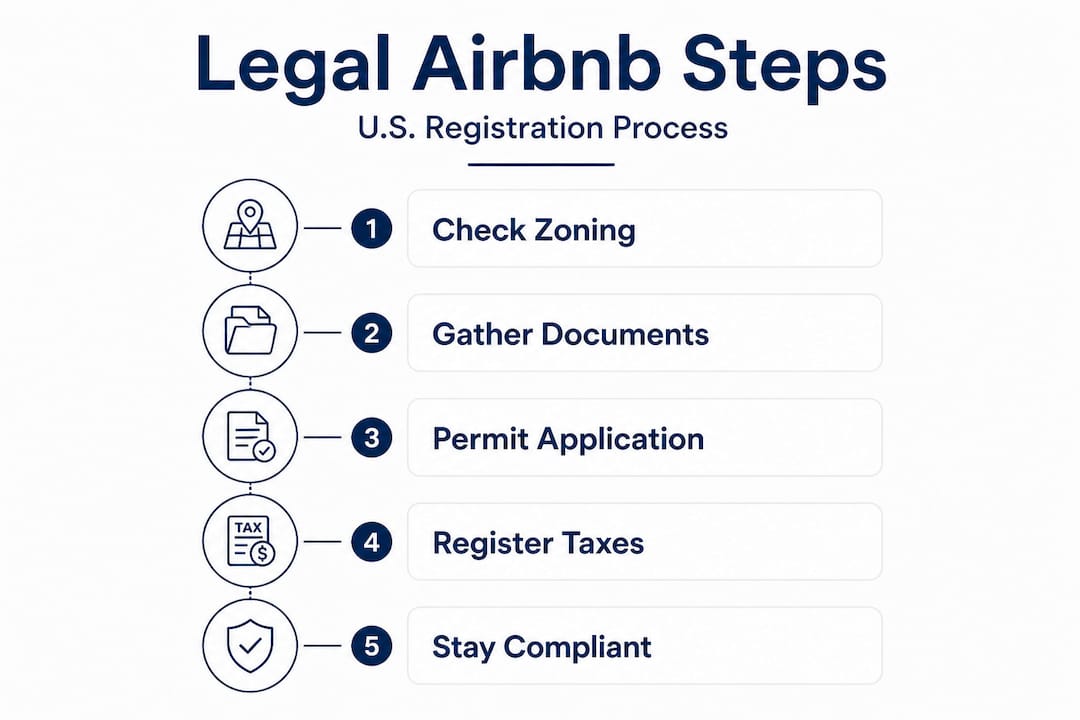
No single federal process governs Airbnb registration in the United States. Local governments control STR licensing and rules entirely, meaning the sequence, cost, and requirements vary significantly from one jurisdiction to another. However, the following framework reflects the most common registration path across U.S. cities.
Step 1: Verify property zoning and city rules
Log in to your city or county’s zoning or planning portal and confirm your property’s zoning designation. Search your address specifically because zoning boundaries do not always follow street lines. Many cities maintain an online zoning map or GIS tool that returns results by address.
At this step, also verify HOA and condominium restrictions. Even if the city allows STRs in your zone, an HOA can independently prohibit them. You need approval or confirmation from both the city and any private governing body before proceeding.
Step 2: Obtain land-use or zoning approval (if required)
Some jurisdictions require a conditional use permit (CUP) or a land-use approval step before you can apply for an operating license. As noted in City of Bend’s permitting process, city permitting is often sequential: you may need a land-use or zoning approval step first, then an operating license or permit afterward, and operating licenses typically require renewals. Skipping this step and going straight to an STR permit application will result in rejection.
This step may involve a public notice period during which neighbors can comment, or it may be administrative and processed without a hearing.
Step 3: Apply for your STR permit or operating license
This is the central registration step. You’ll submit your gathered documents through the city’s official portal or in person at a municipal office. Common requirements at this stage include:
- Completed STR application form (specific to your city)
- Proof of ownership or landlord consent
- Current liability insurance certificate
- Safety inspection checklist or third-party inspection report
- Site plan or floor plan of the rental unit
- Payment of the application fee (fees range from $50 to $500+ depending on jurisdiction)
Processing times vary. Some cities issue permits within a few days through an automated portal. Others take four to eight weeks and include an inspection before approval.
Step 4: Register for local lodging or occupancy taxes
Nearly every U.S. city or county with an active STR market requires hosts to collect and remit a transient occupancy tax (TOT), lodging tax, or hotel tax. This registration is separate from your STR permit and often managed by a different municipal department, such as the finance or revenue office.
To generate a compliance report that includes your specific tax registration obligations, you need your property address and the applicable local tax authority details. Some cities require monthly remittance; others allow quarterly filing. Know your schedule before your first guest checks in.
Step 5: Complete additional requirements
Depending on your city, additional steps may include:
- Neighbor notification: Some jurisdictions require written notice to adjacent property owners before your permit is issued
- License number display: Your STR license or permit number must appear on your Airbnb listing in certain cities
- On-property posting: Some cities require the permit or certificate to be physically displayed inside the rental unit
- Annual renewal: Most STR permits expire annually and must be renewed on time to avoid lapsing
Important: Do not list your property on Airbnb before receiving written confirmation of permit approval. Operating without a valid permit, even for a single night, can result in fines that exceed the cost of the entire registration process.
Troubleshooting: Common legal pitfalls and how to avoid them
Even with careful preparation and following the main steps, STR hosts often trip up on easy-to-miss details. Here’s what to watch out for.
HOA and condo rules override city permits
This is the most frequently overlooked compliance issue. A city-issued permit does not override an HOA or condominium board’s authority to prohibit short-term rentals. As noted in guidance on short-term home rental regulations, condominium and HOA restrictions can independently bar STR operations even when permits are formally approved, and the responsibility for verifying this rests entirely with the host. If you receive a city permit without HOA clearance and start renting, you risk losing both your listing and your permit.
Missing notification requirements
Neighbor notification rules are not optional in cities that require them. These rules exist in places like Spokane, Washington, and other municipalities where adjacent property owners must receive written notice before an STR can operate. Missing this step does not just delay your approval. It can trigger a denial and require you to restart the process from scratch.
Assuming Airbnb handles your tax registration
This is a costly and common mistake. While Airbnb does remit certain state and local taxes in many markets through its Voluntary Collection Agreements (VCAs), this does not eliminate your obligation to register separately with local tax authorities. Separate STR licensing and local tax collection steps often exist across different city and state offices, and you may still be legally required to register independently and remain liable for any gap in collection.
For practical guidance on how different tax structures interact with Airbnb’s remittance process, the STR Comply blog covers city-specific tax scenarios in detail.
The key pitfalls to monitor and avoid include:
- Relying on Airbnb’s platform as confirmation of local compliance
- Missing HOA board meeting deadlines for STR approval votes
- Filing permit applications under an address that differs from official county records
- Operating during the permit processing period before written approval arrives
- Forgetting to update your Airbnb listing with new license numbers after renewals
Pro Tip: Set calendar reminders 60 days before each permit and business license renewal date. Many cities charge significant late fees or force you to reapply from the beginning if renewal lapses, which can cost you bookings during the gap.
How to confirm your Airbnb is fully compliant
Successfully registering is just the start. Here’s how to ensure you stay compliant and out of the crosshairs of city enforcement.
Ongoing compliance requires active management, not passive assumption. Receiving your STR permit does not mean your obligations are finished. Enforcement agencies across the U.S. are increasing inspections, responding to neighbor complaints, and using digital tools to flag unlicensed or expired listings.
Many jurisdictions require you to post or display your STR permit or registration number directly on your Airbnb listing once approved. This is not optional. Cities cross-reference listing sites against their permit databases, and a listing without a valid, current license number is a red flag for enforcement teams.
Additionally, enforcement patterns frequently target unlicensed operations, expired licenses, or mismatched registration numbers and addresses. Even a minor discrepancy, such as “123 Main St” on your permit versus “123 Main Street” on your listing, can trigger a compliance review.
To maintain permit records and stay current, follow these practices:
- Display your permit number on your Airbnb listing and, where required, visibly inside the rental unit
- Store copies of all approvals including your STR permit, insurance certificate, inspection results, and tax registration confirmation in a secure, easily accessible location
- Update your listing immediately any time you receive a renewed or reissued permit with a new number or expiration date
- Conduct self-audits at least twice per year to verify that your permit status, insurance coverage, and listing information all match current records
- Track regulatory changes in your city because STR ordinances are updated frequently, and a rule that didn’t apply last year may apply this year
Building a simple compliance calendar with all renewal dates, tax filing deadlines, and inspection windows will dramatically reduce your risk of accidental non-compliance.
Our take: Why ‘one-size-fits-all’ solutions put Airbnb hosts at risk
You’ve mastered the legal steps. Now, let’s address the persistent myth that Airbnb registration works the same way across the country.
Generic checklists and cookie-cutter guides give hosts a false sense of security. The reality is that HOA rules, city zoning departments, and local tax offices each operate independently with no coordination between them. A host who followed a generic registration guide to the letter could still be non-compliant because the guide didn’t account for a specific city’s neighbor notification window, or a condo association’s quiet hours restriction, or a county tax office that requires separate registration from the city.
Enforcement is intensifying. Cities across the U.S. are investing in third-party software that scrapes short-term rental platforms and flags listings without valid, current license numbers. The cost of an expired or missing license has never been higher. Fines in cities like New York, Los Angeles, and San Francisco now regularly reach into the thousands of dollars per violation, per day.
From our experience reviewing compliance data across thousands of U.S. addresses, roughly 80% of compliance errors stem from three sources: mismatched address information between permit records and listing details, expired documents that hosts didn’t realize had lapsed, and ignorance of required public displays for permit numbers. These are not complex legal failures. They are administrative gaps that could be prevented with the right systems in place.
Smart hosts combine legal requirements by address with calendar management and digital document storage. That combination, address-specific review plus proactive tracking, is the only approach that holds up when enforcement teams come looking.
The one-size-fits-all era of Airbnb compliance is over. Hosts who treat registration as a one-time task rather than an ongoing operational responsibility are the ones receiving fines and losing their listings.
Legal compliance made simple: Get a personalized Airbnb registration check
Ready to make sure every box is checked for your Airbnb?
STR Comply offers a free, instant compliance check built specifically for U.S. short-term rental hosts. Enter your property address and get a detailed summary of the permits, zoning approvals, tax registrations, and operational requirements that apply to your specific listing location. No legal research, no hours spent navigating city portals.
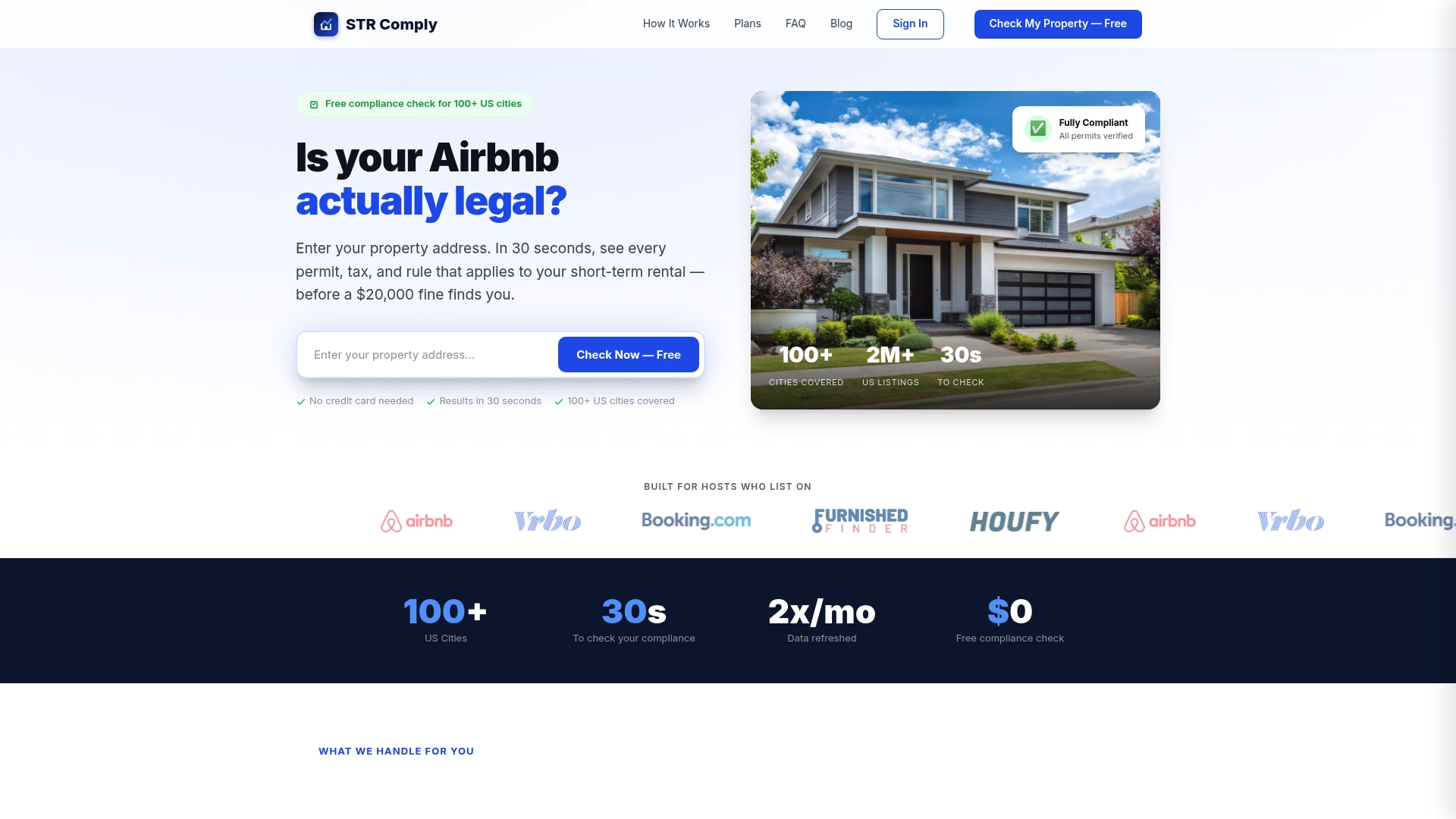
If you’re ready to move forward, check if your Airbnb is legal at no cost with STR Comply’s on-demand tool. For hosts managing multiple properties or preparing for a new market, you can get a custom registration report that covers every compliance layer in detail, from zoning through tax registration and renewal timelines. Staying compliant is not just about avoiding fines. It’s about building a rental business that operates without interruption.
Frequently asked questions
Do I need a separate business license to host on Airbnb?
Yes, most U.S. cities require a short-term rental-specific license or permit before you can legally list on Airbnb. Some cities, like Kennesaw, Georgia, require both a business license and a Short-Term Rental Certificate before you can advertise or operate.
How often do short-term rental permits need to be renewed?
Many cities require annual renewal, and missing the renewal window can result in suspension or loss of your license. For example, Bend requires annual renewals and enforces late renewal and expiration rules that can force hosts to reapply entirely.
What happens if I don’t register my Airbnb with my city?
Unregistered Airbnbs face fines, forced removal from the platform, and city enforcement actions. Enforcement teams actively target unlicensed listings, expired permits, and address mismatches between permit records and live listings.
If Airbnb remits taxes for me, do I still need to register for lodging taxes?
Yes. Even when Airbnb remits taxes through a Voluntary Collection Agreement, hosts are often still required to independently register with local tax authorities. Separate licensing and tax registration steps exist across different city and state offices, and you remain liable for any gap.
Do I have to display my Airbnb registration or license number?
Many cities require the license number to appear on your Airbnb listing and physically inside the rental unit. Failure to display it is treated as a violation even if your permit is otherwise valid. Some cities, like Kennesaw, require the certificate visibly displayed inside the rental property at all times.
Recommended
Check your city's STR regulations
Free compliance reports for 100+ US cities. Permits, taxes, zoning — all in one place.
Check My Address — Free