
Operating a short-term rental without airtight paperwork is one of the most financially dangerous positions a host can hold. Many hosts focus on guest satisfaction, pricing strategy, and occupancy rates while assuming that compliance is a secondary concern. That assumption is wrong. A single missing permit or an unfiled transient occupancy tax (TOT) certificate can produce fines large enough to wipe out months of rental income. Legal penalties for Airbnb hosts exist across virtually every US market, and the enforcement machinery cities use to find violations is growing more sophisticated every year.
Table of Contents
- Why legal penalties exist for Airbnb hosts in the US
- The most common violations and penalty triggers
- How enforcement actually works: city strategies and audit systems
- How penalty amounts and enforcement styles vary by city
- What hosts can do: practical compliance steps and edge case guidance
- What most hosts get wrong — and how to actually mitigate penalty risk
- Take the next step: How STR Comply can help you ensure legal safety
- Frequently asked questions
Key Takeaways
| Point | Details |
|---|---|
| Local rules drive penalties | State and city regulations are the main source of legal penalties for Airbnb hosts. |
| Compliance failures are costly | Missing permits, licenses, or tax filings can lead to large fines—even for first violations. |
| City enforcement is evolving | Municipal audit, registry, and data cross-checks are making violations easier to detect. |
| Documentation is your best defense | Thorough documentation before listing is the most reliable way to avoid fines. |
| No exceptions for tax compliance | Even short stays require proper tax certificates and registration in many cities. |
Why legal penalties exist for Airbnb hosts in the US
Short-term rental regulation in the United States is not handled at the federal level. Instead, it falls entirely to state and local governments, which means every city, county, and municipality can set its own rules. As a result, zoning, licensing, and safety rules can vary dramatically from one ZIP code to the next, even within the same state.
Cities impose penalties because operating a short-term rental affects housing supply, neighborhood character, hotel tax revenues, and building safety. When hosts bypass local rules, they undercut systems designed to protect both guests and long-term residents. That is why enforcement actions can range from written notices to five-figure fines and, in serious cases, the revocation of a host’s ability to operate at all.
The STRO framework in San Diego illustrates the breadth of regulation: short-term rentals are primarily governed by state and local governments across zoning, licensing, permits, safety, occupancy limits, and taxes, and operating outside those rules triggers enforcement actions and fines. Most US cities follow a similar structure.
Common compliance categories include:
- Permits and licenses: A valid short-term rental permit or business license is required before the first guest arrives.
- Zoning restrictions: Not every property in every neighborhood is legally permitted to operate as a short-term rental.
- Occupancy limits: Cities often cap the number of guests allowed per unit or per bedroom.
- Night limits: Some jurisdictions allow only a fixed number of rental nights per year.
- Safety standards: Fire extinguishers, carbon monoxide detectors, and egress requirements must be met and documented.
- Tax registration and remittance: Hosts must collect and pay applicable taxes, including transient occupancy tax and state sales tax.
“Compliance is not optional, and the consequences of ignoring local rules extend well beyond a warning letter. Cities have the legal authority to impose fines, suspend licenses, and refer cases for civil or criminal prosecution.”
Running an Airbnb legal compliance check before listing your property is the most direct way to understand what your specific city requires.
The most common violations and penalty triggers
Understanding the categories of regulation is one thing. Knowing which violations actually trigger enforcement is another. According to New York State’s tax guidance, penalties most commonly attach to missing permits or licenses, violating occupancy or night limits, and failing to register, collect, or remit required taxes.
Here are the top five violation types that result in fines:
- Operating without a permit or license. This is the most frequent trigger. Cities require hosts to obtain a permit before listing, and operating without one can result in immediate fines from the first day of operation.
- Failing to collect or remit occupancy taxes. Transient occupancy tax, hotel tax, and short-term rental tax are required in most jurisdictions. Failing to file or remit correctly generates interest, back-billing assessments, and penalties that compound over time.
- Exceeding occupancy or night limits. If a city caps rental nights at 90 per year or limits guests to two per bedroom, those limits are enforceable and often tracked through permit data.
- Hosting in a non-permitted zoning area. Some residential zones explicitly prohibit short-term rentals. Hosts who list in those zones face removal orders and fines.
- Failing to meet safety inspection requirements. Missing property inspection rules such as fire safety documentation or proper egress can result in immediate closure orders.
| Violation type | Typical penalty range | Compounding factor |
|---|---|---|
| No permit or license | $250 to $10,000+ per day | Continues until permit obtained |
| Tax noncompliance | Back taxes plus 10 to 25% interest | Grows with each billing period |
| Occupancy limit breach | $500 to $5,000 per incident | Repeat violations escalate |
| Zoning violation | $1,000 to $10,000+ | May require property modifications |
| Safety deficiency | $100 to $5,000 per item | Can trigger closure order |
A detailed look at short-term rental tax obligations shows how quickly back-tax assessments accumulate, especially when hosts have operated for multiple months or years without proper registration.
Pro Tip: Never assume Airbnb’s automatic tax collection covers all of your local obligations. In many markets, Airbnb collects state-level taxes but does not remit local transient occupancy tax on your behalf. Verify with your city what is collected by the platform and what remains your responsibility.
Understanding legal risks for Airbnb hosts reinforces why this issue deserves serious attention rather than casual monitoring.
How enforcement actually works: city strategies and audit systems
Most hosts who receive fines did not expect them. That is because enforcement is not always visible or predictable. Cities use two primary enforcement models: complaint-driven enforcement and audit-driven enforcement.

In complaint-driven systems, neighbors, housing advocates, or competing businesses file reports about unlicensed or disruptive short-term rentals. Cities then investigate specific addresses. In audit-driven systems, municipalities proactively cross-reference permit registries with active listings on platforms like Airbnb and VRBO. They identify listings that have no corresponding permit on file and initiate enforcement without waiting for a complaint.
A 2026 Portland Ombudsman report found that city enforcement can produce very high penalties and is becoming more systematic over time through permit and licensing cross-checks and the use of data from third-party sources, which increases hosts’ practical exposure.
Cities are now using:
- Online listing scrapers that automatically identify active rental listings without valid permit numbers.
- Guest review analysis to confirm a property is operating as a short-term rental even when not listed on major platforms.
- Third-party compliance vendors contracted by municipalities to track unlicensed rentals at scale.
- Registration cross-checks between STR permit databases and property tax records.
- Citizen complaint portals that make it simple for neighbors to submit violations with photos and descriptions.
“The era of operating informally under the radar is ending. Cities are allocating resources specifically to short-term rental enforcement, and the data tools available to them are increasingly precise.”
Staying current with your permit renewal obligations is no longer just about avoiding a fine during a random inspection. It is about staying off a city’s active enforcement list entirely.
| Enforcement model | How it initiates | Host detection risk |
|---|---|---|
| Complaint-driven | Neighbor or guest complaint | Moderate, depends on neighborhood |
| Audit-driven | City cross-checks permit database vs. active listings | High, automated and systematic |
| Platform data sharing | City compels platform to share host data | Very high, no hiding possible |
| Third-party vendor scan | Contracted data firm identifies unlicensed listings | High, ongoing and scalable |
Understanding short-term lease structures in your market can also help you anticipate where enforcement tends to concentrate.
How penalty amounts and enforcement styles vary by city
Not all cities punish violations the same way. Penalty structures vary significantly depending on local ordinances, political priorities, and the size of the city’s enforcement staff. Some jurisdictions offer a warning notice and a “cure period,” which is a grace window during which the host can fix the violation before any fine is assessed. Others impose fines immediately, with no grace period at all.
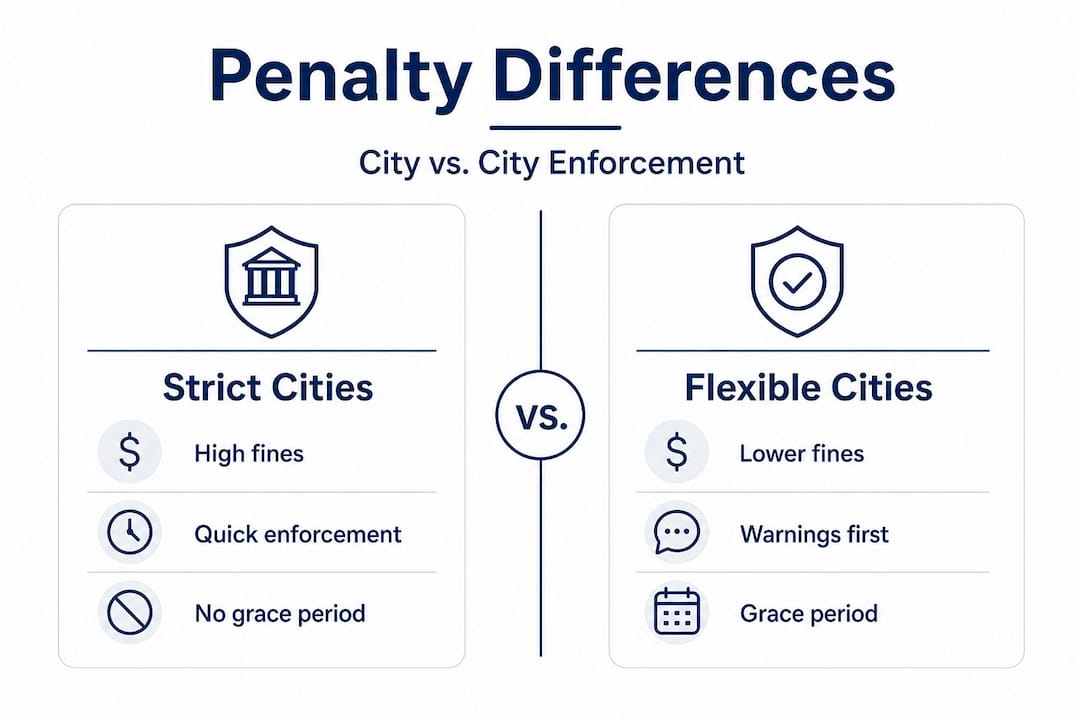
Portland, Oregon, is one of the most documented examples of aggressive enforcement. The Portland Ombudsman found that some enforcement policies were unusually punitive compared with other cities, with very large caps for first-time offenders and major fines for paperwork or permit errors. In one documented case, a first-time offender received a fine that was initially set above $100,000 before being rescinded and reassessed at $27,513. That is still a significant financial penalty for what may have been a permit or documentation error.
| City | Reported first-offense fine range | Cure period offered | Key trigger |
|---|---|---|---|
| Portland, OR | Up to $100,000+ (assessed at $27,513) | Not guaranteed | Permit/paperwork violations |
| San Diego, CA | $100 to $1,000 per day | Sometimes offered | TOT certificate, STRO permit |
| New York, NY | $1,000 to $7,500 per violation | Rarely | Illegal hotel law violations |
| Nashville, TN | $50 to $500 per day | Varies | Zoning, permit lapses |
Key factors that shape penalty severity:
- Whether the host has prior violations on record.
- How long the property operated without a valid permit.
- Whether the host cooperated with the investigation or ignored notices.
- Whether the violation involved tax fraud or simply a missed filing deadline.
Pro Tip: Before listing your property, confirm in writing whether your city offers a cure period for first-time violations. Do not assume it. Some municipalities publish this information on their short-term rental pages; others require a direct inquiry to the code enforcement office.
Reviewing permit renewal best practices for your city will help you understand what the renewal failure penalties look like and how to avoid lapsing into noncompliance.
Understanding short-term lease flexibility options in regulated markets also helps you see how local policy shapes what is and is not permissible.
What hosts can do: practical compliance steps and edge case guidance
Knowing that enforcement is real and penalties are serious, the practical question becomes: what exactly should you do before and after you list?
Follow these steps to build a compliant foundation:
- Research your city’s short-term rental ordinance. Find the official municipal code or STR-specific page for your city before you list. Confirm whether your property type and zoning classification are eligible.
- Obtain all required permits and licenses. Apply for and receive your short-term rental permit, business license (if required), and any additional certificates before accepting bookings.
- Register for transient occupancy tax and any applicable local taxes. Complete registration with your city or county tax authority, not just your state. Review your rental tax guide to confirm what applies.
- Verify that your listing includes your permit number. Many cities require hosts to display their permit number visibly on all platform listings. Missing this detail can trigger an audit.
- Meet all safety requirements before the first guest arrives. Document fire extinguisher placement, detector installation, and egress routes with dated photographs.
- Track your rental nights against local limits. If your city caps rentals at 90 nights per year, maintain a log and stop accepting bookings once you reach that threshold.
- Set calendar reminders for permit renewals. Permit lapses are one of the most common compliance failures and one of the easiest to prevent.
One critical edge case that many hosts overlook: San Diego’s STRO framework explicitly states there are no exceptions for lacking a TOT certificate when a property is rented for stays under one month. This means that if your guest stay is 29 days, you still need the certificate. There is no minimum-stay threshold below which the tax requirement disappears.
Many hosts assume that shorter stays or part-time rentals place them in a gray zone where requirements are relaxed. That is not how most jurisdictions operate. The rules apply from the first night you rent, regardless of frequency or duration.
Pro Tip: Create a compliance folder for each property. Store copies of all permits, tax registration confirmations, safety inspection records, and correspondence with your city. If you are ever audited, having organized documentation dramatically reduces your exposure.
What most hosts get wrong — and how to actually mitigate penalty risk
Most hosts who receive fines are not bad actors. They are hosts who believed that compliance would be resolved once they got the permit. That assumption misses two major realities.
First, permits are just the starting point. Renewal deadlines, updated safety requirements, new tax registration rules, and zoning reclassifications can all create new compliance gaps even after a host was initially approved. Cities change their rules, and hosts who do not track those changes find themselves noncompliant without realizing it.
Second, the documentation surrounding your compliance is just as important as the compliance itself. If you cannot prove when your permit was active, when your taxes were remitted, or when your safety inspection occurred, enforcement agencies may treat gaps in documentation as evidence of noncompliance. The Portland Ombudsman’s reporting shows that enforcement mechanics can be complaint or audit-driven, and operating informally under the radar is becoming less viable as local governments use registries, permit verification, advertising data, and guest review information to identify violations.
A second critical insight from reporting on Portland’s enforcement: some cities impose large penalties quickly for first-time permit or compliance errors, even when hosts believed they were close to compliance. That variation in enforcement culture means you cannot calibrate your documentation standards to your best-case scenario. You should document as if your city is the most aggressive enforcer in the country, because you may not know otherwise until a fine arrives.
The hosts who avoid fines consistently are those who approach permit renewal the same way they approach property maintenance: as an ongoing responsibility, not a one-time task. They set renewal alerts, audit their own compliance quarterly, and keep organized records of every filing.
Take the next step: How STR Comply can help you ensure legal safety
Navigating short-term rental regulations across different cities is genuinely complex, and the stakes are high enough that guesswork is not a viable strategy.
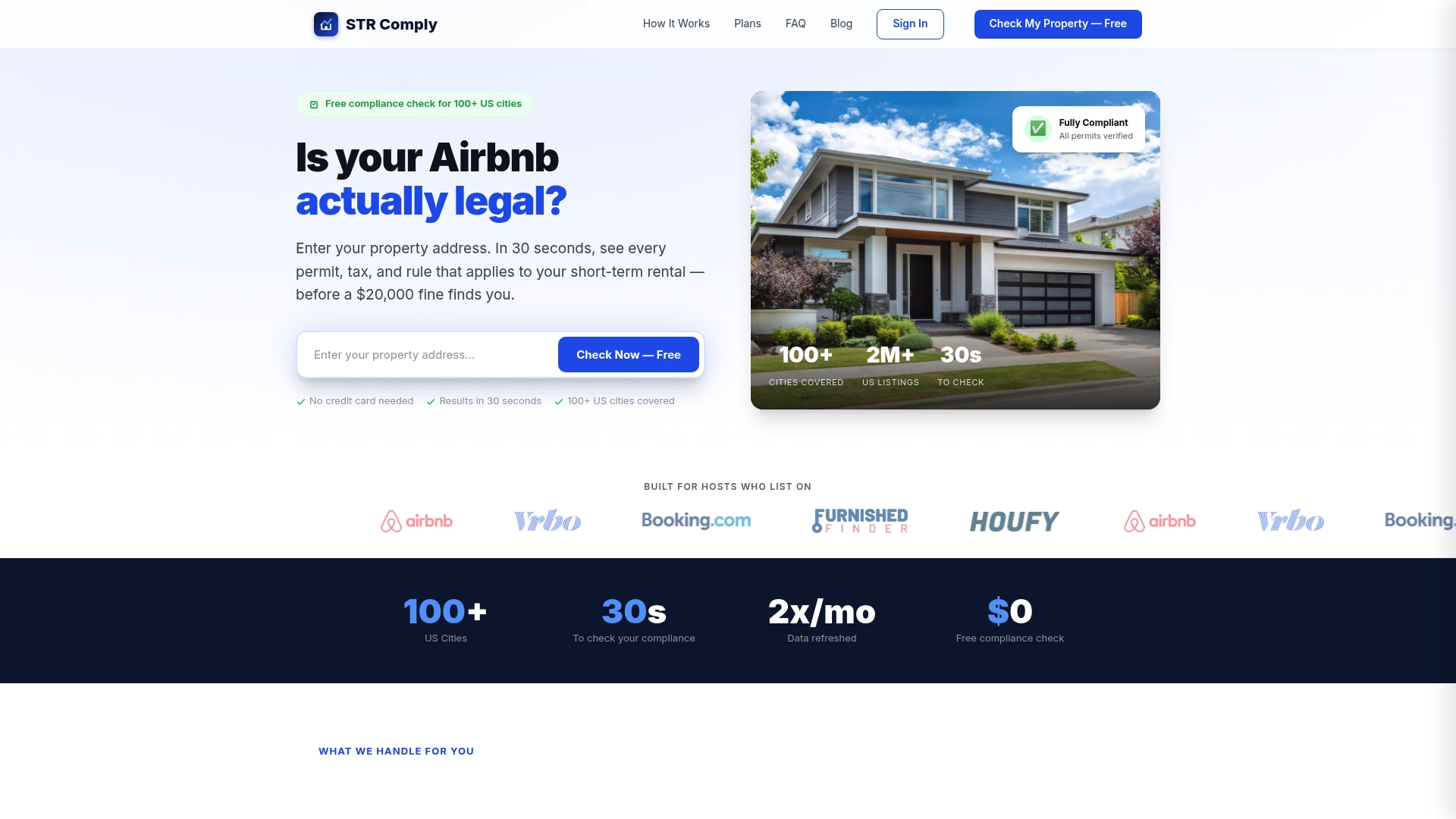
STR Comply is built specifically for hosts who want to eliminate compliance uncertainty. Using the free compliance report tool, you can instantly check whether your listing meets local permit requirements, tax obligations, and zoning restrictions without spending hours reading municipal codes. The platform delivers city-specific summaries that tell you exactly what you need and what you are missing. For hosts managing multiple properties, paid plans include permit tracking dashboards, renewal alerts, and real-time regulatory updates. Review the terms of service to understand what is included, and visit STR Comply to get started with your first compliance check today.
Frequently asked questions
What are the most common reasons Airbnb hosts receive fines?
Missing permits, failing to remit required taxes, and violating occupancy rules are the most frequent triggers for penalties across US markets.
How do cities track Airbnb host compliance?
Cities use permit registries, advertising data, and guest reviews to verify compliance, and systematic cross-checks are making this process increasingly automated and accurate.
Can first-time offenders receive huge fines?
Yes. Some cities impose very large penalties even for first-time permit or paperwork violations, though caps are sometimes reduced after formal review.
What is a “cure period” and are hosts guaranteed one?
A cure period is a grace window to fix a violation before fines are assessed, but not all cities offer them. Always confirm your local enforcement policy before listing.
Is there any exception for short-term rental tax certificates if stays are under one month?
No. Cities like San Diego explicitly state that there are no exceptions for required tax certificates regardless of how long the guest stays.
Recommended
Check your city's STR regulations
Free compliance reports for 100+ US cities. Permits, taxes, zoning — all in one place.
Check My Address — Free