
Managing a short-term rental portfolio is far more demanding than most hosts expect. This short-term rental portfolio management guide exists because the gap between owning one property and profitably managing five or more is wider than it looks. Short-term rentals demand 10x the operational effort of long-term rentals while delivering 2 to 3 times the revenue. That ratio is compelling — until you’re buried in guest messages at midnight, chasing a cleaner who canceled, and wondering whether your newest listing is even legal. The hosts who scale successfully do so because they build systems, not just portfolios.
Table of Contents
- Key Takeaways
- Essential preparation steps before scaling your rental portfolio
- Operational execution: managing daily workflows across your portfolio
- Leveraging technology and analytics for portfolio optimization
- Regulatory compliance and risk management
- My take on sustainable portfolio growth
- Manage your portfolio with confidence using Strcomply
- FAQ
Key Takeaways
| Point | Details |
|---|---|
| Prepare before you scale | Research local regulations, build a vetted local team, and set up a property management system before adding properties. |
| Centralize operations early | A centralized PMS prevents double bookings, automates messaging, and keeps your team coordinated across multiple listings. |
| Use dynamic pricing consistently | Automated pricing tools can increase rental income by 20 to 40 percent by responding to real-time market conditions. |
| Stay ahead of compliance | Track permits, licenses, and tax obligations by city to avoid fines, de-listing, and legal penalties. |
| Track management hours for taxes | Logging active management time is required to qualify for significant tax benefits like bonus depreciation. |
Essential preparation steps before scaling your rental portfolio
Before you add your third or fourth property, the decisions you make in preparation will determine whether scaling feels manageable or chaotic. Most hosts who burn out do so not because they took on too many properties, but because they never built the foundation to support growth.
Define your investment strategy first
Start with a clear investment thesis. Are you targeting urban business travelers, beach vacation guests, or mountain retreat seekers? Each segment has different seasonal demand patterns, amenity expectations, and regulatory environments. Picking a niche lets you standardize operations, which becomes critical at scale.
Market research should come next. Study occupancy rates, average daily rates, and local competition before committing to any property. Platforms that track over 2.5 million listings across more than 15,000 U.S. cities give you data-backed confidence in your acquisition decisions.
Build your local team before you need it
One of the most overlooked rental portfolio management tips is assembling your operations team before you go live. You need at least two vetted cleaners per property, a reliable handyman, and a backup co-host. Building a local team with verified backup providers is what separates hosts who maintain 3 to 4 hour turnovers from those who get hit with bad reviews after a scheduling failure.
Here is what your core team should include:
- Primary cleaner with a proven track record and confirmed availability for same-day turnovers
- Backup cleaner who knows your standards and can step in with short notice
- Maintenance contact for urgent repairs (plumbing, HVAC, locks)
- Co-host or property manager for on-the-ground guest issues when you are unavailable
- Local inspector or handyman for pre-guest walkthroughs on longer stays
Set up your technology stack
Your technology choices at this stage will either multiply your capacity or limit it. At minimum, you need a Property Management System (PMS), a channel manager to sync calendars across Airbnb and VRBO, and a dynamic pricing tool.

| Tool Category | Primary Function | Example Use Case |
|---|---|---|
| Property Management System | Centralizes reservations, messaging, and tasks | Preventing double bookings across platforms |
| Channel Manager | Syncs availability in real time | Updating all listings simultaneously after a booking |
| Dynamic Pricing Tool | Adjusts rates based on demand signals | Raising rates during local events or peak weekends |
| Compliance Tracker | Monitors permits and regulatory deadlines | Alerting you when a permit renewal is due |
Pro Tip: Set up your PMS before your first listing goes live, not after your second booking conflict. Retrofitting your operations onto software is significantly harder than starting with it in place.
Make sure your listing optimization is done at this stage too. High-quality photos, a detailed description that highlights unique amenities, and a clear house manual all reduce guest friction before check-in.
Operational execution: managing daily workflows across your portfolio
Once your properties are live, the focus shifts to daily operations. This is where most portfolio management guides gloss over the real complexity. Running three to ten properties well requires disciplined workflows, not just good intentions.
A centralized PMS reduces burnout and errors by integrating channel management, automated guest messaging, and dynamic pricing into one system. Without centralization, you are manually reconciling calendars, sending individual check-in instructions, and hoping nothing slips through.
Guest communication done right
Automated messaging handles 80 percent of guest interactions when set up correctly. Create message templates for booking confirmation, pre-arrival instructions, check-in day reminders, mid-stay check-ins, and post-checkout review requests. Personalize each template with the guest’s name and property-specific details.
Fast, accurate responses directly affect your search ranking on major platforms. Hosts with response rates above 90 percent consistently receive higher visibility and stronger review scores, which compounds into higher average daily rates over time.
Cleaning and maintenance coordination
Here is a practical workflow for cleaning and maintenance across multiple properties:
- Connect your PMS calendar to your cleaning team’s scheduling app so turnovers are assigned automatically after each checkout.
- Use a standardized cleaning checklist specific to each property, stored digitally and accessible to every cleaner.
- Set a 15-minute buffer after each checkout time to account for late guests before cleaning begins.
- Conduct a digital property inspection after each turnover using photos uploaded to a shared folder.
- Schedule a monthly deep-clean and maintenance walkthrough to catch wear before guests do.
Pro Tip: Pay your cleaners above the local market rate. Reliable cleaning is the single biggest factor in guest reviews, and the cost difference is small compared to the review damage a single bad turnover causes.
Financial tracking and reporting
Automate your financial reporting from day one. Your PMS should export monthly revenue by property, and you should reconcile this against platform payouts, cleaning costs, supplies, and maintenance expenses. Hosts who track this at the property level can quickly identify underperformers and make data-driven decisions about pricing or repositioning.
For hosts with investors or co-owners, standardized monthly reports build trust and reduce the time spent on ad-hoc requests. Most PMS platforms generate these automatically once configured.
Leveraging technology and analytics for portfolio optimization
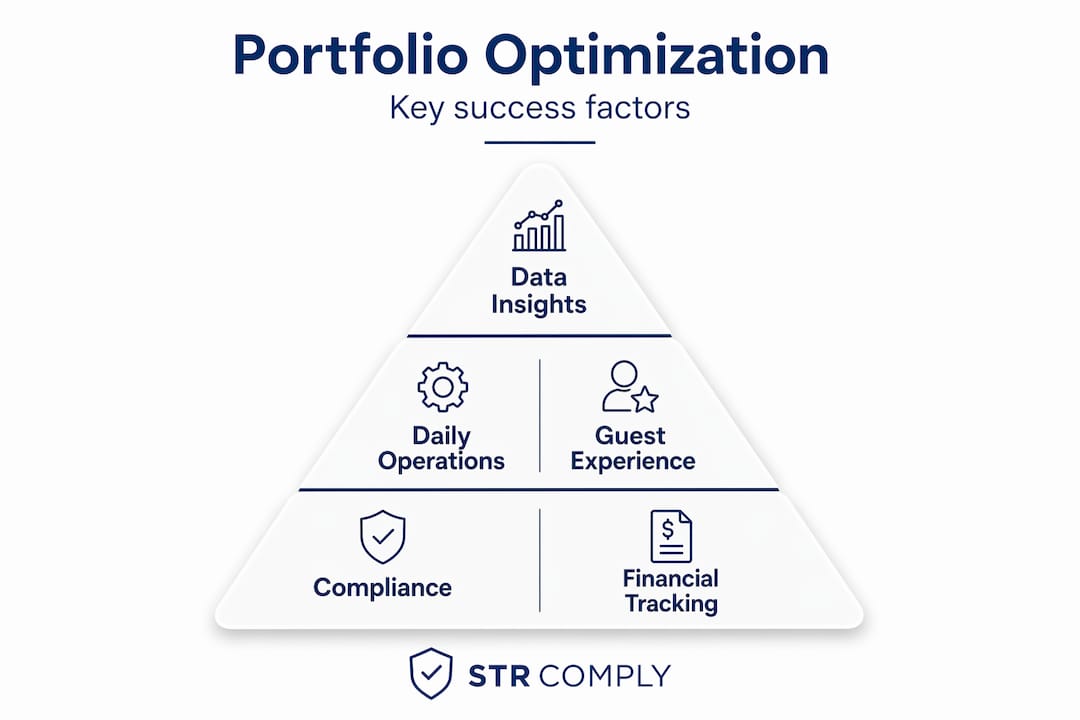
The short-term rental market growth is shifting from volume to quality. Hosts who win in this environment use data to make decisions that gut instinct alone cannot support.
Key metrics every host should monitor
Track these performance indicators across your entire portfolio:
- Occupancy rate: percentage of available nights booked (target: 65 to 80 percent depending on market)
- Average Daily Rate (ADR): average revenue earned per booked night
- Revenue Per Available Night (RevPAN): the true measure of performance because it combines occupancy and rate
- Guest rating average: directly tied to search visibility on all platforms
- Review-to-stay ratio: the percentage of guests who leave a review, which signals algorithm favorability
Dynamic pricing is non-negotiable
Dynamic pricing increases rental income by 20 to 40 percent by automatically adjusting rates based on demand, competitor activity, seasonality, and local events. Manual pricing leaves significant money on the table during high-demand periods and keeps rates artificially high during slow periods, hurting occupancy.
Most dynamic pricing tools integrate directly with your PMS and channel manager. Set a floor price, a ceiling price, and let the algorithm handle everything in between. Review the pricing logic quarterly and adjust floor rates as your operating costs change.
Pro Tip: Layer your dynamic pricing tool with a local event calendar. Major conferences, sporting events, and festivals create demand spikes that algorithms sometimes react to too slowly. Manually adjust minimums three to four weeks before major local events.
For hosts managing vacation rental taxes across multiple markets, integrating your PMS with accounting software creates a clean audit trail and reduces tax preparation time significantly.
Regulatory compliance and risk management
Compliance is the part of this guide that most hosts skip until they receive a fine or a de-listing notice. That is a costly approach. Regulations vary dramatically by city and county, and they change frequently.
Every host managing multiple properties needs to track:
- Short-term rental permits and their renewal dates for each property
- Transient occupancy tax (TOT) registration and remittance schedules
- Zoning restrictions that govern which property types can operate as short-term rentals
- Operational restrictions such as guest caps, noise rules, and parking limits
- HOA rules that may prohibit or limit short-term rentals independent of city law
Understanding rental license requirements for each market where you operate is not optional. Cities from New York to Palm Springs have enacted strict permitting regimes, and operating without a valid license puts your entire portfolio at risk.
Proactive engagement with local authorities and neighbors mitigates regulatory risk and supports long-term portfolio viability. Attending city council meetings, joining local host associations, and maintaining good relationships with neighbors reduces the likelihood of complaints that trigger enforcement actions.
Regulatory compliance is not a one-time task. It requires ongoing monitoring of city ordinances, permit renewal schedules, and tax obligations across every market where you operate. Missing a single renewal date can result in fines, forced closure, or removal from booking platforms.
Tax documentation deserves equal attention. To qualify for tax benefits like bonus depreciation, hosts must meet material participation requirements by meticulously logging management hours. Use dedicated software to track time spent on management activities. This documentation can mean the difference between a substantial tax deduction and losing it entirely on audit.
My take on sustainable portfolio growth
I’ve spent a lot of time studying how hosts scale from two properties to ten, and the pattern that consistently leads to failure is the same: adding properties before the operating system is ready.
In my experience, the hosts who build genuinely profitable portfolios resist the temptation to expand until their current operations run with minimal daily intervention. Portfolio growth is about sustainable systems, not raw property count. If you are manually managing guest communication, manually coordinating cleaning, and manually updating prices, you do not have a scalable business. You have a job that scales linearly with every new property you add.
What I’ve also learned is that technology alone does not solve operational problems. A PMS and a dynamic pricing tool are only as good as the local team executing behind them. The hosts I’ve seen thrive are the ones who invest heavily in their cleaning and maintenance relationships. They treat their cleaners as business partners, not vendors. That mindset shift pays for itself in review quality alone.
On compliance: most hosts treat it reactively. I think that is the single most expensive mistake in this industry. A single enforcement action can de-list a property that generates $60,000 a year. The cost of monitoring permits and attending a city council meeting occasionally is trivial by comparison. Active regulatory engagement is not just responsible hosting. It is smart asset protection.
Focus on operational excellence over portfolio size. Ten properties running at 75 percent occupancy with strong reviews will outperform twenty properties in disarray every time.
— Jure
Manage your portfolio with confidence using Strcomply
Running a short-term rental portfolio means staying on top of regulations that change constantly, across cities that don’t coordinate with each other. Strcomply takes the guesswork out of compliance so you can focus on operations and growth.
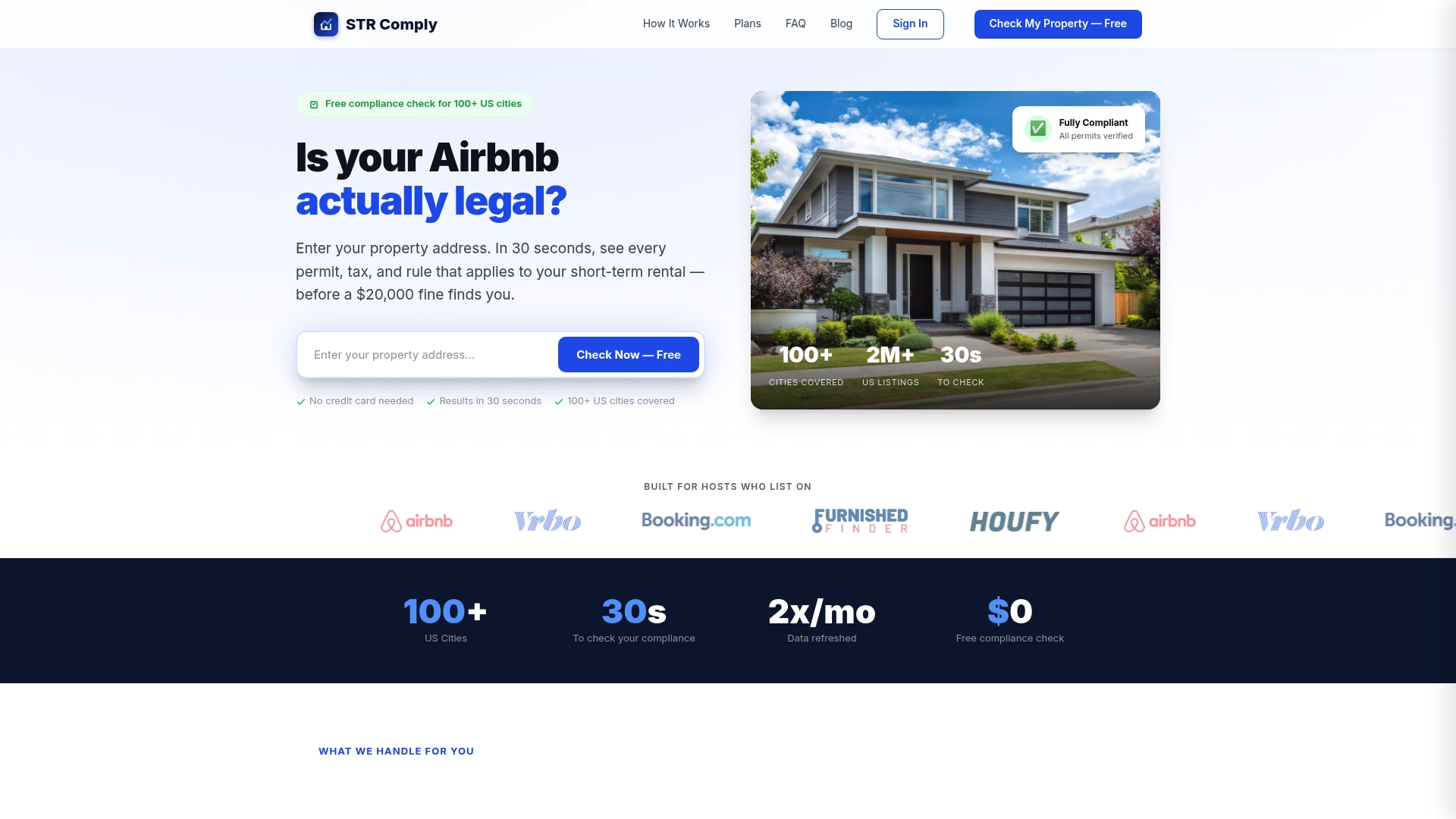
With Strcomply, you can check your Airbnb’s legality in under 30 seconds, getting a detailed summary of permit requirements, tax obligations, and operational restrictions specific to your city. For hosts managing multiple properties across different markets, the Strcomply platform offers portfolio dashboards, permit tracking, and renewal alerts that keep your entire operation compliant without requiring hours of legal research. Whether you are confirming compliance on a new acquisition or tracking renewals across an existing portfolio, Strcomply gives you the clarity and confidence to manage your properties without regulatory blind spots.
FAQ
What is short-term rental portfolio management?
Short-term rental portfolio management is the practice of overseeing multiple short-term rental properties using systems, tools, and processes to maximize revenue, maintain operational quality, and stay legally compliant across all listings.
How many properties can one person manage without a team?
Most experienced hosts recommend a maximum of three to five properties before bringing on a co-host or virtual assistant, as guest communication, cleaning coordination, and compliance tracking become unmanageable beyond that threshold without support.
What tools are needed for managing a rental portfolio?
The core short-term rental portfolio management tools include a Property Management System, a channel manager, a dynamic pricing tool, and a compliance tracker to monitor permits and tax obligations across multiple markets.
How does dynamic pricing help rental portfolio performance?
Dynamic pricing increases rental income by 20 to 40 percent by automatically adjusting nightly rates based on real-time demand, seasonality, and competitor activity, which improves both occupancy and average daily rate simultaneously.
Why is compliance tracking critical for portfolio managers?
Operating without valid permits or failing to remit transient occupancy taxes can result in significant fines, forced closures, and platform de-listing. Tracking permit renewal deadlines for every property protects your revenue and your legal standing in each market.
Recommended
Check your city's STR regulations
Free compliance reports for 100+ US cities. Permits, taxes, zoning — all in one place.
Check My Address — Free