
Operating a vacation rental in the United States means navigating a maze of local regulations that vary dramatically from one city to the next. Miss a single permit step and you risk financial penalties, forced shutdowns, or having your listing removed from platforms like Airbnb or VRBO entirely. This guide breaks down the core permit criteria every U.S. host needs to understand, walks through real requirements in major cities, and highlights the compliance pitfalls that catch even experienced operators off guard. Whether you manage one property or a growing portfolio, staying ahead of local rules is essential to protecting your rental income.
Table of Contents
- Core criteria for vacation rental permits in the U.S.
- Local permit requirements: city-by-city breakdown
- Comparison of city permit requirements
- Navigating edge cases and compliance pitfalls
- Why permit compliance is more than paperwork
- Simplify permits and stay compliant with STR Comply
- Frequently asked questions
Key Takeaways
| Point | Details |
|---|---|
| Local rules lead | Permit requirements are set mainly at the city or county level, so hosts must research local laws specifically. |
| Documentation is critical | Applications typically require proof of ownership, identification, business certification, and inspection records. |
| Eligibility matters | Many cities tie permit eligibility to occupancy, primary residence, and other zoning restrictions. |
| Enforcement risks | Noncompliance can lead to fines and platform removal, not just denial of permit. |
| Expert navigation | Using specialized platforms can simplify research and ongoing permit tracking for hosts. |
Core criteria for vacation rental permits in the U.S.
With the challenge outlined, let’s get specific on what permit requirements typically entail. Permit requirements are primarily local, involving city registration, zoning, safety compliance, business licenses, and tax obligations. There is no federal standard. Every municipality writes its own rulebook, and the differences can be significant.
Understanding the typical categories will help you build a reliable compliance checklist. Here are the major areas you will encounter in most U.S. markets:
-
City-level registration or licensing. Most cities require hosts to register their short-term rental (STR) with a local authority before accepting any guests. This usually means completing an application, paying a fee, and receiving a permit number that must be displayed on your listing. Read more about what this process involves in this rental registration overview for STR hosts.
-
Zoning and eligibility rules. Your property must be located in a zone that allows short-term rentals. Many cities also limit eligibility based on whether the unit is your primary residence, how many nights you can rent it per year, or what type of dwelling it is. Condos, single-family homes, and multi-unit buildings often face different rules.
-
Safety and inspection obligations. Cities frequently require properties to pass a safety inspection before a permit is issued or renewed. Common requirements include working smoke detectors, carbon monoxide alarms, fire extinguishers, and clearly marked emergency exits. Review the specific inspection rules for rentals to understand what inspectors typically look for.
-
Tax registration and remittance. Hosts are generally required to register for local transient occupancy tax (TOT), which is a tax charged to guests on a per-night basis. You must collect this from guests and remit it to the city or county on a scheduled basis. Failure to do so carries its own set of penalties, separate from permit violations.
-
HOA and building rules. Even if the city approves your permit, your homeowners association or building management may prohibit short-term rentals outright. These restrictions are private agreements and are enforced independently of municipal rules. Always check both.
Important: Meeting one category of requirements does not substitute for the others. A valid city permit does not override an HOA ban, and tax registration does not replace a zoning clearance.
Pro Tip: Before you apply for any permit, pull up your local zoning map and verify your property’s classification. Many hosts waste time completing applications only to discover their property is ineligible before the process even begins.
Local permit requirements: city-by-city breakdown
Now, let’s explore how these criteria play out in specific cities, showing practical permit requirements in action. The differences between markets are striking and underscore why hosts cannot rely on assumptions when operating across multiple cities.
Houston, Texas
Houston has established a formal STR registration framework that carries real enforcement weight. Houston requires an STR certificate, and failure to obtain one can trigger platform delisting, meaning your listing can be removed from booking platforms following a permit denial or revocation. The city also enforces nuisance and noise violation rules, and repeat offenders face escalating penalties.
Key requirements in Houston include:
- Completing a certificate of registration application with the city
- Posting your registration number on all listing platforms
- Complying with noise ordinances and neighborhood conduct rules
- Renewing the certificate on the schedule set by the city’s administration
Hosts who receive nuisance complaints risk losing their certificate entirely. The platform delisting consequence is particularly serious because it cuts off revenue immediately. Refer to these Airbnb registration steps to make sure your listing setup aligns with what the city requires.
San Francisco, California
San Francisco runs one of the stricter STR programs in the country. San Francisco ties eligibility to primary residence status and occupancy, meaning you must actually live in the unit as your principal home. Hosts must occupy the residence for at least 275 nights per year, which significantly limits how many nights they can rent it out. The city also requires quarterly reporting of rental activity.
Key requirements in San Francisco include:
- Registering with the Office of Short-Term Rentals (OSTR)
- Obtaining a business registration certificate from the city
- Proving primary residency through documentation such as a voter registration card or utility bills
- Submitting quarterly rental activity reports to the OSTR
The quarterly reporting requirement is often overlooked by new hosts, but failing to file on time can jeopardize your registration status. Familiarize yourself with the permit renewal steps that apply in regulated markets like San Francisco to avoid lapses.
Miami Beach, Florida
Miami Beach is known for one of the most document-intensive STR application processes in the United States. Miami Beach requires a Certificate of Use, a recorded warranty deed, an operator ID, and additional supporting documentation before a host can legally operate. The city has faced significant community pressure over the impact of vacation rentals in residential neighborhoods, which is reflected in its strict process.
Key requirements in Miami Beach include:
- Obtaining a Certificate of Use and Business Tax Receipt
- Submitting a recorded warranty deed showing property ownership
- Registering for a state vacation rental license through the Florida Department of Business and Professional Regulation
- Providing proof of liability insurance coverage
- Displaying the operator ID on all listings and marketing materials
Pro Tip: Miami Beach periodically updates its requirements, and failing to track changes can mean your previously valid permit no longer meets current standards. Monitor market controls and compliance updates regularly to stay current.
Comparison of city permit requirements
Having seen individual city requirements, let’s lay them side-by-side to highlight major similarities and differences. This comparison makes it clear that no two cities follow the same path, and hosts operating across markets need to manage each set of rules independently.
| Requirement | Houston | San Francisco | Miami Beach |
|---|---|---|---|
| Registration/permit type | Certificate of Registration | OSTR Registration + Business Certificate | Certificate of Use + Business Tax Receipt |
| Primary residence rule | Not required | Required (275+ nights/year) | Not required |
| Proof of ownership | Not specifically listed | Primary residency docs | Recorded warranty deed |
| Safety inspection | Yes | Yes | Yes |
| Tax registration | Transient occupancy tax | Transient occupancy tax | State + local TOT |
| Reporting requirement | Ongoing compliance | Quarterly reports | Annual renewal |
| Platform delisting risk | Yes, enforced | Yes, via OSTR | Yes, via state license |
| Operator ID on listing | Yes | Yes | Yes |
Houston, San Francisco, and Miami Beach each have distinct documentation requirements, eligibility rules, and enforcement mechanisms. The table above illustrates that while the categories are similar, the specific standards within each category vary widely.
One major point of divergence is tax administration. Understanding your full STR tax obligations is critical in every market. Some cities collect taxes directly from platforms under marketplace facilitator laws, while others require hosts to register and remit independently. In Miami Beach, hosts must manage both state-level and local transient occupancy tax obligations, which means two separate registration and remittance tracks.
Another area of divergence is reporting frequency. Houston focuses on ongoing compliance through incident response, while San Francisco mandates structured quarterly reporting. This distinction matters when building your operational calendar, since missing a reporting deadline in San Francisco carries administrative consequences regardless of whether any other violations have occurred.
Navigating edge cases and compliance pitfalls
Even after you clear the main requirements, hosts need to watch for hidden compliance challenges that could jeopardize their business. Several categories of risk exist beyond the standard permit checklist, and they catch many hosts by surprise.

Caps and oversaturation controls. Some cities limit the total number of STR permits issued within a given neighborhood or citywide. Zoning rules and city-imposed caps or waiting periods can block STR approval even if your property otherwise qualifies. In markets with caps, being second in line means waiting indefinitely.
Eligibility tied to ownership and eviction history. Certain cities will deny a permit if the applicant has a recent history of evicting tenants or converting long-term rental units to short-term use. This is an increasingly common restriction as cities try to protect housing supply. If you recently purchased a property that was previously a long-term rental, check whether your city has conversion restrictions before applying.
HOA and building rules as a separate hurdle. Even a fully permitted property can be shut down if the HOA votes to ban or restrict STRs. HOA enforcement typically involves fines and legal action under the association’s covenants, conditions, and restrictions (CC&Rs). Hosts in condos or planned communities must review their CC&Rs before listing, not after.
Key pitfalls to watch for include:
- Permit caps that limit availability by zone or neighborhood
- Waiting lists in markets where demand for permits exceeds the cap
- Ownership requirements that disqualify recently purchased or converted properties
- Occupancy rules that require you to be present during guest stays in some cities
- Noise and nuisance violations that can trigger permit suspension even without a formal complaint process
Important: Platform delisting is a real enforcement consequence following permit denial or revocation. It is not a theoretical risk. Cities coordinate with platforms, and non-compliant listings are removed from search results, cutting off booking revenue immediately.
Pro Tip: Set a recurring calendar reminder to review your permit renewal guide checklist at least 60 days before your permit expiration date. Many cities do not send renewal notices, and a lapsed permit is treated the same as having no permit at all.
Why permit compliance is more than paperwork
Let’s step back and rethink what permit compliance really means for your rental operation. Most hosts approach compliance as a one-time administrative task, something to handle at setup and then forget about. That framing is a liability.
Permit compliance is directly tied to your ability to generate revenue. Platform delisting and loss of rental income can result from permit denials, not just from missing other legal obligations. When a listing is removed from a platform, there is no grace period. Bookings stop immediately, and in peak seasons, that can mean thousands of dollars in lost income within days.
The compliance landscape also shifts. Cities update their rules, add new eligibility requirements, or change renewal procedures with little notice. A property that was fully compliant last year may face new conditions this year. Treating compliance as a set-and-forget task puts your entire operation at risk of being blindsided by a regulatory update.
There is also a reputational dimension. Hosts who operate without proper permits and get caught are not just subject to fines. They can be listed as violations in public records, which affects how neighbors, HOAs, and future city officials view short-term rentals in that area. Responsible operation protects not just your own business but the broader STR ecosystem in your market.
The most effective operators treat compliance as an ongoing business function, not a one-time checkbox. They monitor regulatory updates across their markets, track permit expiration dates, and review eligibility rules before expanding to new properties. That discipline separates operators who build stable rental businesses from those who are constantly reacting to compliance emergencies.
The overlooked reality is that eligibility rules catch more hosts off guard than documentation requirements. You can have every document ready but still be denied because your property does not meet a residency rule or zoning restriction you did not know existed. Checking eligibility first, before investing time in the application, is the single most important habit you can build.
Simplify permits and stay compliant with STR Comply
If permit complexity feels overwhelming, here’s how STR Comply can help you secure your rental’s future. Managing permit requirements across multiple cities, tracking renewal dates, and staying current on regulatory changes demands consistent attention that most hosts and property managers cannot realistically provide on their own.
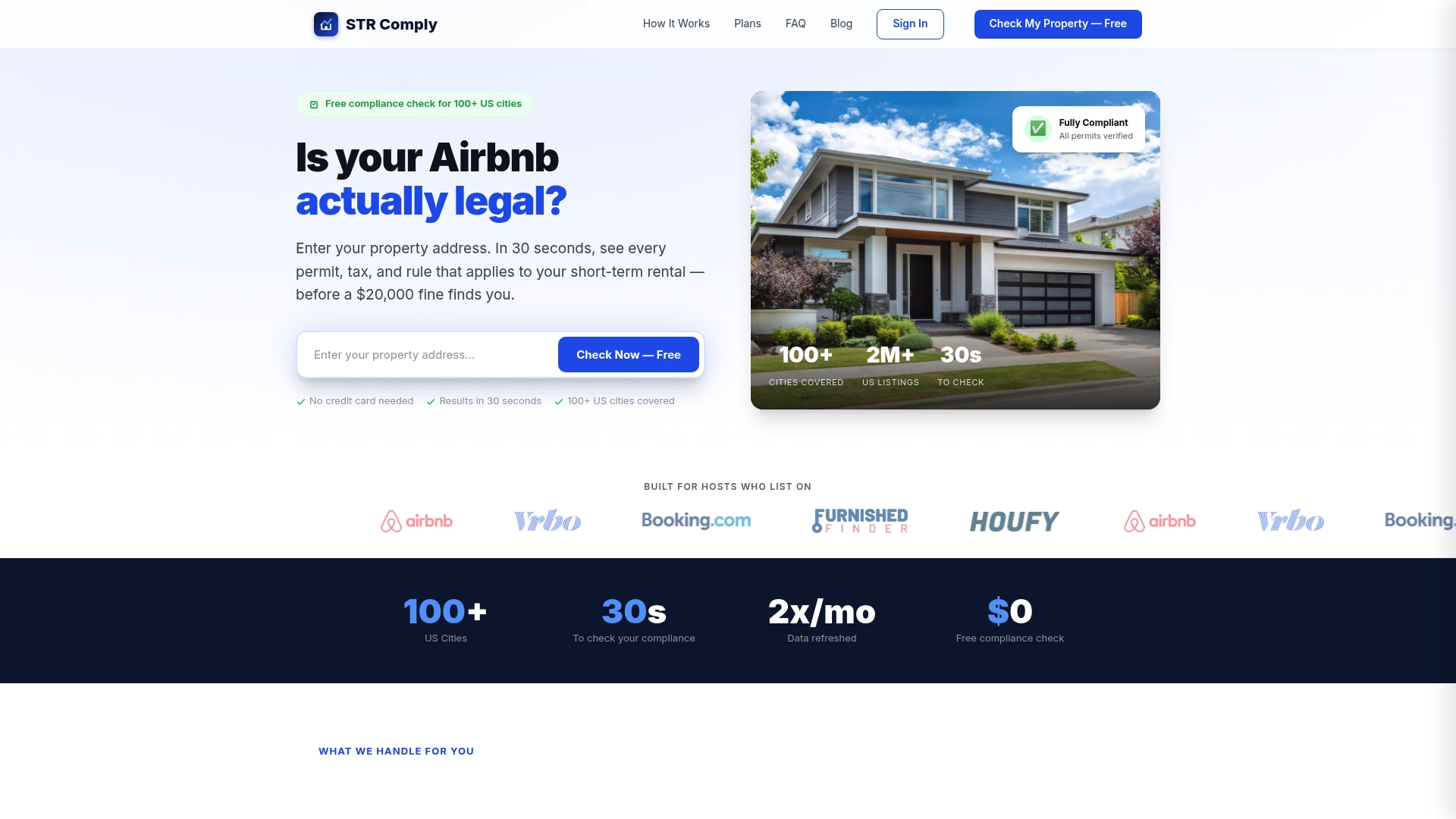
STR Comply gives you a faster path to compliance clarity. You can check permit status instantly for any U.S. property in seconds, receiving a city-specific compliance summary that covers permit requirements, zoning rules, tax obligations, and operational restrictions. No hours of research. No guessing. If you need formal documentation to support your permit application or to demonstrate compliance to a platform, you can get permit documentation directly through the platform. Paid plans add portfolio-level dashboards, renewal alerts, and ongoing regulatory monitoring so you stay ahead of changes, not behind them. Review the terms of service to understand exactly what each plan includes and how STR Comply protects your data and access rights.
Frequently asked questions
Do permit requirements for vacation rentals differ by city in the U.S.?
Yes, every city sets its own registration, zoning, and safety rules. Permit requirements are local and city-specific, with no single statewide standard that applies across the country.
What documentation do I need to apply for a short-term rental permit?
Typical requirements include proof of ownership, an operator ID, business registration, and safety inspection reports. Miami Beach specifically lists a Certificate of Use, a recorded warranty deed, an operator ID, and liability insurance documentation.
Can my vacation rental listing be removed from platforms for permit non-compliance?
Yes, cities like Houston actively delist properties from booking platforms following permit denial or violations. Platform delisting is enforced as a direct consequence of permit revocation, making compliance critical to maintaining active listings.
Are there rules about who can operate a vacation rental in San Francisco?
Yes, hosts must be primary residents who occupy the unit for at least 275 nights per year and submit quarterly rental activity reports. San Francisco requires primary residency along with ongoing occupancy and reporting obligations to maintain a valid STR registration.
Recommended
Check your city's STR regulations
Free compliance reports for 100+ US cities. Permits, taxes, zoning — all in one place.
Check My Address — Free