
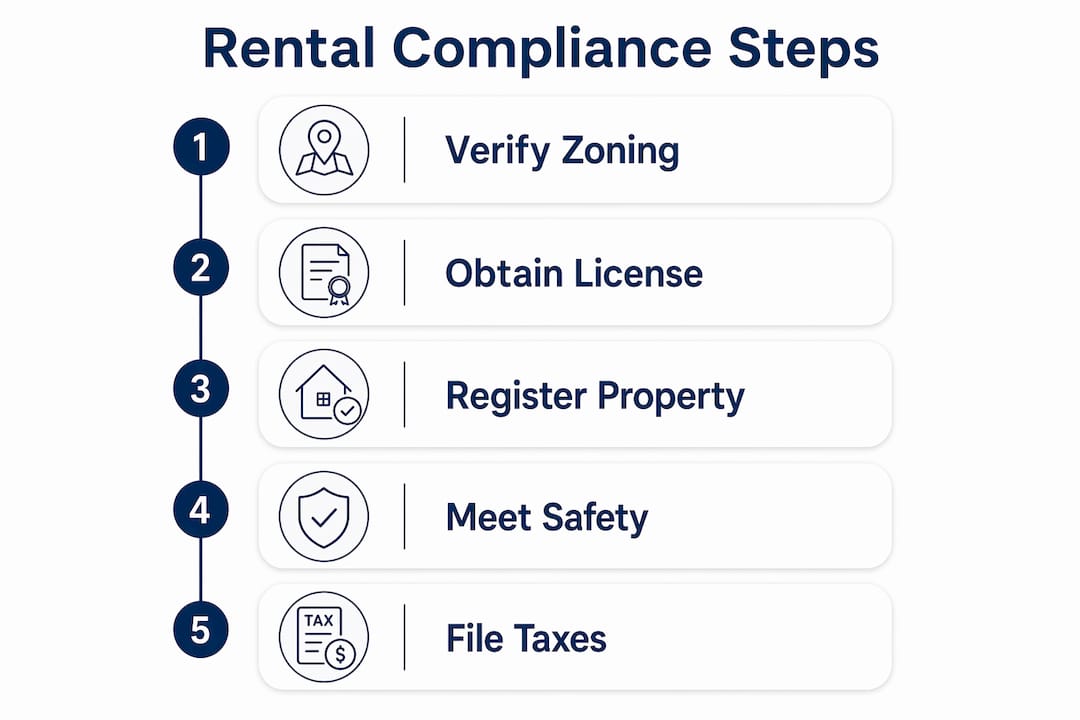
Short-term rental compliance is defined as the full set of legal obligations a host must satisfy to operate an Airbnb, VRBO, or similar listing without facing fines, permit revocation, or de-listing. Knowing how to manage rental legal requirements means addressing five distinct legal layers: zoning, licensing and registration, habitability and safety, tenant rights and disclosures, and tax obligations. Platforms like Strcomply and compliance resources from city portals have made it easier to track these obligations, but the responsibility to verify and act still falls on the host. Skipping any one layer creates real financial exposure.
How to manage rental legal requirements: zoning, licensing, and registration
Zoning laws determine whether a short-term rental is permitted at your address at all. Most U.S. cities classify properties by residential, commercial, or mixed-use zones, and STR activity is restricted or banned outright in many residential zones. Before listing a property, you must check the local zoning code through your city’s planning department or a dedicated STR compliance platform.
Registration and licensing requirements vary sharply by jurisdiction. Mountain View, California, requires STR operators to register, obtain a business license, and file quarterly transient occupancy tax returns even when platforms like Airbnb collect the tax on their behalf. That layered requirement is typical of California cities and is becoming standard across the country in 2026.

One distinction that directly affects your legal exposure is the hosted versus unhosted classification. In Mountain View, unhosted rentals carry a 60-day annual cap, while hosted rentals have no cap. Getting this classification wrong means operating outside your permitted use, which triggers enforcement. Operational policies must align precisely with these legal definitions in your compliance records.
The table below shows how common registration and licensing requirements differ across major U.S. markets.
| City | Registration required | Business license | Annual cap | Hosted/unhosted distinction |
|---|---|---|---|---|
| Mountain View, CA | Yes | Yes | 60 days (unhosted) | Yes |
| Houston, TX | Yes (Certificate of Registration) | No separate requirement | None specified | No |
| New York, NY | Yes (Local Law 18) | No | 2-unit limit | Yes |
| Nashville, TN | Yes | Yes | None (owner-occupied only) | Yes |
| Denver, CO | Yes | Yes | None | Yes |
Pro Tip: Use your city’s official planning portal or a platform like Strcomply to verify your zoning classification before you apply for any license. Applying under the wrong classification wastes time and can trigger a compliance review.
Understanding zoning laws for short-term rentals before you list is the single most effective way to avoid a forced shutdown in the first 90 days of operation.
How do habitability, safety standards, and tenant rights affect compliance?
Habitability requirements are not optional, and state-level preemption laws do not remove them. Even in states that prohibit local STR bans, fire safety codes, occupancy limits, noise rules, and HOA restrictions remain fully enforceable. This is one of the most common misunderstandings among new hosts: a pro-host state law protects your right to operate, but it does not shield you from local building and safety codes.
The core habitability checklist for most U.S. jurisdictions includes:
- Functioning smoke detectors on every floor and in every sleeping area
- Carbon monoxide detectors in any unit with gas appliances or an attached garage
- Clearly posted occupancy limits that match your permit
- Accessible emergency exit routes with no obstructions
- Working locks on all exterior doors and windows
- Proof of a recent property inspection on file
Tenant disclosure obligations are equally binding. In England, landlords must provide a government-issued Information Sheet by May 31, 2026, with civil penalties up to £7,000 for non-compliance. That figure illustrates the financial stakes of disclosure failures globally, and U.S. jurisdictions are moving in the same direction with mandatory disclosure laws at the state level.
Fair housing laws apply to short-term rentals in most U.S. states. Refusing a booking based on race, national origin, disability, or familial status violates the Fair Housing Act and exposes hosts to federal enforcement action, regardless of platform policies.
Linking your operational policies to your legal classification prevents the most common compliance gaps. If your property is classified as unhosted, your guest management rules, response-time policies, and occupancy limits must all reflect that classification consistently across your listing, your permit application, and your internal records.
What are the tax obligations for short-term rental operators?
Transient occupancy tax (TOT) and hotel occupancy tax (HOT) are the two primary tax types that apply to short-term rentals in the United States. TOT is levied by cities and counties on the gross rental receipts from stays typically under 30 days. HOT applies in states like Texas, where the obligation spans multiple jurisdictions simultaneously.
Houston is the clearest example of multi-jurisdictional tax complexity. Houston STR operators must manage hotel occupancy tax filings across state, county, and city levels, totaling 17% of gross receipts. Harris County alone collects a 4% tax requiring quarterly reports. Failure to file at any one level risks fines and operational shutdown, even if the other levels are current.
The critical mistake many hosts make is assuming that platform remittance covers all obligations. Hosts must verify local tax filing requirements and reconcile platform-collected amounts against their own records each filing period. Platforms like Airbnb remit tax in some jurisdictions but not all, and the host remains legally liable for any shortfall.
Common tax reporting mistakes to avoid:
- Assuming platform remittance covers all local and county obligations
- Missing quarterly filing deadlines because no calendar reminder is set
- Failing to reconcile platform tax reports against your own gross receipts
- Not registering for a local tax account before your first booking
- Overlooking county-level taxes when only city-level taxes are prominently listed
Pro Tip: Set up a dedicated compliance calendar with quarterly TOT and HOT filing dates marked 30 days in advance. Cross-reference your platform tax summary reports against your own booking records every quarter to catch discrepancies before the filing deadline.
For a detailed breakdown of how TOT works across jurisdictions, the transient occupancy tax guide from Strcomply covers filing schedules, rate tables, and reconciliation steps.
How to build and maintain an effective rental compliance program
A compliance program is only as strong as its documentation. The most common failure point is documentation drift: owners renew licenses and complete repairs but fail to update compliance records, leaving a gap between what was done and what can be proven during an audit. A retention schedule that links each legal requirement to its proof document and renewal date is the foundation of any working compliance program.
Building that program requires four concrete steps:
- Create a compliance register. List every legal obligation that applies to your property: zoning classification, business license, STR registration, TOT account, safety inspection, and any HOA approvals. Assign a renewal date and a proof document to each item.
- Set a review cycle. Review the full register quarterly. Regulations change, and a requirement that did not exist last year may apply today. Cities like Denver and Nashville have updated their STR ordinances multiple times since 2022.
- Store proof documents centrally. Keep digital copies of all permits, inspection reports, tax filings, and correspondence with local agencies in one location. Cloud storage with version control works well for portfolios of more than three properties.
- Respond to audits with a prepared package. When a city inspector or tax authority requests documentation, you should be able to produce a complete compliance file within 24 hours. Hosts who cannot do this face extended investigations and higher penalty exposure.
Technology reduces the manual burden significantly. Platforms built for STR compliance monitoring send renewal alerts, track regulatory changes by city, and flag permit expirations before they become violations. For hosts managing multiple markets, this kind of automated monitoring is not a convenience. It is a risk control measure.
Pro Tip: Review your essential compliance documents checklist at least once per quarter. Regulations in high-demand markets like Austin, Scottsdale, and Miami update frequently, and a permit that was valid in January may require renewal or amendment by April.
Key takeaways
Managing short-term rental legal requirements demands a documented, jurisdiction-specific compliance program that covers zoning, licensing, safety, tenant rights, and tax obligations without exception.
| Point | Details |
|---|---|
| Zoning comes first | Verify your property’s zoning classification before applying for any license or listing on any platform. |
| Hosted vs. unhosted matters | Your legal classification determines occupancy caps, local contact rules, and operational policy requirements. |
| Tax remittance is your responsibility | Platform collections do not eliminate your obligation to file and reconcile at every applicable jurisdiction level. |
| Documentation drift is the top audit risk | Maintain a compliance register that links each requirement to its proof document and renewal date. |
| Safety codes survive state preemption | Fire, CO, occupancy, and HOA rules remain enforceable even in pro-host states. |
Why most hosts underestimate the complexity of rental compliance
After working closely with short-term rental operators across dozens of U.S. markets, the pattern I see most often is not willful non-compliance. It is underestimation. Hosts assume that registering once and letting the platform handle taxes covers the full obligation. It does not, and the gap between that assumption and reality is where most enforcement actions originate.
The hosted versus unhosted distinction is a perfect example. Most hosts I speak with have never read the specific language in their city’s STR ordinance that defines these categories. They list their property, set their rules, and move on. Then an audit reveals that their operational setup does not match their registered classification, and suddenly they are facing a retroactive violation for every night they operated outside their permitted use.
The other pattern I find consistently underestimated is the speed at which local regulations change. A city that had no STR registration requirement in 2023 may have a full permit-and-inspection regime by 2026. Hosts who set up their compliance once and never revisit it are operating on outdated assumptions. Continuous review is not bureaucratic overhead. It is the only way to stay legally protected in a market where the rules are still being written.
My honest recommendation: treat your compliance program the way you treat your property maintenance schedule. Set fixed review dates, assign responsibility, and document everything. The hosts who avoid enforcement are not the ones who know the most about the law. They are the ones who have the best systems for tracking it.
— Jure
How Strcomply simplifies your compliance management
Strcomply is built specifically for short-term rental hosts and property managers who need to track legal requirements across multiple U.S. markets without spending hours on city portals and tax authority websites. The platform provides city-specific compliance summaries covering permits, zoning, TOT obligations, and operational restrictions for Airbnb and VRBO listings. Paid plans include a portfolio dashboard with permit tracking, renewal alerts, and regulatory update notifications so you never miss a filing deadline or a rule change. Before you commit to a new market or renew an existing permit, review the Strcomply terms of service and run a free compliance check to see exactly where your listing stands.
FAQ
What is short-term rental business compliance?
Short-term rental business compliance is the process of meeting all local, state, and federal legal requirements to operate a rental property legally, including zoning approvals, permits, safety standards, tax filings, and tenant disclosure obligations.
Why comply with local rental laws if platforms handle some requirements?
Platforms like Airbnb remit tax in select jurisdictions but do not cover all local and county obligations. Hosts remain legally liable for any unfiled returns, unregistered properties, or safety violations regardless of platform policies.
What are common examples of rental compliance violations?
Common violations include operating without a valid STR registration, exceeding permitted occupancy limits, missing quarterly TOT filings, failing safety inspections, and misclassifying a property as hosted when it operates as unhosted.
How do I maintain rental compliance across multiple markets?
Maintain a compliance register for each property that lists every applicable requirement, its renewal date, and its proof document. Review the register quarterly and use a compliance platform with automated alerts to track regulatory changes by city.
What are the top short-term rental compliance platforms in 2026?
Strcomply offers free compliance checks and paid portfolio management with permit tracking and renewal alerts for U.S. hosts. Other compliance-focused tools exist in the market, but Strcomply is purpose-built for the STR industry with city-specific regulatory data.
Recommended
Check your city's STR regulations
Free compliance reports for 100+ US cities. Permits, taxes, zoning — all in one place.
Check My Address — Free