
If you rent your property on Airbnb or VRBO, you’ve likely heard the phrase “stay compliant” more times than you can count. But what is regulatory monitoring for short-term rentals, exactly? It goes well beyond getting a one-time permit. Regulatory monitoring, also referred to as compliance oversight in the industry, is an ongoing process that authorities use to verify that your listing meets licensing, safety, occupancy, and tax requirements continuously. This guide breaks down every layer of that process, with real jurisdiction examples and practical steps to keep your rental on the right side of the law.
Table of Contents
- Key Takeaways
- What regulatory monitoring for short-term rentals actually means
- How data sharing powers compliance enforcement
- Local case studies showing monitoring in practice
- Common pitfalls in compliance monitoring for STR hosts
- Best practices for staying compliant with monitoring requirements
- My take on what regulatory monitoring really demands
- How Strcomply helps you stay on top of monitoring requirements
- FAQ
Key Takeaways
| Point | Details |
|---|---|
| Monitoring is ongoing, not one-time | Compliance requires regular renewals, inspections, and tax filings, not just an initial permit. |
| Data accuracy determines risk | Incorrect addresses or expired registration numbers trigger automated enforcement flags. |
| Rules vary by location and property type | Zoning, building type, and jurisdictional boundaries shape your specific compliance profile. |
| Platforms are enforcement partners | Digital platforms collect and transmit host and listing data directly to regulatory authorities. |
| Technology reduces compliance risk | Using a dedicated tracking tool keeps deadlines, renewals, and regulatory changes from slipping through. |
What regulatory monitoring for short-term rentals actually means
Regulatory monitoring for short-term rentals is the continuous process by which authorities verify that each active listing complies with all applicable local laws. This includes checking whether licenses are current, whether safety standards are met, whether occupancy rules are followed, and whether tax obligations are being fulfilled. The key word is continuous. It does not stop after your first registration.
The distinction between registration and ongoing monitoring matters a great deal. Registration gets you a permit number and officially records your property. Monitoring is the mechanism that confirms you remain compliant every week, month, and year after that. Authorities use data signals from booking platforms, city databases, and inspection records to conduct these checks.
The core elements of regulatory oversight in rentals include:
- License and registration validity checks: Authorities verify that your permit has not expired and that the registration number displayed on your listing matches official records.
- Safety and occupancy verification: Inspections and documentation confirm that your property meets fire safety, electrical, and structural standards, and that guest limits are not exceeded.
- Tax compliance reviews: Jurisdictions cross-reference booking volume data with your reported transient occupancy tax or hotel occupancy tax filings.
- Data reporting obligations: Many cities now require platforms to submit periodic reports on host activity, which regulators compare against registered listings.
Pro Tip: Review your license requirements annually. Regulatory requirements change, and what satisfied a city auditor last year may not meet current standards.
How data sharing powers compliance enforcement
The relationship between booking platforms and government agencies has shifted significantly. Platforms are no longer passive intermediaries. In many jurisdictions, they are active participants in regulatory oversight, required by law to collect, verify, and transmit host data to authorities.
The most significant framework shaping this relationship is EU Regulation 2024/1028, which establishes a Single Digital Entry Point for collecting standardized short-term rental data across member states. While this regulation applies to Europe, it is setting a precedent that regulators worldwide are watching closely. The framework enters application on May 20, 2026, and it fundamentally changes how host and listing data flows to national authorities.
Here is what platforms are now required to collect and report under this type of framework:
| Data Type | Purpose |
|---|---|
| Full property address | Verified against official zoning and permit records |
| Registration number | Cross-checked for validity and expiration status |
| Dates of stay | Used to calculate tax liability and occupancy patterns |
| Guest count per booking | Compared against maximum occupancy limits |
| Booking type (short vs. long) | Determines applicable licensing category |
“Platforms must collect and transmit verified host, listing, and transaction data to national authorities. Listings with invalid or missing registration numbers can be automatically suspended.” — EU Regulation 2024/1028 enforcement mechanism
This automated cross-check model changes enforcement dramatically. A listing with a mismatched address or an expired registration number does not require a human inspector to trigger action. The data discrepancy does it automatically. That shift means hosts face real consequences from administrative errors alone, not just deliberate violations.
Local case studies showing monitoring in practice
Abstract frameworks only tell part of the story. Looking at specific U.S. cities reveals exactly how monitoring rental compliance plays out in practice.
Austin, Texas operates one of the more detailed short-term rental license systems in the country. Licenses are valid for two years, with renewal required 60 days before expiration. Hosts must collect and remit Hotel Occupancy Taxes quarterly, and platforms are also obligated to collect and remit on the host’s behalf in many cases. Austin differentiates between Type 1 owner-occupied and Type 2 non-owner-occupied licenses, each with different eligibility rules based on zoning. Missing the renewal window is an enforcement trigger, not a grace period.

Sarasota, Florida requires hosts to hold a vacation rental certificate before accepting any guests. Certificates are renewed annually and require a safety inspection before issuance. The minimum stay is seven nights, and renting without a current certificate is a code violation subject to fines. Sarasota’s approach illustrates how inspection requirements tie directly to the ongoing compliance calendar, not just the initial application.
Pinellas County, Florida takes a layered approach. Hosts must obtain a Certificate of Use, comply with a maximum occupancy of 10 guests, observe quiet hours from 10 p.m. to 9 a.m., and pass safety inspections before the certificate is issued. Certificates renew annually, and safety inspections recur every two years. This cadence reflects a philosophy that monitoring includes ongoing behavioral compliance, not just document filing.
Spokane, Washington links permit validity directly to building code compliance, liability insurance requirements, and guest limits. Permits can be revoked if any of these conditions lapse. Spokane’s model shows that monitoring is multidimensional. Letting your insurance policy expire is just as much a compliance failure as not having a permit at all.
Pro Tip: Build a jurisdiction-specific compliance calendar for each property you manage. Include permit renewal dates, inspection windows, tax filing deadlines, and insurance renewal dates in one place to avoid any single item falling through.
| Jurisdiction | License Cycle | Inspection Required | Tax Obligation |
|---|---|---|---|
| Austin, TX | 2-year license, 60-day renewal window | No mandatory inspection | Hotel Occupancy Tax quarterly |
| Sarasota, FL | Annual certificate renewal | Yes, before issuance | State and local tourist tax |
| Pinellas County, FL | Annual Certificate of Use | Yes, biennial safety inspection | County tourist development tax |
| Spokane, WA | Annual permit renewal | Tied to building code | Washington state lodging tax |
Common pitfalls in compliance monitoring for STR hosts
Most compliance failures do not come from deliberate rule-breaking. They come from misunderstanding what regulatory monitoring actually requires over time, or from small data errors that compound into enforcement actions.
The most dangerous misconception is treating registration as a one-time task. Regulatory monitoring is a rolling compliance calendar with checks that extend well beyond the original application. Biennial inspections, annual renewals, and quarterly tax filings all require active attention.
Here are the most common pitfalls hosts and property managers encounter:
-
Expired registration numbers on live listings. When your permit lapses but your Airbnb or VRBO listing still shows the old number, automated data checks flag the discrepancy. The platform may suspend the listing before you even receive a notice from the city.
-
Incorrect address formatting. A minor difference between the address on your permit and the address on your listing, such as “Ave” versus “Avenue,” can cause a mismatch in automated cross-checks. Data accuracy is what modern enforcement systems rely on, not just permit possession.
-
Assuming one license covers multiple units. If you manage several properties, each unit typically requires its own permit. Zoning and building type variances mean the rules for a downtown condo are often different from those for a suburban single-family home, even in the same city.
-
Misaligning tax reports with platform data. If your platform submits booking volume data to the city and your tax return shows a lower number, that gap becomes an audit trigger.
-
Missing inspection windows. In jurisdictions like Pinellas County, inspections are required on a set schedule. Missing the window does not pause enforcement. It creates a violation.
Pro Tip: Set calendar reminders 90 days before any permit, certificate, or insurance renewal date. Ninety days gives you enough time to gather documents, schedule inspections, and resolve any issues without rushing.
Best practices for staying compliant with monitoring requirements
Staying ahead of regulatory requirements for rentals requires a systematic approach. Ad-hoc checks are not reliable when you are managing multiple properties or operating in more than one jurisdiction.
The following practices form a solid foundation for ongoing compliance:
- Keep all registration documents current and accurate. Update your permit records immediately if your property address, contact information, or ownership status changes. Small discrepancies trigger automated flags.
- Display registration numbers correctly on all listings. Every platform listing should show the exact registration number as it appears on your official permit, formatted exactly as the issuing authority records it.
- Schedule inspections proactively. Do not wait for a notice. Review your permit renewal timeline and book required inspections well in advance of the deadline.
- Track occupancy and operational rules at the property level. Review occupancy limits and noise ordinances for each specific property, since these rules vary even within the same city.
- Use a dedicated compliance platform. Spreadsheets become unreliable at scale. A platform that tracks permits, sends renewal alerts, and monitors regulatory updates across jurisdictions reduces the risk of a deadline slipping unnoticed.
- Reconcile your tax filings with platform-reported data. Before submitting any occupancy tax return, confirm the numbers match what your booking platform has on record.
My take on what regulatory monitoring really demands
I’ve worked with enough short-term rental hosts to see the same pattern repeat. A host gets their permit, checks that box, and then is genuinely surprised when enforcement shows up two years later over an expired renewal or a mismatched address. They thought they were done. That assumption is where most compliance problems begin.
What I’ve found is that the shift to automated, data-driven enforcement changes the risk calculus entirely. In the past, a lapsed permit might go unnoticed for months while a city inspector worked through a backlog. Today, a platform’s data pipeline can flag your listing within days of a registration expiring. The gap between law and practice used to be wide enough that reactive compliance worked. That gap is closing fast.
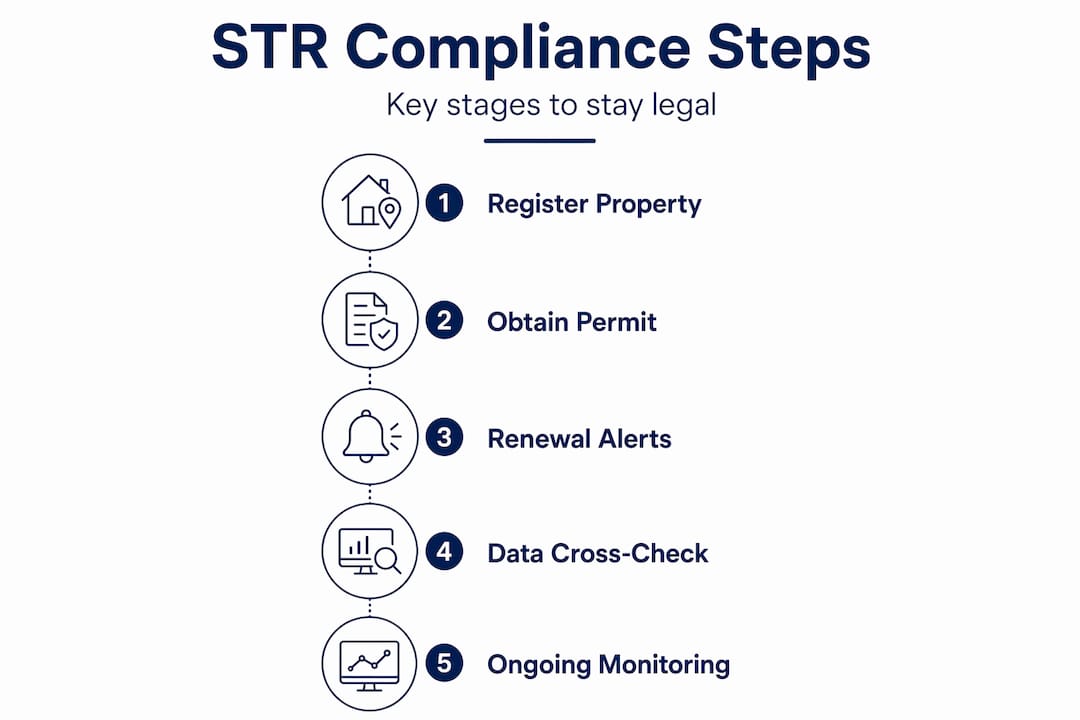
My honest advice is to treat compliance as a property operating cost, not a bureaucratic hurdle. Budget time and money for it the same way you budget for maintenance. Hosts who do this are rarely caught off guard. Hosts who approach it as a one-time task tend to accumulate problems quietly until a fine or a listing suspension forces the issue.
The hosts I’ve seen manage multiple markets successfully all share one trait: they know their compliance calendar at least 90 days out, at every property, at all times. That discipline is what separates operators who scale from those who stall.
— Jure
How Strcomply helps you stay on top of monitoring requirements
Keeping up with short-term rental laws across multiple jurisdictions is time-consuming and technically complex. Strcomply is built to handle exactly that. The platform gives hosts and property managers instant access to city-specific compliance summaries covering permit requirements, tax obligations, zoning restrictions, and operational rules for listings on Airbnb, VRBO, and similar platforms.
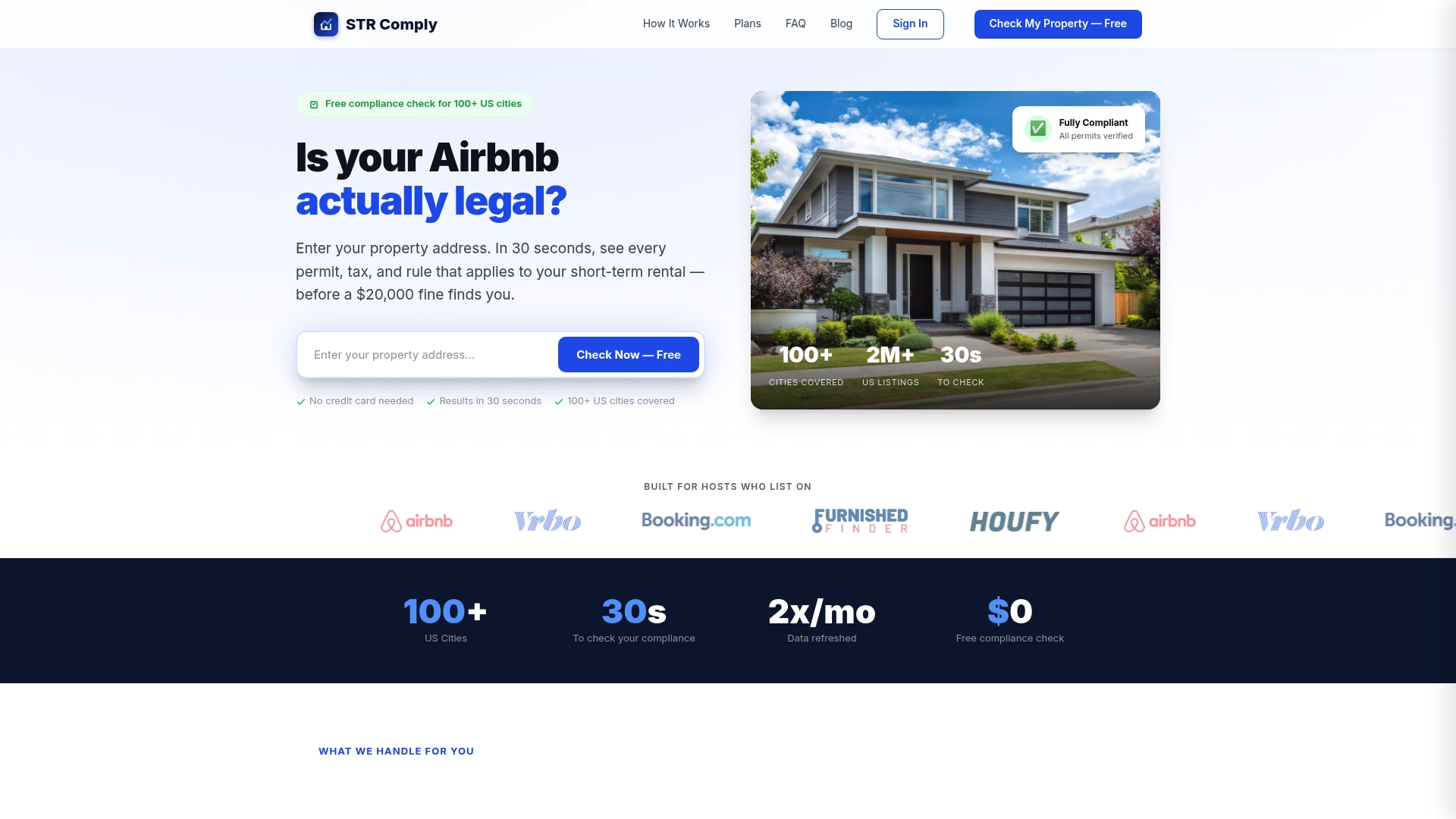
With paid plans, you get a full compliance dashboard that tracks permit status, sends renewal alerts, and monitors regulatory changes so you are never caught off guard by a deadline or a rule update. Whether you manage one property or a portfolio across several states, Strcomply reduces the research burden and helps you maintain ongoing compliance proactively. Review the platform terms to understand exactly what the service covers, and check your first listing for free to see your compliance profile immediately.
FAQ
What is regulatory monitoring for short-term rentals?
Regulatory monitoring is the continuous process by which local authorities verify that short-term rental listings meet all applicable licensing, safety, occupancy, and tax requirements. It goes beyond initial registration to include ongoing renewals, inspections, and data reporting obligations.
How do platforms like Airbnb participate in compliance enforcement?
Platforms collect and transmit host and listing data, including registration numbers, addresses, guest counts, and booking dates, to regulatory authorities. Listings with invalid or expired registration numbers can be automatically suspended based on this data.
How often do short-term rental permits need to be renewed?
Renewal cycles vary by jurisdiction. Austin requires renewal every two years, while Sarasota and Pinellas County require annual certificate renewals. Some jurisdictions also require separate safety inspections on a biennial schedule independent of the renewal date.
What are the most common reasons STR hosts fail compliance checks?
The most common failures involve expired registration numbers still displayed on active listings, address mismatches between permits and listing pages, and missed inspection or renewal windows. Data accuracy is the primary enforcement trigger in automated monitoring systems.
Does regulatory monitoring apply differently based on property type?
Yes. Zoning classifications, building types, and jurisdictional boundaries all affect which rules apply to a specific property. A condominium in one zoning district may face entirely different licensing requirements than a single-family home across the street, even within the same city.
Recommended
Check your city's STR regulations
Free compliance reports for 100+ US cities. Permits, taxes, zoning — all in one place.
Check My Address — Free