
Most rental hosts assume that getting a permit means they’re done with compliance. That assumption is wrong, and it’s costing operators real money. The role of government oversight in rentals extends far beyond a one-time approval. It covers how you list your property, how many guests you host, how often inspectors can visit, and what happens when a neighbor files a complaint. Whether you operate a single Airbnb or manage a portfolio across multiple cities, understanding how government regulation in housing affects your operations is no longer optional. It’s a core part of running a responsible and profitable rental business.
Table of Contents
- Key takeaways
- The role of government oversight in rentals
- Inspection and enforcement practices
- Challenges in short-term rental enforcement
- City case studies: enforcement in practice
- My take on navigating government oversight
- How Strcomply helps you stay compliant
- FAQ
Key takeaways
| Point | Details |
|---|---|
| Oversight goes beyond permits | Getting approved is only the start. Governments monitor ongoing operations, guest counts, and listing compliance. |
| Proactive inspections are growing | More cities are shifting from complaint-driven to scheduled inspections that target health and safety risks. |
| Compliance drift is a real risk | NYC data shows 27% of approved listings later violated guest and occupancy rules after initial approval. |
| City rules vary dramatically | Portland, NYC, Santa Barbara, and Spokane each take different enforcement approaches that require different host strategies. |
| Staying current prevents fines | Monitoring permit renewals, operational restrictions, and regulatory updates reduces your exposure to enforcement action. |
The role of government oversight in rentals
Government oversight in rental housing is the collection of laws, regulations, and enforcement mechanisms that local, state, and federal authorities use to govern how rental properties are operated. For most hosts, this shows up as permit requirements, zoning restrictions, tax collection obligations, and property inspection programs. What surprises many operators is how broad this authority actually reaches.
Here are the core regulatory categories you need to understand:
- Rent control and rent stabilization. These rules cap how much a landlord can increase rent year over year. Rent control typically applies to long-term tenancies, but in some jurisdictions, short-term rental conversions can trigger rent stabilization concerns at the policy level.
- Eviction controls and landlord-tenant laws. Landlord tenant laws set the terms for lease agreements, notice periods, and legal grounds for eviction. Even short-term rental hosts can face tenant protections if a guest occupies a unit long enough to establish residency under state law.
- Rental registration and licensing. Many cities require rental property registration before a unit can be legally listed. Some cities tie registration to annual inspections. Missing this step can result in fines or listing removal.
- Short-term rental permit frameworks. Cities like New York, Portland, and Santa Barbara have created permit-specific frameworks for short-term rentals. These typically include host-present requirements, guest limits, annual fee structures, and renewal deadlines. You can review what these vacation rental permit requirements look like across U.S. jurisdictions before applying.
- Zoning restrictions. Many municipalities limit short-term rentals to specific residential zones or exclude them entirely from certain districts. Zoning laws for short-term rentals determine whether your property is even eligible to operate legally.
- Transient occupancy tax. Most cities require hosts to collect and remit a lodging or occupancy tax on each booking. Failure to comply is one of the most common and fastest-growing enforcement triggers.
Understanding these categories as a connected system, rather than separate isolated rules, is the first step toward managing your compliance obligations effectively.
Inspection and enforcement practices
The way a city enforces rental rules matters just as much as what the rules say. Two broad approaches define most U.S. markets today: complaint-driven enforcement and proactive inspection programs.
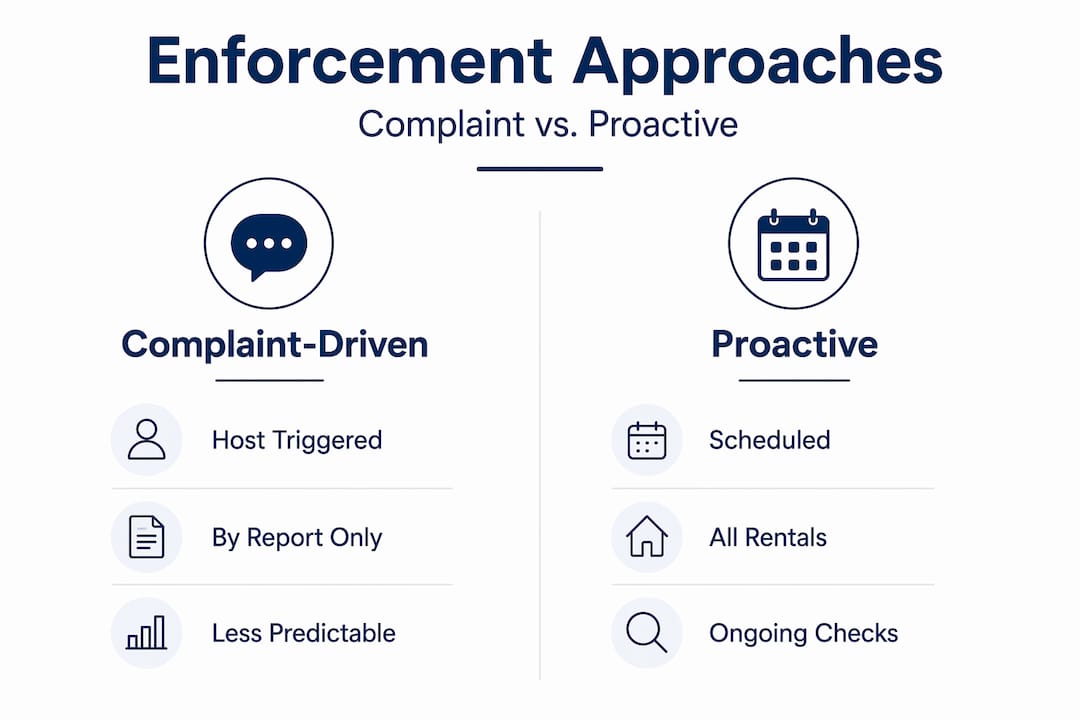
Complaint-driven enforcement means the city only investigates when someone files a report, typically a neighbor, guest, or competing host. The problem with this model is inconsistency. Proactive inspection programs target health and safety hazards such as lead paint, mold, and structural dangers through scheduled visits, which creates a more predictable environment for compliant operators.
The trend is shifting. More cities are adopting proactive rental inspection programs that require registration and regular inspections with penalties for noncompliance. These programs use property data including property age, violation history, and health indicators to prioritize which units get inspected first. Compliant landlords often earn longer intervals between visits, which is a real operational benefit.
For hosts, the practical implications are clear:
- Properties with documented violations face more frequent inspection cycles.
- Noncompliance can trigger license suspension, not just fines.
- Cities using proactive inspection models typically give advance notice and offer a warning before penalties apply.
- Being unprepared for an inspection while actively listing a property is an enforcement risk you can control.
Pro Tip: Review your city’s rental inspection schedule before your next permit renewal. If your city uses a proactive program, request your inspection history so you know exactly what criteria inspectors use when they arrive.
Shifting from reactive to proactive thinking about inspections is one of the most practical changes a host can make. Proactive enforcement leads to reduced tenant displacement and a stronger housing market overall, but for you as an operator, it means inspections can happen regardless of whether anyone files a complaint.
Challenges in short-term rental enforcement
Short-term rentals introduce a specific layer of complexity that standard landlord-tenant oversight frameworks were not designed to handle. The challenges are real, and many operators encounter them only after an enforcement notice arrives.
Here are the most common compliance failures hosts make over time:
- Compliance drift after initial approval. Getting a permit and then gradually drifting away from its conditions is the single most common enforcement trigger. NYC’s Local Law 18 compliance reviews reveal ongoing issues beyond initial approval, emphasizing sustained adherence. Treat your permit conditions as active operational constraints, not a historic checklist.
- Exceeding guest count limits. Most short-term rental ordinances cap guests at two per bedroom or set an absolute maximum. 27% of approved NYC listings were later found in violation due to offering entire-home stays and exceeding guest counts. This is often an unintentional error hosts make when updating their listings.
- Ignoring entire-home rental restrictions. Many cities only permit short-term rentals when the host is present on-site. Renting out an entire unit while absent is illegal in those markets, regardless of what the booking platform allows.
- Missing operational restriction updates. Cities revise rules. A guest limit that was three people last year might be two this year. Tracking rental operational restrictions after initial permitting is an ongoing task, not a one-time review.
- Assuming no complaint means no risk. Complaint-driven enforcement systems often show low citation yields and may disproportionately impact marginalized communities, but receiving no complaints is not the same as operating in compliance. Proactive audits can surface violations regardless of complaint history.
Privacy and data challenges also shape how cities enforce short-term rental rules. Regulators increasingly request booking data from platforms to audit compliance, and hosts who operate under the assumption that their booking activity is invisible to local authorities are taking a significant risk.
City case studies: enforcement in practice

Seeing how specific cities handle the government role in rental market oversight makes the abstract rules concrete. The four examples below represent very different enforcement strategies and carry lessons applicable to any market.
| City | Enforcement Model | Key Host Requirement | Notable Risk |
|---|---|---|---|
| Portland, OR | Complaint-driven, shifting to proactive | Host must register accessory STR | Over 50% of complaints led to no citation, but violations still on record |
| New York City | Registration-based with active audits | Host must be present; no entire-home rentals | 27% of approved listings found out of compliance post-approval |
| Santa Barbara, CA | Permit and nuisance complaint program | Location-specific permitting by zone | Nuisance complaints including noise and parking can trigger permit review |
| Spokane, WA | Permit with neighbor notification | Adjacent property owners must be notified | Permit does not override HOA rules or existing lease terms |
Portland’s experience is particularly instructive. The city’s Ombudsman found that more than half of STR complaints led to no citation, which might seem reassuring. But the recommendation to shift toward proactive enforcement with data-driven prioritization signals that the lenient era of complaint-only oversight is ending. Hosts who relied on low complaint volumes to stay under the radar should recalibrate their approach now.
Spokane’s model highlights something most hosts overlook: a government-issued permit does not cancel out your HOA agreement or lease terms. Many operators discover this conflict after they’ve already started hosting. The city’s requirement that hosts notify adjacent property owners before receiving a permit also creates a local accountability layer that has no direct equivalent in larger cities.
Pro Tip: If you operate in multiple cities, map the enforcement model used in each market. Cities moving toward proactive inspection programs require a fundamentally different compliance posture than those still relying on complaints.
My take on navigating government oversight
I’ve reviewed enough enforcement histories to say with confidence that the hosts who get fined are rarely the ones who were unaware of the rules when they started. They’re the ones who got their permit, set up their listing, and then stopped paying attention.
The impact of oversight on rentals is not static. Rules change. Cities revise guest limits, add new zoning exclusions, and shift enforcement models. I’ve seen operators lose their permits not because they were operating recklessly, but because they missed a renewal notice or didn’t catch a regulation update that changed their allowed occupancy.
What I’ve learned from watching this pattern repeat is that compliance needs to be treated as an operational function, not a startup task. That means scheduling time quarterly to review your permit conditions, checking whether your city has issued any regulatory updates, and making sure your listing accurately reflects your current permit terms. Reading through essential rental compliance documents is a good place to start building that habit.
The other thing I’d push back on is the idea that complaint-driven enforcement means low risk. Enforcement design matters more than just increasing inspections. Focused warnings and data-driven proactive strategies improve equity and effectiveness, and cities are learning this. The ones that make that shift will catch violations that complaint systems missed for years. If you’re banking on staying invisible, that strategy has an expiration date.
— Jure
How Strcomply helps you stay compliant
Keeping up with the government role in rental market rules across multiple jurisdictions is genuinely complex. Strcomply is built specifically for hosts who need to manage that complexity without spending hours on legal research.
With Strcomply’s free compliance check tool, you can verify whether your listing meets current local regulations in seconds, covering permit requirements, tax obligations, and operational restrictions. For hosts managing multiple properties, paid plans include dashboards that track permit renewal deadlines, flag regulatory changes, and alert you before your compliance status lapses. Checking your listing’s legality takes 30 seconds at Strcomply and requires no legal background to interpret the results.
The platform is specifically designed for Airbnb, VRBO, and similar platform operators operating across the U.S. Given that permit approval conditions are ongoing operational constraints rather than one-time checkboxes, having a tool that monitors those constraints continuously is a practical risk management decision. Visit Strcomply to explore compliance plans for individual hosts and portfolio managers.
FAQ
What is government oversight in rental housing?
Government oversight in rental housing refers to the laws, inspections, permits, and enforcement mechanisms local and state authorities use to regulate how rental properties are operated. It covers rent control, landlord tenant laws, registration requirements, zoning restrictions, and short-term rental ordinances.
How does government oversee short-term rentals?
Cities oversee short-term rentals through permit systems, registration databases, tax collection requirements, and inspections. Enforcement ranges from complaint-driven investigations to proactive scheduled audits, depending on the jurisdiction.
Why do approved short-term rental listings get violations?
Permit approval only confirms compliance at the time of registration. Hosts can fall out of compliance later by exceeding guest limits, renting entire homes when presence is required, or missing regulatory updates. NYC data shows 27% of approved listings were later found in violation.
What is a proactive rental inspection program?
A proactive rental inspection program requires landlords to register their units and submit to scheduled inspections, regardless of whether anyone files a complaint. These programs use property data to prioritize inspections and typically reward compliant operators with longer intervals between visits.
Do short-term rental permits override HOA or lease restrictions?
No. As Spokane’s permitting system explicitly clarifies, a city-issued short-term rental permit does not override HOA agreements, lease terms, or other private restrictions. Hosts need to verify all applicable rules before listing, not just government-issued permit terms.
Recommended
Check your city's STR regulations
Free compliance reports for 100+ US cities. Permits, taxes, zoning — all in one place.
Check My Address — Free