
An STR business license is a government-issued authorization that legally permits property owners or managers to operate short-term rental properties within a specific U.S. jurisdiction. This is not the same as listing approval on Airbnb or Vrbo. What are STR business licenses, exactly? They are official permits and registrations that satisfy local government requirements for safety, zoning, and taxation before a single guest checks in. Operating without them exposes you to fines, forced delisting, and in some cities, a permanent ban on future STR activity.
What are STR business licenses and how do they work?
STR business licensing is the process of obtaining government authorization to legally rent a property for short periods, typically fewer than 30 consecutive nights. The term covers two distinct but related documents: a general business license and an STR-specific permit. Both are usually required, and applying for one does not fulfill the other’s requirements.
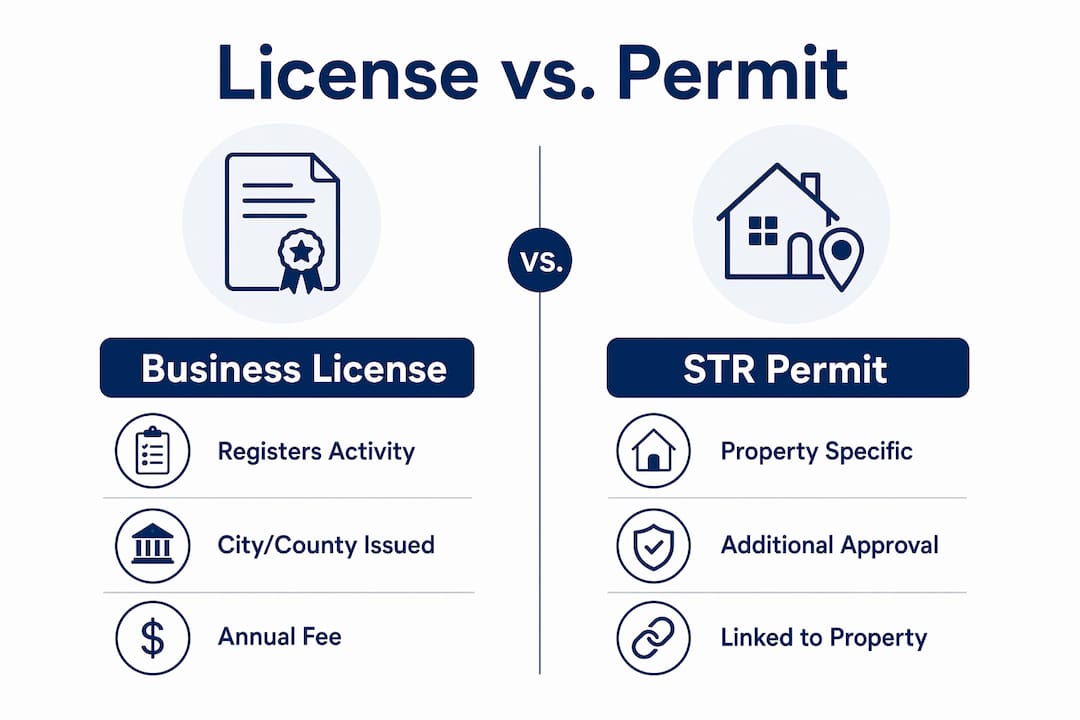
A general business license registers your rental activity as a commercial operation with your city or county. It establishes you as a legal business entity for tax and regulatory purposes. An STR permit goes further. It confirms that your specific property meets local zoning rules, safety standards, and occupancy conditions for short-term rental use.

Cities like San Diego, Albuquerque, and Nashville have built entire regulatory frameworks around this two-document structure. Airbnb and Vrbo both require hosts in regulated markets to enter valid permit numbers on their listings. Without those numbers, the platforms can delist your property automatically.
How do STR permits differ from general business licenses?
The distinction matters because many hosts obtain a general business license and assume they are fully authorized. That assumption is one of the most common compliance failures in the STR industry.
The table below shows the core differences:
| Category | General business license | STR permit |
|---|---|---|
| Purpose | Registers commercial activity with local government | Authorizes a specific property for short-term rental use |
| Issuing authority | City or county clerk | Planning, zoning, or housing department |
| Typical annual cost | $25 to $300 | $50 to $500 |
| Key requirements | Business registration, tax ID | Safety inspection, zoning review, proof of ownership |
| Transferable? | Sometimes | Rarely. Usually property-specific and non-transferable |
The STR permit is property-specific. If you sell the property or change the ownership structure, the permit does not transfer to the new owner. The buyer must apply independently. This is a detail that catches real estate investors off guard, particularly when acquiring existing STR operations.
Most jurisdictions require you to obtain a business license first, then use that registration as a prerequisite to apply for the STR permit. The sequence matters. Skipping the first step will stall your permit application.
Pro Tip: Before applying for an STR permit, confirm with your local planning department whether a general business license is a prerequisite. Some cities process both simultaneously, but most require sequential applications.
What are the typical requirements and fees for STR permits?
The specific requirements vary by jurisdiction, but most U.S. cities and counties follow a recognizable pattern. Understanding what to expect reduces delays and prevents costly mistakes.
Common requirements include:
- Proof of ownership or authorization: A deed, lease, or written landlord consent confirming you have the right to operate the property as an STR.
- Safety equipment compliance: Functioning smoke detectors, carbon monoxide detectors, fire extinguishers, and clearly posted emergency exit information. Inspectors verify these on-site.
- Zoning compliance: Confirmation that your property sits in a zone where STR activity is permitted. Some residential zones prohibit STRs entirely, while others allow them only as a primary residence.
- Liability insurance: Many jurisdictions require a minimum coverage level, often $1 million per occurrence, before issuing a permit.
- Occupancy limits: Typical STR permit conditions include maximum guest counts, often calculated by bedroom count or square footage.
- Operational rules: Noise ordinances, parking restrictions, and in some cities, night caps that limit the total number of rental nights per year.
On the financial side, a general business license runs $25 to $300 per year. An STR permit adds another $50 to $500 annually, depending on the city. Some jurisdictions also charge a one-time application fee on top of the annual renewal cost.
Transient Occupancy Tax (TOT) registration is a separate but closely related requirement. Most cities that regulate STRs also require hosts to register for TOT and remit taxes on rental income, typically between 8% and 15% of gross revenue. TOT registration is not the same as an STR permit, but many jurisdictions require both before you can legally operate.
Pro Tip: Schedule your safety inspection at least four weeks before your planned launch date. Inspectors in high-demand markets like San Diego and Austin are often booked weeks out, and a delayed inspection will push back your entire permit timeline.
What happens if you operate without proper STR licenses?
The consequences of non-compliance are concrete and escalating. Cities have moved well beyond passive enforcement.
- Fines: First-offense fines in cities like San Diego and Albuquerque can reach several thousand dollars per violation. Repeat violations multiply quickly.
- Permit bans: Operating without a permit in cities like San Diego or Albuquerque can result in permanent bans on future STR activity at that address.
- Platform delisting: Airbnb and Vrbo now use automated tools that scan listings for valid permit numbers. A missing or expired permit number triggers automatic removal from search results.
- Back taxes and penalties: Operating without TOT registration creates a tax liability that compounds with interest and penalties over time.
- Property sale complications: An undisclosed STR violation can surface during a title search and delay or derail a property sale.
Cities are increasingly using automated digital monitoring to scan rental platforms for compliance, making the display of a valid permit number on your listing a non-negotiable operational requirement, not just a formality.
STR ordinances in cities like Albuquerque also control neighborhood density by capping the total number of permits available in a given area. In some neighborhoods, permits are awarded through lotteries. This means that even a fully compliant application may not result in a permit if the cap has been reached. Waiting for a permit slot while operating unlicensed is not a legal gray area. It is a violation.
How can hosts maintain ongoing STR license compliance?
Obtaining your license is the starting point, not the finish line. Permit revocation is a real operational risk, and failure to renew or update required inspections is one of the leading causes.
Here is a practical framework for ongoing compliance:
- Calendar all renewal deadlines. Most STR permits and business licenses renew annually. Mark the expiration date and set a reminder 60 days in advance to allow time for inspections and paperwork.
- Schedule re-inspections proactively. Some jurisdictions require a safety re-inspection at each renewal. Do not wait for a notice. Contact the inspection office before your renewal window opens.
- Monitor local regulatory changes. STR regulations in the U.S. are changing faster in 2026 than at any prior point. Cities regularly amend zoning rules, fee structures, and operational restrictions. Subscribe to your city’s planning department newsletter or use a compliance monitoring service.
- Keep documentation current. If your insurance policy renews, your ownership structure changes, or you make physical modifications to the property, update your permit file immediately. Outdated documentation is grounds for revocation.
- Engage with local STR advocacy groups. Organizations like the National Association of Realtors and local host associations often provide early warnings about regulatory changes before they take effect.
You can also use the host compliance checklist from Strcomply to audit your current status across all active listings. For hosts managing multiple properties, a centralized tracking system is not optional. It is the only way to prevent a missed renewal from cascading into a delisting event.
Pro Tip: Contact your local zoning and tax authority directly once a year, even if you believe you are fully compliant. Regulations change, and a five-minute phone call can surface a new requirement before it becomes a violation.
Key takeaways
STR business licenses are legally distinct from general business licenses, and operating without both in regulated U.S. markets exposes hosts to fines, delisting, and permanent permit bans.
| Point | Details |
|---|---|
| Two documents required | A general business license and an STR permit are both typically required and serve different legal purposes. |
| Sequential applications | Most jurisdictions require a business license before an STR permit application can be submitted. |
| Fees and inspections | STR permits cost $50 to $500 annually and require safety inspections, zoning review, and proof of ownership. |
| Non-compliance consequences | Fines, platform delisting, and permanent bans are active enforcement outcomes in cities like San Diego and Albuquerque. |
| Ongoing renewal required | Permit revocation from missed renewals or lapsed inspections is a leading cause of operational disruption for STR hosts. |
Why hosts consistently underestimate STR licensing complexity
The single most persistent mistake I see hosts make is treating Airbnb or Vrbo approval as a proxy for legal authorization. Platform approval means the listing meets the platform’s content standards. It says nothing about whether the property complies with local government requirements. These are entirely separate systems, and local law overrides platform policy every time.
What makes this worse in 2026 is the pace of regulatory change. Cities that had no STR ordinance three years ago now have permit caps, lottery systems, and automated enforcement. A host who was compliant in 2023 may be operating illegally today simply because the rules changed and no one sent a notification.
The other underestimated factor is the non-transferability of STR permits. Real estate investors who acquire properties with existing STR operations often assume the license transfers with the deed. It does not. The new owner must apply from scratch, which can take weeks or months in backlogged markets. During that window, the property cannot legally operate as an STR.
Licensing is not a one-time administrative task. It is an ongoing operational function that requires the same attention as pricing, maintenance, and guest communication. Hosts who treat it that way avoid the expensive surprises. Hosts who do not eventually learn the hard way.
— Jure
Stay compliant with Strcomply
Managing STR business licenses across one property is manageable. Managing them across five or ten properties in different cities is a different problem entirely.
Strcomply is built specifically for this challenge. The platform gives hosts and property managers instant access to city-specific compliance requirements, including permit requirements, tax obligations, zoning restrictions, and renewal deadlines. Paid plans include a portfolio dashboard with renewal alerts, regulatory update notifications, and permit tracking across all your markets. If you are operating in multiple U.S. cities or planning to expand, Strcomply removes the guesswork from STR license management and replaces it with a clear, current picture of your compliance status.
FAQ
What is an STR business license?
An STR business license is a government-issued authorization that permits a property owner or manager to legally operate a short-term rental in a specific jurisdiction. It is distinct from a general business license and typically requires a safety inspection, zoning review, and proof of ownership.
Do I need both a business license and an STR permit?
Most U.S. jurisdictions require both. A general business license registers your commercial activity, while an STR permit authorizes your specific property for short-term rental use. Applying for one does not satisfy the requirements of the other.
How much does an STR permit cost?
STR permit fees typically range from $50 to $500 per year, depending on the city or county. General business licenses add another $25 to $300 annually. Some jurisdictions also charge a one-time application fee separate from the annual renewal cost.
What happens if I operate an STR without a license?
Operating without a valid STR license can result in fines, back taxes, platform delisting from Airbnb or Vrbo, and in cities like San Diego and Albuquerque, a permanent ban on future STR activity at that address.
Does my STR permit transfer when I sell the property?
STR permits are almost always non-transferable and property-specific. A new owner must apply for a fresh permit independently, which means the property cannot legally operate as an STR during the application period.
Recommended
Check your city's STR regulations
Free compliance reports for 100+ US cities. Permits, taxes, zoning — all in one place.
Check My Address — Free