
Assuming that your booking platform handles all the taxes is one of the most costly mistakes a short-term rental host can make. Platforms like Airbnb or Vrbo do not always cover all local taxes, which means you can still have direct obligations to your city or county regardless of what the platform collects on your behalf. Local tax rules vary not just by state, but by city, county, and sometimes even by neighborhood, making it difficult to copy what neighboring hosts do and expect the same results. This guide breaks down what local STR tax obligation actually means, who is responsible for collecting and remitting it, and the exact steps you should take to stay fully compliant.
Table of Contents
- What does ‘local STR tax obligation’ really mean?
- Who is liable for collection and remittance?
- Permits, reporting, and exemptions: Local rules matter
- Beyond occupancy tax: Other local business taxes
- How to determine your property’s local STR tax obligation
- Why most STR tax mistakes happen—and how to avoid them
- Easily verify and manage your STR compliance
- Frequently asked questions
Key Takeaways
| Point | Details |
|---|---|
| Local tax definitions vary | Your obligations depend not just on state law but city and county rules where the property is located. |
| Booking method matters | Platform-facilitated and direct bookings may have completely different tax collection requirements. |
| Registration usually required | Most localities mandate registration and regular reporting, even for exempt or low-volume STRs. |
| More than just occupancy tax | Check for business or gross receipts taxes, which may apply in addition to lodging taxes. |
| Verify with local authority | Always confirm with the city or county to ensure your compliance is accurate and up to date. |
What does ‘local STR tax obligation’ really mean?
With the complexity outlined, let’s nail down exactly what “local STR tax obligation” means for hosts. The term gets used loosely, but it has a specific legal meaning that varies depending on where your property sits.
“Local STR tax obligation” usually refers to jurisdiction-specific lodging or occupancy taxes imposed by the city and/or county on short-term stays. In San Francisco, for example, the transient occupancy tax applies to any rental of 30 days or fewer. These taxes go by many names depending on the jurisdiction:
- Transient occupancy tax (TOT)
- Hotel tax or hotel occupancy tax
- Tourist tax or visitor tax
- Room tax or lodging tax
- Short-term rental tax
The name differs, but the concept is the same. The local government wants a percentage of revenue collected on short stays, and someone needs to collect it from guests and send it to the right authority.
Key distinction: Lodging and occupancy taxes are separate from other taxes that may apply to your STR operation, including sales tax, income tax, and local business taxes. Many hosts focus only on occupancy tax and miss the others entirely.
It is also important to understand that definitions of “short-term” differ by jurisdiction. Some cities define it as any stay under 30 days. Others use a 90-day threshold. A rental that qualifies as long-term and therefore tax-exempt in one county might still be taxable just a few miles away under a neighboring county’s rules. This geographic patchwork is precisely why blanket assumptions about your tax status are so risky.
Rates also vary considerably. Some cities charge 6%, while others charge upward of 15% or more on top of state-level taxes. A host operating in multiple markets faces a genuinely different tax landscape in each location, even if the properties seem similar on the surface.

Who is liable for collection and remittance?
Knowing what obligations exist, the next question is: who actually has to handle the money?
If a marketplace facilitates the booking and is qualified, it may collect and remit taxes; for direct bookings, hosts are always liable. This creates a two-tier responsibility structure that many hosts do not fully understand.
Here is a comparison of how liability typically breaks down based on booking channel:
| Booking channel | Who collects occupancy tax | Host still responsible for… |
|---|---|---|
| Major platform (Airbnb, Vrbo) | Platform (in some jurisdictions) | Registration, filing reports, local gaps |
| Direct booking (own website) | Host | All collection, remittance, and reporting |
| Third-party channel manager | Varies | Verifying platform agreements per location |
| Mixed channels | Split responsibility | Tracking which channel covers which tax |
In San Francisco, a Qualified Website Company (QWC) can collect and remit taxes on behalf of hosts if specific criteria are met. But that arrangement does not automatically apply in every city, and it rarely covers every tax layer. A platform might cover the city-level transient occupancy tax but leave the county portion uncollected. The host is then on the hook for that difference, often without realizing it.
Common situations where hosts remain liable even when using major platforms:
- The property is in a jurisdiction where the platform has no tax collection agreement
- The host also takes direct bookings outside the platform
- A new city ordinance introduced additional tax categories not yet covered by the platform
- The host operates in a county that has its own separate tax rate from the city
Pro Tip: Never assume a platform’s tax collection covers your full local obligation. Download your monthly tax statements from the platform and compare them to your local taxing authority’s rate schedule line by line. Gaps appear more often than you expect.
For a fuller breakdown of your tax duties across all booking channels, the STR tax obligations guide covers both platform-facilitated and direct bookings in detail. Understanding STR registration requirements is also a critical first step before any remittance discussions.
Permits, reporting, and exemptions: Local rules matter
Now that you know who might collect tax, let’s look at the paperwork and exceptions that trip up many hosts.
Local rules often include registration and licensing plus reporting requirements, and may include exemptions for infrequent or certain long-term rentals. Bend, Oregon is a useful example. The city requires hosts to register for a room tax account, file regular reports, and remit collected taxes on a schedule, regardless of whether any exemption might reduce the amount owed. Filing the paperwork is mandatory even when the tax bill is zero.
Steps most cities require before you can legally operate and remit STR taxes:
- Apply for a short-term rental permit or license through the local planning or business office
- Register with the local taxing authority for a lodging tax account
- Collect the correct tax rate from each guest at the time of booking
- File periodic reports (monthly or quarterly) with the taxing authority
- Remit collected taxes by the due date specified in local code
- Renew your permit and tax registration annually or as required
Common exemption categories that reduce or eliminate occupancy tax liability:
- Stays exceeding a defined length (often 30 days or more)
- Rentals below a certain number of nights per year (infrequent rental exemption)
- Properties used primarily as the host’s primary residence with limited rental activity
- Long-term lease agreements that convert what would be STR activity into residential tenancy
The important nuance is that exemptions do not eliminate your filing obligation. Many cities still require you to report exempt stays and explain the basis for the exemption. Failing to file, even when you owe nothing, can trigger penalties just as easily as failing to remit taxes.
Pro Tip: Set a recurring calendar reminder at the start of each year to review your city and county’s STR rules. Local governments update ordinances frequently, and an exemption that applied last year may have been narrowed or removed.
For detailed guidance on staying current with required paperwork, the permit renewal for STRs walkthrough covers the renewal cycle in depth. If you are unsure whether your property is even in an approved zone for STR activity, reviewing STR zoning and compliance rules should come first.
Beyond occupancy tax: Other local business taxes
Even with occupancy taxes handled, local government may impose more requirements on STR hosts. Lodging or occupancy tax is just one part of the full compliance picture, and many experienced hosts are surprised to learn how much more can apply.
Some jurisdictions impose additional business taxes on STR operators, including gross receipts tax and Business and Occupation (B&O) tax, not just lodging taxes. Seattle is a notable example. Operators there may owe both the transient occupancy tax and the city’s B&O tax, which is applied to gross revenue regardless of profit. These are two distinct obligations that require separate filings.
Other local taxes and fees that STR hosts may encounter:
- Gross receipts tax: Applied to total rental income, not just profit
- Business and Occupation (B&O) tax: Common in Washington State municipalities
- Local business license fee: An annual flat fee to operate as a business within city limits
- Tourism improvement district (TID) assessments: Levied in some resort and tourism-heavy cities to fund local tourism programs
- Infrastructure or impact fees: Charged in some jurisdictions to offset the effect of STR activity on housing and infrastructure
Keep this in mind: Penalties for overlooking business taxes can match or exceed penalties for missed occupancy taxes. Some cities apply interest charges that compound monthly, turning a small oversight into a significant liability over time.
The connection between STR tax compliance and property-level standards also matters. Many taxing authorities conduct compliance checks that overlap with property inspection rules, meaning a tax registration audit can sometimes trigger a property review as well.
How to determine your property’s local STR tax obligation
To tie it all together, here is how to find out exactly what you owe, step by step.
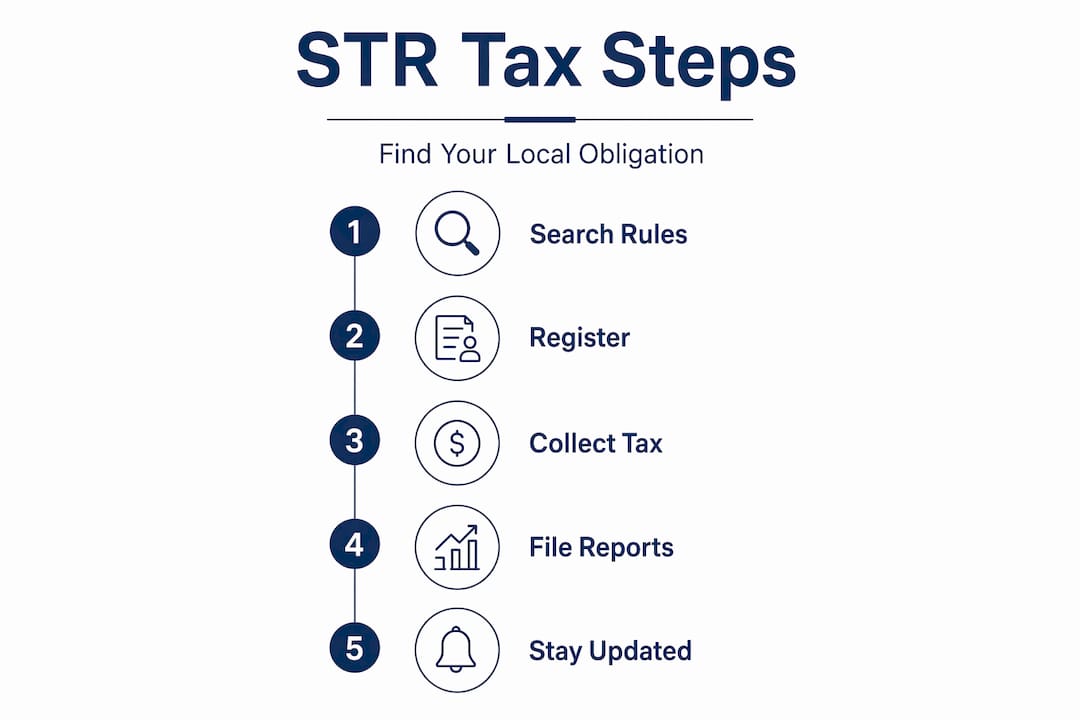
You need your property’s exact location, the local definition of “short-term,” details on booking channels, and potential exemptions to verify compliance. Gathering this information before you list, or before your next renewal cycle, is the most reliable way to avoid surprises.
Step-by-step process for verifying your local STR tax obligation:
- Identify your exact tax jurisdiction. Look up which city and county your property falls in. Properties near municipal borders sometimes fall into unexpected jurisdictions.
- Locate the official STR or room tax web page for that city and county. Start with the local government website, not third-party summaries.
- Find the applicable tax rate for short-term rentals and confirm whether separate city and county rates apply simultaneously.
- Review the local definition of “short-term rental.” Confirm how many days constitute a short-term stay and whether any stay-length exemptions apply to your property.
- Check whether your booking channels have active tax collection agreements with the local authority. Contact the platform directly if the answer is not published.
- Determine registration and licensing requirements. Identify whether you need a short-term rental permit, a business license, or both.
- Review filing schedules and deadlines. Confirm whether you file monthly, quarterly, or annually and note payment due dates.
- Document everything. Save copies of official tax rate schedules, registration confirmations, and filed returns.
Pro Tip: Call the city or county finance office directly when written guidance is unclear. Ask them to confirm your tax category and filing schedule in writing, either by email or formal letter. Documentation protects you if a dispute arises later.
Staying informed about the consequences of non-compliance is equally important. The host penalty pitfalls article documents real scenarios where hosts faced fines that could have been avoided with basic due diligence.
Why most STR tax mistakes happen—and how to avoid them
With the basics covered, what are the real-world traps that cause experienced hosts to fall out of compliance?
The most common root cause is a false sense of security created by platform tax collection. A host sees a line item on the guest’s receipt that reads “occupancy taxes,” assumes everything is covered, and never looks further. But because local lodging taxes are city and county administered, compliance workloads vary widely even between nearby jurisdictions, and a platform agreement in one city does not transfer to the next.
The second trap is cross-jurisdiction confusion. A host who owns properties in three cities, even within the same state, may face three entirely different tax rates, three different registration portals, and three different filing schedules. It is easy to confuse one city’s rules with another’s, especially when you rely on memory instead of a documented system.
The third and perhaps most avoidable trap is failing to update your compliance process when local rules change. Cities revise STR ordinances, adjust tax rates, and add new registration requirements with some regularity. A host who checked the rules in 2023 and never reviewed them again is very likely operating with outdated information by now.
The practical fix is simpler than most hosts expect. A well-maintained checklist for each property, combined with a scheduled annual review of local codes, catches the vast majority of compliance gaps before they become penalties. For hosts with larger portfolios, understanding occupancy taxes in-depth across multiple jurisdictions becomes a core operational skill rather than a one-time task.
The takeaway is this: platforms are not compliance partners. They are booking tools. Your tax obligations belong to you, and local authorities will hold you accountable regardless of what any platform collected or failed to collect on your behalf.
Easily verify and manage your STR compliance
Navigating local tax rules, permit requirements, and filing schedules across multiple jurisdictions takes time and precision. Mistakes are costly, and keeping up manually is difficult even for experienced property managers.

STR Comply makes it fast and accurate to check your local STR tax and permit status for any U.S. property. Run a free STR compliance check instantly and see exactly what your city or county requires. For deeper insight, a local STR compliance report gives you a full breakdown of permit requirements, tax rates, registration steps, and operational restrictions specific to your listing’s location. Paid plans add portfolio dashboards, permit renewal alerts, and regulatory update notifications, so you stay current without constant manual research. Review the terms of service to understand what is included. When compliance is clear and organized, you can focus on running a successful rental business.
Frequently asked questions
Do all Airbnb hosts owe local STR taxes, or just hotel-like properties?
Most Airbnb hosts owe local STR taxes if their city or county imposes them, since local STR tax obligations apply to small and home-based listings, not just hotel-style operations. The obligation depends on your jurisdiction, not the size or type of your property.
If Airbnb or Vrbo collects occupancy tax, do I still need to file or register locally?
Yes, you may still need to register and file reports locally, especially for direct bookings or if platforms do not fully cover all local taxes. Hosts can have additional local obligations not covered by platform collection agreements.
What’s the difference between lodging tax and local business tax?
Lodging tax targets revenue from short-term stays specifically, while local business taxes often apply to total rental revenue or gross receipts and may require separate permits. Some places apply business or gross receipts tax in addition to lodging tax, creating two distinct filing obligations.
Are there exemptions from STR taxes for infrequent or long-term rentals?
Yes, many cities exempt certain infrequent rentals or long-term arrangements from local occupancy taxes, but rules vary significantly. Bend, Oregon exempts certain infrequent and long-term rentals but still mandates that hosts file required reports.
How do I find my city or county’s exact STR tax rules?
Start by visiting your local taxing authority’s STR web page, then review the applicable codes or call the city or county finance office directly for clarification specific to your property.
Recommended
Check your city's STR regulations
Free compliance reports for 100+ US cities. Permits, taxes, zoning — all in one place.
Check My Address — Free