
VRBO rental regulation is defined as the full set of legal obligations a host must satisfy to lawfully list and operate a short-term rental property, covering local laws, state statutes, tax requirements, licensing, safety codes, and platform policies simultaneously. VRBO’s Terms of Service place legal compliance responsibility directly on the host, not the platform. Listing a property on VRBO does not constitute legal authorization to operate it as a short-term rental. Every host needs to understand this distinction before accepting a single booking.
What is VRBO rental regulation and why does it matter?
VRBO rental regulation is the industry term for short-term rental (STR) compliance, which refers to the layered system of rules governing how a host may legally rent a property to guests. These rules originate from multiple sources at once: municipal zoning codes, state licensing agencies, tax authorities, homeowners associations, and VRBO’s own platform policies. Compliance spans multiple regulatory domains, and failure in any single one can result in fines, permit revocation, or forced delisting from the platform.
The reason this matters so directly to you as a host is financial exposure. A single code violation in cities like Denver or Nashville can carry fines exceeding $1,000 per day. Beyond fines, municipalities increasingly share enforcement data with platforms, meaning a local citation can trigger a VRBO account review. Understanding what VRBO compliance actually requires is the first step toward protecting your rental income.

What local and state short-term rental regulations apply to VRBO hosts?
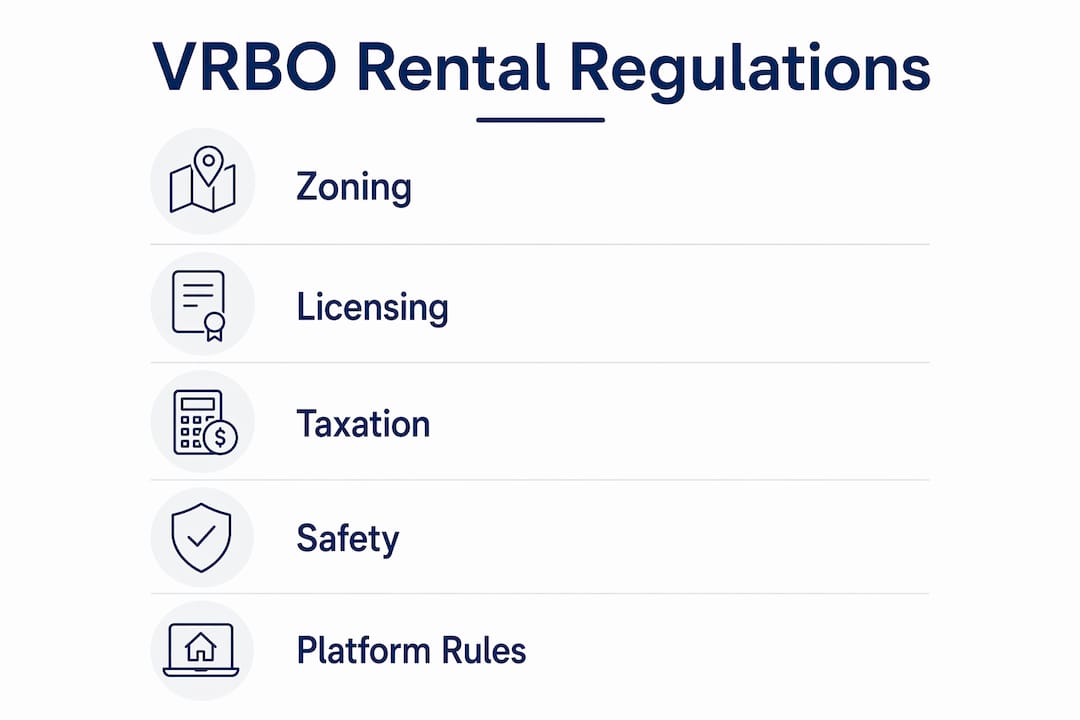
Most VRBO hosts face five distinct categories of regulation. Each operates independently, so satisfying one does not automatically satisfy another.
- Zoning restrictions: Local zoning codes classify land into residential, commercial, and mixed-use categories. Many municipalities prohibit STRs in certain residential zones entirely, or limit them to owner-occupied properties. Before listing, confirm your parcel’s zoning classification with your city or county planning department.
- Business licensing and permits: Most jurisdictions require a dedicated STR or vacation rental license, separate from a general business license. Cities like Boulder County require a vacation rental license, and unpermitted rental areas risk placing a license hold on your property.
- Occupancy and safety codes: Building codes dictate maximum guest occupancy, smoke detector placement, carbon monoxide detector requirements, egress windows, and fire extinguisher standards. These are inspected and enforced independently of your VRBO listing status.
- Transient occupancy taxes (TOT): Most states and many cities impose a lodging or transient occupancy tax on short-term rentals. Delaware, for example, requires a 4.5% lodging tax collected and remitted either by the platform or the host, depending on the arrangement. Hosts cannot assume the platform handles all tax obligations.
- HOA and condo rules: Homeowners associations and condominium boards frequently prohibit or restrict short-term rentals through their CC&Rs. These restrictions are enforceable through civil action and can result in fines or forced cessation of rentals, independent of any municipal approval you hold.
Pro Tip: Request a written confirmation of your zoning classification and permitted use from your local planning department before applying for any STR license. This document becomes part of your compliance packet and protects you if zoning rules change.
The table below summarizes the five regulatory categories and their primary enforcement bodies.
| Regulatory category | Primary enforcement body |
|---|---|
| Zoning restrictions | City or county planning department |
| STR licensing and permits | Municipal licensing office |
| Occupancy and safety codes | Building and fire inspection departments |
| Transient occupancy taxes | State revenue agency or local tax authority |
| HOA and condo rules | Homeowners association board or civil court |
How do VRBO’s platform rules affect rental regulation compliance?
VRBO’s platform policies function as a second, parallel compliance layer that operates alongside local law. Violating VRBO’s Terms of Service can result in account suspension or listing removal, even if your property is fully licensed at the local level. The two systems are independent, and both must be satisfied.
VRBO’s Terms establish several specific host obligations:
- Age and identity verification: Hosts must be at least 18 years old, and VRBO enforces identity verification as a condition of account eligibility.
- Listing accuracy: Descriptions, photos, and amenity disclosures must accurately represent the property. Misrepresentation violates VRBO’s Terms and can trigger immediate listing removal.
- House rules and restrictions: Hosts set their own house rules, but those rules must comply with applicable law. A no-pets policy is permissible; a discriminatory guest screening policy is not.
- Legal compliance declaration: By listing on VRBO, hosts contractually affirm that their property complies with all applicable laws. VRBO enforces this contractually and can deny bookings or suspend accounts separately from any municipal enforcement action.
- Permit number disclosure: An increasing number of cities now require hosts to display their STR permit number in their listing. VRBO supports this field, and omitting a required permit number can result in listing suspension.
Pro Tip: Audit your VRBO listing description against your actual permit documentation at least once per quarter. Cities like Bend, Oregon require that listed rental areas match permitted areas exactly. A discrepancy, even an accidental one, can trigger a license review.
VRBO does not verify the validity of municipal permits submitted by hosts. The platform relies on host-provided information. This means the burden of accuracy falls entirely on you, and errors discovered during a municipal audit will not be mitigated by the fact that your listing was active on VRBO.
What jurisdictional nuances and evolving changes should hosts monitor?
Short-term rental laws are among the fastest-changing areas of local regulation in the United States. What was compliant in 2023 may be restricted or prohibited in 2026. Hosts who treat compliance as a one-time setup task face the highest risk of enforcement action.
Several patterns define how regulations are evolving:
- Registration deadlines and caps: Stowe, Vermont introduced a hard registration deadline and license caps tied to property transfers. Hosts who miss a renewal window can lose their license entirely, with no grace period.
- Separation and density rules: Bend, Oregon enforces minimum distance requirements between licensed STR properties. If a neighbor obtains an STR license first, your application may be denied based on proximity alone.
- Owner-occupancy requirements: Many jurisdictions now limit STR licenses to primary residences. Investment properties in these markets cannot legally operate as short-term rentals, regardless of platform listing status.
- Platform data sharing: Cities increasingly require platforms to share host data with tax and licensing authorities. This trend accelerates enforcement and reduces the practical ability to operate without a license undetected.
Operational compliance requires continuous monitoring of new local regulations, especially for registration deadlines, caps, and license continuity. A license that was valid last year may require renewal, modification, or replacement under rules enacted this year.
At the international level, Regulation (EU) 2024/1028 requires platforms operating in EU member states to request host registration numbers and conduct periodic verification checks. While this directly affects European hosts, it signals a global trend toward platform-level enforcement that will likely influence U.S. regulatory frameworks in coming years. Hosts managing properties in multiple markets should review rental platform regulation developments regularly to stay ahead of these shifts.
How can VRBO hosts practically meet and maintain compliance?
Meeting VRBO compliance requirements is a process, not a single event. The following steps reflect what experienced hosts and property managers do to stay compliant across multiple jurisdictions.
- Assemble a regulatory packet before listing. Boulder County recommends that hosts keep evidence of permitted rental areas, license numbers, and tax remittance proof in a single file. This packet should include proof of ownership, your STR license, your tax registration certificate, and your zoning confirmation letter.
- Register for local taxes even when the platform remits. Delaware’s rules illustrate that hosts without platform remittance must collect and remit taxes and obtain licenses independently. Even when VRBO remits occupancy taxes on your behalf in certain jurisdictions, you may still need a local tax license. Confirm this with your state revenue agency directly.
- Align your listing with your permitted areas. Your VRBO listing description and photos should reflect only the areas covered by your STR license. Advertising a basement suite that is not included in your permit is a common violation that triggers license suspension during renewal inspections.
- Set calendar reminders for all renewal dates. STR licenses in most jurisdictions expire annually. Missing a renewal deadline can void your license retroactively, meaning bookings taken during the lapsed period may have been unlawful. Use a permit renewal guide to track deadlines across your portfolio.
- Monitor local ordinance changes quarterly. Subscribe to your city council’s meeting agenda notifications. Most STR ordinance changes are proposed and debated publicly before adoption, giving hosts a window to adjust operations before new rules take effect.
Pro Tip: When you receive a new STR license, photograph it and store the image in cloud storage alongside your VRBO account credentials. If VRBO requests permit verification during a compliance review, you can respond within hours rather than days.
Understanding vacation rental taxes is particularly important for hosts operating in states with complex remittance rules. The distinction between platform-remitted taxes and host-remitted taxes varies by state and sometimes by county within the same state.
Key takeaways
VRBO rental regulation requires hosts to satisfy local licensing, zoning, tax, safety, and platform compliance obligations simultaneously, with no single approval substituting for the others.
| Point | Details |
|---|---|
| Host bears full legal responsibility | VRBO’s Terms place all compliance obligations on the host, not the platform. |
| Five regulatory categories apply | Zoning, licensing, safety codes, taxes, and HOA rules each require independent compliance. |
| Platform listing is not legal authorization | VRBO does not verify municipal permit validity; hosts must confirm their own legal standing. |
| Regulations change frequently | Cities like Stowe, VT and Bend, OR have added caps and deadlines that can void existing licenses. |
| Compliance is an ongoing process | License renewals, tax registrations, and listing audits must be maintained continuously, not just at setup. |
Why proactive compliance is the only defensible strategy
Most hosts I work with make the same initial mistake: they treat getting listed on VRBO as the finish line. It is not. The platform approval process checks whether your listing meets VRBO’s content standards. It does not check whether your property is zoned for short-term rental use, whether your city requires a license, or whether you owe transient occupancy tax to your county. Those obligations exist regardless of your listing status, and enforcement agencies are not obligated to warn you before acting.
What I have found consistently is that the hosts who face the most serious compliance problems are not the ones who ignored the rules intentionally. They are the ones who assumed that because nothing bad had happened yet, they were compliant. Municipalities are investing in enforcement capacity, and platform data-sharing agreements are making it easier to identify unlicensed operators. The window for operating informally is closing in most major STR markets.
The practical solution is not complicated, but it does require discipline. Build your regulatory packet before your first booking. Set renewal reminders the day you receive your license. Check your local council agenda every quarter. These habits take less than two hours per month and eliminate the vast majority of compliance risk. Technology tools and compliance checklists are not a substitute for understanding your obligations, but they are effective at making sure nothing falls through the cracks. Compliance protects your investment, your guests, and your relationship with the neighborhood where you operate.
— Jure
How Strcomply helps VRBO hosts stay compliant
Strcomply is built specifically for short-term rental hosts who need to manage compliance across multiple jurisdictions without spending hours on legal research.
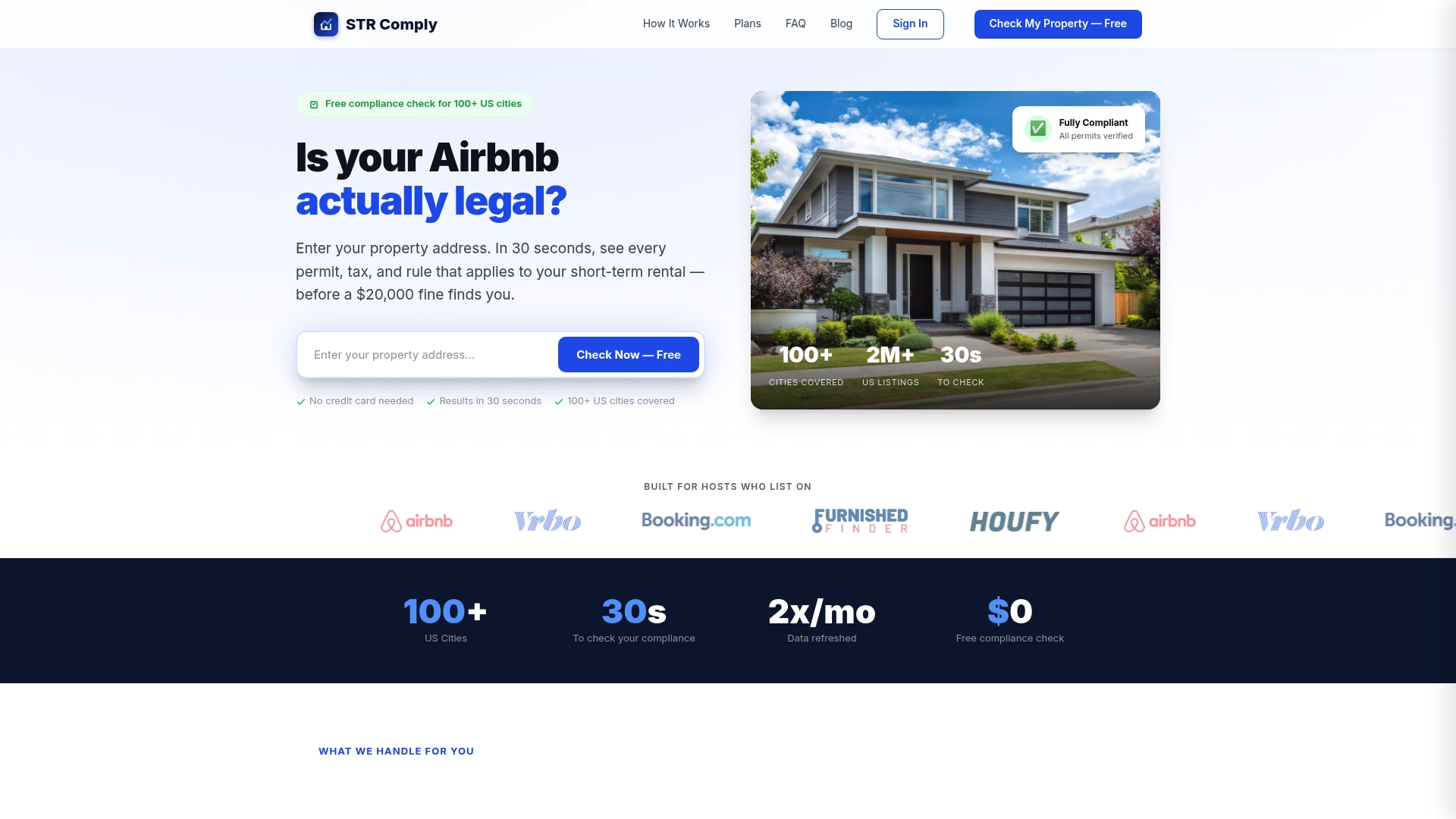
The platform provides instant, city-specific compliance checks covering permit requirements, zoning restrictions, tax obligations, and operational rules for VRBO and similar platforms. Paid plans include a portfolio dashboard with permit tracking, renewal alerts, and regulatory update notifications, so you are informed before a deadline passes or a new ordinance takes effect. For hosts managing properties in multiple markets, Strcomply reduces the research burden that typically requires a compliance attorney. Review the platform terms to understand exactly what Strcomply covers and how it fits your compliance workflow.
FAQ
What is VRBO rental regulation?
VRBO rental regulation refers to the full set of legal obligations a host must meet to lawfully operate a short-term rental listed on VRBO, including local zoning, licensing, tax, safety, and platform compliance requirements. VRBO’s Terms place all compliance responsibility on the host, not the platform.
Does listing on VRBO mean my rental is legally authorized?
No. VRBO does not verify municipal permit validity, and a live listing does not confirm that your property meets local zoning or licensing requirements. Hosts must independently confirm their legal standing with local authorities.
What taxes do VRBO hosts need to collect?
Most VRBO hosts owe transient occupancy tax or lodging tax to their state or municipality. In Delaware, for example, a 4.5% lodging tax applies, collected either by the platform or the host depending on the arrangement. Even when VRBO remits taxes on your behalf, you may still need a local tax license.
What happens if a VRBO host violates rental regulations?
Failing to comply with rental regulations can result in license revocation, municipal fines, forced delisting from VRBO, or account suspension by the platform. Both municipal and platform enforcement actions can occur independently of each other.
How often do short-term rental regulations change?
STR regulations change frequently, with many cities introducing new registration deadlines, license caps, and owner-occupancy requirements each year. Hosts should review local ordinances at least quarterly and set calendar reminders for all license renewal dates to avoid lapses.
Recommended
Check your city's STR regulations
Free compliance reports for 100+ US cities. Permits, taxes, zoning — all in one place.
Check My Address — Free