
Rental compliance is the practice of adhering to all applicable federal, state, and local regulations governing how rental properties are operated, licensed, and maintained. For real estate investors, this is not a bureaucratic formality. It is the primary legal shield protecting property income, ownership rights, and long-term portfolio value. Agencies like HUD, local licensing authorities, and municipal safety inspectors enforce these rules with penalties that can reach tens of thousands of dollars per violation. Understanding why real estate investors need rental compliance starts with recognizing that a single missed registration or safety certification can trigger enforcement actions that halt operations entirely.
Why real estate investors need rental compliance: the regulatory framework
Rental regulations operate across three distinct layers, and investors must satisfy all three simultaneously. Federal law sets baseline standards through the Fair Housing Act and HUD enforcement authority. State law governs landlord-tenant relationships, habitability standards, and licensing frameworks. Local ordinances add a third layer covering zoning, short-term rental registration, and property-specific safety requirements.
At the federal level, the Fair Housing Act prohibits discrimination in housing based on race, color, national origin, religion, sex, familial status, and disability. Repeat Fair Housing Act violations carry penalties up to $131,308, alongside mandatory corrective actions ordered by HUD or the Department of Justice. This means a single discriminatory lease denial, if it follows a prior violation, can cost more than most investors earn from a property in a year.

State and local rules are equally demanding. Tacoma, Washington requires all rental property owners to register and obtain a business license tied to health and safety certifications under RCW 59.18.060. Properties that fail to meet habitability standards may receive provisional licenses, signaling active regulatory scrutiny. New York City’s Local Law 18 goes further, requiring short-term rental hosts to register with the city and prohibiting rentals in rent-stabilized units entirely.
Key compliance areas every investor must track include:
- Rental licensing and registration: Most cities require annual or biennial renewals tied to inspections.
- Fair housing documentation: Written policies, staff training records, and denial logs protect against discrimination claims.
- Short-term rental permits: Cities like New York and San Francisco require separate STR registrations with strict occupancy rules. Review zoning laws for short-term rentals before listing any property.
- Safety certifications: Fire suppression systems, electrical panels, plumbing, and HVAC units must meet local code and be documented after each inspection.
- Ongoing recordkeeping: Evidence management through documentation is as important as the permits themselves. Inspection records, certifications, and renewal confirmations are the difference between liability and safe operation during a dispute.
Pro Tip: Set calendar reminders 90, 60, and 30 days before every license or permit expiration. Missed renewals create multi-week enforcement exposure before the city even sends a notice.
What risks do investors face without proper rental compliance?
The financial exposure from noncompliance is direct and substantial. HUD can impose civil penalties of $6,050 to $25,000 per violation without requiring a court proceeding for knowing violations. Administrative law judges determine the final amount, and multifamily landlords and Section 8 property owners face the highest scrutiny. A portfolio with ten noncompliant units is not facing one fine. It is facing ten.
New York City demonstrates how aggressively local governments now enforce short-term rental rules. In February 2026, the city announced a lawsuit seeking penalties exceeding $4 million against operators of illegal short-term rentals in rent-stabilized buildings, along with court orders to cease operations immediately. That enforcement action illustrates a critical point: noncompliance does not just generate fines. It can result in court-ordered operational shutdowns that eliminate rental income entirely.
Beyond financial penalties, investors face collateral risks that rarely appear in compliance checklists:
- Insurance claim denial: Many property insurance policies exclude coverage for incidents that occur while the property is operating in violation of local law. A fire at an unlicensed rental may result in a denied claim.
- Loss of possession rights: In some jurisdictions, noncompliance with registration requirements removes a landlord’s legal right to pursue eviction. The tenant stays; the investor loses control.
- Tenant litigation: Habitability violations expose investors to tenant lawsuits for rent abatement, relocation costs, and damages.
“Failure to register can lead to rent repayment orders covering up to 24 months of rent and civil penalties reaching £40,000 per property.” — UK PRS database enforcement analysis
While that figure applies to the UK’s private rented sector database, the enforcement logic mirrors what US cities are building toward. Investors who treat registration as optional are operating on borrowed time.
How can investors build effective rental compliance management systems?
A compliance system that actually works is built around recurring calendars and documented proof, not one-time checklists. Successful compliance programs use renewal windows of 30 to 90 days to prevent quiet expiry of licenses, insurance certificates, and safety inspections. The goal is to eliminate the gap between expiration and enforcement.
Here is a practical framework for building a compliance management system across a rental portfolio:
- Audit every property against local requirements. Identify all applicable licenses, permits, registrations, and safety certifications for each jurisdiction. Use resources like rental license requirements guides to map what each market demands.
- Build a master compliance calendar. Assign expiration dates, renewal windows, and responsible parties for every obligation. Include federal, state, and local items in one unified view.
- Standardize documentation protocols. Store inspection reports, permit copies, tax filings, and correspondence in a centralized system. Standardizing compliance workflows across jurisdictions prevents errors from applying the wrong local rules to the wrong property.
- Schedule routine safety inspections. Fire, electrical, plumbing, and HVAC checks should follow a fixed annual or biannual schedule, not just respond to tenant complaints. A safety and compliance framework treats inspections as ongoing systems, not one-time events.
- Train all team members and vendors. Property managers, maintenance contractors, and leasing agents must understand the compliance requirements for each market they serve. A vendor applying Chicago rules to a Seattle property creates portfolio-wide exposure.
- Use technology to automate reminders and tracking. Manual calendars fail at scale. Compliance software that tracks permit renewals, sends automated alerts, and stores documentation reduces human error significantly.
Pro Tip: When onboarding a new property in an unfamiliar market, complete a compliance audit before the first tenant moves in. Retroactive compliance is always more expensive than proactive compliance.
How do compliance requirements compare across key US markets?
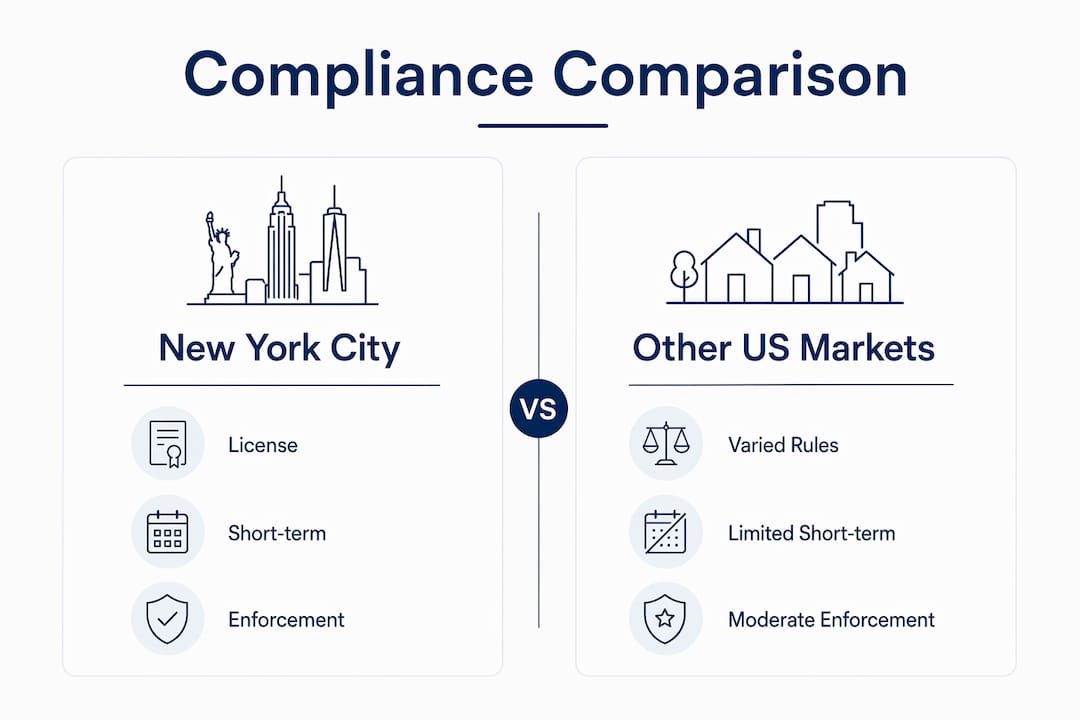
Compliance intensity varies sharply by market, and investors managing properties across multiple cities face genuinely different regulatory environments. The table below compares three key compliance dimensions across major US markets.
| Market | Licensing requirement | Short-term rental rules | Enforcement intensity |
|---|---|---|---|
| New York City | Local registration required for all rentals | Local Law 18 bans STRs in rent-stabilized units; host must be present | Very high. $4M+ lawsuit filed in 2026 |
| Tacoma, WA | Rental business license tied to RCW 59.18.060 health and safety certification | STR permits required; provisional licenses issued for substandard properties | Moderate to high; provisional licenses signal active scrutiny |
| Federal (HUD) | N/A (federal oversight applies nationwide) | Fair Housing Act applies to all rental types | High; $25,000 per violation without court involvement |
New York City represents the most aggressive enforcement environment in the country for short-term rentals. Local Law 18 effectively ended most Airbnb-style operations in rent-stabilized buildings, and the city is actively litigating against violators. Tacoma’s system is notable because it links licensing directly to habitability, meaning a property that fails a safety inspection does not just get cited. It gets a provisional license that signals ongoing regulatory risk to any future buyer or lender.
The federal layer applies everywhere. HUD’s civil penalty authority covers all rental markets, and Fair Housing Act enforcement has no geographic carve-outs. Investors who assume their smaller market is under the radar are taking a risk that the penalty schedule does not support.
Key takeaways
Rental compliance is the single most effective tool investors have for protecting property income, ownership rights, and portfolio value against legal and regulatory risk.
| Point | Details |
|---|---|
| Compliance is multi-layered | Federal, state, and local rules apply simultaneously and must all be satisfied. |
| Penalties are severe | HUD fines reach $25,000 per violation; NYC pursued $4M+ in a single 2026 lawsuit. |
| Documentation is as critical as permits | Inspection records and renewal confirmations are your defense in disputes and audits. |
| Systems beat checklists | Recurring compliance calendars with 30 to 90-day renewal windows prevent enforcement exposure. |
| Market knowledge is non-negotiable | NYC, Tacoma, and federal HUD rules each impose distinct obligations that cannot be generalized. |
Compliance as a competitive advantage, not just a legal obligation
Most investors I speak with treat compliance as a cost center. They budget for it reluctantly, delegate it to whoever has time, and only pay close attention after a fine arrives. That approach is backwards, and it costs more in the long run than any compliance program ever would.
The investors who build the most stable portfolios treat compliance as evidence management. Every inspection report, every permit renewal, every safety certification is a documented record that protects them in tenant disputes, insurance claims, and regulatory audits. When a tenant alleges a habitability violation, the investor with a complete compliance file has a defense. The investor who relied on memory has a liability.
There is also a market positioning argument that rarely gets made. Properties that are fully licensed, inspected, and documented attract better tenants and command stronger rents. Tenants increasingly check whether a rental is legally registered, particularly in cities like New York where Local Law 18 has raised public awareness. A compliant property signals professionalism and stability.
The most common pitfall I see is investors who expand into new markets without auditing local requirements first. They assume the rules in their home market apply everywhere. They do not. Tacoma’s provisional license system, NYC’s host-present requirement, and HUD’s nationwide fair housing authority are three entirely different compliance environments. Treating them as interchangeable creates the exact portfolio-wide exposure that cross-market compliance guides warn against.
Start with a compliance audit on every property you own. Build a calendar. Document everything. The upfront investment is a fraction of what a single enforcement action costs.
— Jure
How Strcomply helps investors manage rental compliance
Strcomply is built specifically for real estate investors and short-term rental hosts who need to manage compliance across multiple markets without spending hours on legal research. The platform provides instant, city-specific compliance checks covering permits, taxes, zoning restrictions, and registration requirements for Airbnb, VRBO, and similar platforms. Paid plans include portfolio dashboards, permit tracking, automated renewal alerts, and regulatory update notifications, so nothing expires quietly. For investors who want to reduce legal risk and keep every property operating within local law, Strcomply’s compliance tools deliver the structure and visibility that manual tracking cannot. Start with a free compliance check and see exactly where your portfolio stands today.
FAQ
What is rental compliance for real estate investors?
Rental compliance is the practice of meeting all federal, state, and local regulations that govern how rental properties are licensed, operated, and maintained. It covers fair housing laws, safety certifications, short-term rental permits, and ongoing documentation requirements.
How much can investors be fined for noncompliance?
HUD can impose civil penalties of $6,050 to $25,000 per violation without court involvement. Fair Housing Act repeat violations carry penalties up to $131,308, and NYC pursued over $4 million in a single 2026 enforcement action.
Do short-term rental investors face different compliance rules?
Yes. Cities like New York City enforce Local Law 18, which requires host registration and bans short-term rentals in rent-stabilized units entirely. Short-term rental investors must check local STR registration rules before listing any property.
What documentation should investors keep for compliance?
Investors should retain inspection reports, permit copies, license renewals, safety certifications, and all tenant-related correspondence. Documented proof is the primary defense in regulatory audits and tenant disputes.
How often should investors review their compliance status?
Compliance status should be reviewed on a rolling 30 to 90-day window tied to each permit and license expiration date. Regulations change frequently, so a full market audit is recommended whenever local ordinances are updated or a new property is acquired.
Recommended
Check your city's STR regulations
Free compliance reports for 100+ US cities. Permits, taxes, zoning — all in one place.
Check My Address — Free